Last updated: November 19, 2026
The theme points to one clear idea: breastfeeding support works best when mothers are protected at home, in hospitals, and in public life, not just praised once a year. For families with a premature baby, that means the most useful questions are practical ones — how milk is started, how it is kept going, and how a baby who cannot latch yet still gets the benefits.
Key takeaways
- The theme is about support, not slogans. Real help matters more than a poster or speech.
- For a premature baby, breast milk may begin with pumping, hand expression, or tube feeding before direct nursing.
- The most useful questions are about timing, milk supply, skin-to-skin contact, and when to get extra help.
- WHO and UNICEF both support breastfeeding as the normal first food, with exclusive breastfeeding for the first 6 months when possible.
- This topic is not about blame. If feeding is hard, the next step is support, not guilt.
What does this year’s theme mean?
This theme means breastfeeding support should reach mothers in every setting, including hospitals, workplaces, homes, and public spaces. The phrase “nurturing motherhood globally” points to a bigger message than celebration: mothers need practical care, paid time, trained staff, and family support.
For a family with a premature baby, that matters because the first 24 hours, 48 hours, and first 6 weeks can shape feeding more than any slogan. A preterm baby may need expressed milk, colostrum, tube feeding, or short feeding sessions before full breastfeeding is possible. That is still breastfeeding support, even when the baby is not latching yet.
WHO recommends exclusive breastfeeding for the first 6 months, and UNICEF gives the same public health message. Those are population-level targets, not a rule that every baby follows on the same day. Premature babies often need a slower path, and that path still counts.
The theme also pushes back against the idea that feeding is only a personal choice. Choice matters, but so do staffing levels, lactation help, milk storage, and time off. A mother cannot “choose” easier feeding if the setting makes pumping impossible or if no one shows her how to express milk.
Which question matters most for a family with a premature baby?
The most important question is: how does a premature baby get breast milk before direct breastfeeding is possible? That question matters more than the usual “Is breastfeeding best?” because preterm feeding often starts with support steps, not a full latch.
The answer usually involves a chain of feeding methods. A mother may hand-express colostrum, pump every few hours, and give milk by cup, syringe, tube, or bottle depending on the baby’s medical plan. The exact method depends on the baby’s size, breathing, strength, and the hospital’s feeding policy, so a neonatal team or lactation specialist should guide the plan.
The common mistake is to treat pumping as a backup that can wait. In preterm care, milk expression often is the feeding plan at the start. Milk production depends heavily on early and regular removal of milk, and delays can make supply harder to build.
Another common mistake is thinking a small amount does not matter. For a premature baby, even early drops of colostrum can be meaningful. The first milk is dense and intended for tiny stomachs, which is one reason early support matters so much.
What questions do people ask about breastfeeding during Breastfeeding Week?
People usually ask about timing, milk supply, pain, and whether their baby is “doing it right.” Those are the right questions, because they lead to action.
Here are the questions that matter most for a premature baby:
- Can my baby breastfeed right away, or does my milk need to be expressed first?
- How often should I pump if my baby is too small or sleepy to latch?
- How do I know if my baby is getting enough milk?
- What if breastfeeding hurts or my nipples crack?
- When should I ask for help from a lactation consultant or NICU team?
These questions are better than broad ones like “Is breastfeeding natural?” Natural does not mean easy, and for preterm babies the process is often technical before it becomes simple. A good answer usually includes a feeding method, a timing plan, and one sign that the plan is working.
The theme is useful only if it leads to these practical questions. If it stays at the level of celebration, it misses the mother who is pumping at 2 a.m. for a baby in the NICU. The real test of support is whether the questions get answered.
Breastfeeding support or awareness campaign: which one helps more?
Breastfeeding support helps more than awareness alone, especially for premature babies. Awareness can start the conversation, but support changes the feeding outcome.
| Criteria | Awareness campaign | Practical support | Winner for this condition |
|---|---|---|---|
| Main goal | Raise visibility and repeat the message | Help a mother feed, pump, and recover | Support, when a baby is premature |
| Effect on day-to-day feeding | Indirect | Direct | Support, when the baby cannot latch yet |
| Use in hospitals | Poster or event | Lactation help, milk storage, feeding plans | Support, in NICU settings |
| Use at home | Encouragement | Pumping schedule, help with meals, rest | Support, for the first 6 weeks |
| Risk of guilt | Higher if it sounds idealized | Lower if it is specific and realistic | Support, when feeding is hard |
| Helps build milk supply | No | Yes, through frequent milk removal | Support |
| Fits a premature baby | Only as background messaging | Yes, because the process can start before direct nursing | Support |
| What it often misses | The hard parts of feeding | Sometimes the big public message | Campaign, if the goal is public awareness |
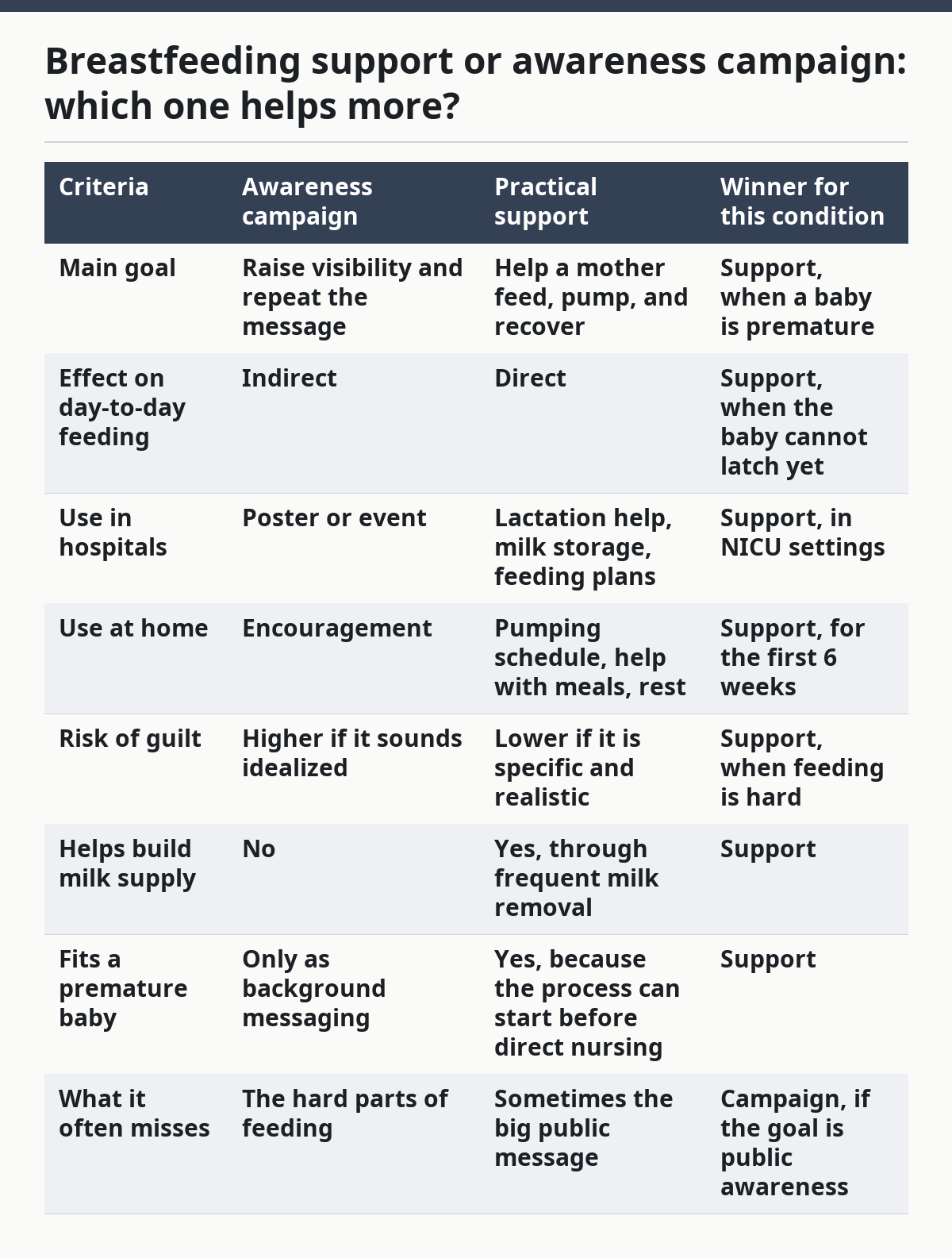
The honest answer is that a campaign without support feels good and solves little. Support without a campaign may help one family, but it can stay hidden. For premature babies, support wins because feeding success depends on what happens between feeds, not just on what is said in public.
That does not make awareness useless. It does mean awareness should lead to action: trained staff, access to breast pumps, privacy, family leave, and clear feeding guidance. Without those pieces, the theme becomes decoration.
What do mothers of premature babies need most?
Mothers of premature babies need clear feeding help, not vague encouragement. The most useful help is often simple and specific: a pump that works, a schedule that is realistic, and someone who can explain what is happening.
Skin-to-skin contact is one important piece. It can help both baby and mother, and it often supports feeding behavior over time. For many premature babies, it is part of the plan even before full breastfeeding begins, but the medical team should confirm when it is safe.
Milk storage is another common question. Families need to know how milk is labeled, cooled, and given to the baby in the hospital or at home. A missed label or a mixed-up bottle can waste work that took hours.
This is also where honest limits matter. Not every premature baby can breastfeed on the same timetable, and not every mother will have an easy milk supply. Stress, surgery, birth complications, and NICU separation can slow the process. That is not a failure of effort.
The most helpful mindset is: milk can be built, skills can be learned, and the baby’s pace matters. If a team acts as if breastfeeding should be immediate, the family may feel blamed instead of supported. A better plan respects the baby’s medical needs and the mother’s recovery.
When does the theme miss the point?
The theme misses the point when it becomes a feel-good message with no practical support behind it. If the only action is a social media post, it does not help a mother trying to express milk every few hours.
It also misses the point when it ignores mothers who cannot breastfeed fully or immediately. Some babies need help with breathing, weight gain, or oral strength before direct nursing is possible. In those cases, breast milk feeding can still be the goal, even if the method changes.
Another weak spot is blame. Any message that sounds like “good mothers breastfeed perfectly” is wrong for a premature-baby audience. A family dealing with a NICU stay needs facts, patience, and a plan, not shame.
The theme works best when it names real barriers: no paid leave, no private space to pump, no skilled help, and no family backup. Those barriers have numbers and consequences in real life, even if the campaign itself stays general. A good message points toward policy and bedside care, not just praise.
What should a reader ask next?
The next question should be: what is the baby’s feeding plan for today, not just this week? That question turns a broad theme into action. It helps the family ask the right people about latch, pumping, weight checks, and timing.
A second question is: who will help if the plan changes overnight? Premature babies can change quickly, and feeding plans often shift with their breathing, stamina, or weight gain. A clear contact person matters.
A third question is: what does success look like this week? Success may be more milk expressed, less pain, a better latch, or one extra tube feed of breast milk. For a premature baby, progress is often stepwise, not dramatic.
Choose awareness if you need a public message. Choose support if you need a feeding plan. Neither if the setting uses the theme to avoid giving mothers real help.
Awareness fits when the goal is education, policy, or public attention. Support fits when the goal is to feed a premature baby well and keep milk flowing. If a hospital, workplace, or family cannot offer time, tools, and guidance, the theme alone is not enough.
Is breastfeeding still possible if my baby was born early?
Yes, breastfeeding is often still possible, but it may begin with pumping, hand expression, or tube feeding before direct nursing. A premature baby may need time to grow stronger before latching well, so the first goal is usually getting milk to the baby safely. A neonatal team or lactation specialist should guide the plan.
Should I start pumping if my premature baby cannot latch yet?
Yes, pumping or hand expression usually matters early if the baby cannot breastfeed yet. Regular milk removal helps build and protect supply, and that can make later breastfeeding easier. Ask the hospital team or a lactation specialist how often to express milk for your situation.
Does Breastfeeding Week mean I have to breastfeed in one exact way?
No, it does not mean one exact method for every mother and baby. The better message is that breast milk feeding can take several forms, especially for premature babies. A feeding plan can change as the baby grows, and that flexibility is part of good care.
When should I ask for extra help?
Ask for help as soon as pain, low milk supply, poor latch, or a confusing feeding plan shows up. For a premature baby, waiting can make feeding harder, especially if the baby is in the NICU or separated from the mother. A lactation consultant, nurse, or doctor can help adjust the plan before problems grow.
What if breastfeeding feels harder than I expected?
That is common, and it does not mean you are doing it wrong. Breastfeeding a premature baby often takes more support than people expect, because the baby may be sleepy, small, or not ready to latch. The safest move is to ask for a feeding review rather than trying to guess alone.
Sources
- World Health Organization: https://www.who.int/health-topics/breastfeeding
- UNICEF breastfeeding information: https://www.unicef.org/nutrition/breastfeeding
Drafted with AI; not yet reviewed by a person.