
Last updated: November 18, 2026
Quick answer: the standard power pumping schedule takes 1 hour — 20 minutes pumping, 10 minutes resting, 10 minutes pumping, 10 minutes resting, then 10 minutes pumping. Power pumping schedule: how it works and when to use it is a short-term way to mimic cluster feeding with a breast pump so the body gets a stronger milk-removal signal. It is not a fix for every supply problem, and it is not the same thing as ordinary pumping.
Key takeaways
- Power pumping means back-to-back pumping blocks with short breaks, not one long session.
- The usual schedule is built around 20 minutes pumping, 10 minutes resting, 10 minutes pumping, 10 minutes resting, then 10 minutes pumping.
- It is most useful as a short experiment when milk supply seems to need a stronger signal.
- It is not a replacement for fixing flange fit, pump parts, or latch problems.
- If pumping hurts, or if milk removal is already painful or inefficient, the schedule is the wrong first move.
What power pumping is and why the schedule looks the way it does

Power pumping is a clustered pumping session designed to look more like a baby’s cluster-feeding pattern than a normal pump session. The schedule is usually built around 1 hour total: 20 minutes on, 10 minutes off, 10 minutes on, 10 minutes off, and 10 minutes on. That pattern matters because the point is not to pump longer once. The point is to send repeated removal signals in a short window.
A standard pumping session often stops after milk flow slows. Power pumping keeps the cycle going even after the first letdown drops off, which is why many people use it for a few days rather than as a daily routine forever. The repeated start-stop pattern can help some people get more total milk removed in the session, especially if they have been relying on a breast pump after a schedule change, a growth spurt, or a stretch of missed sessions.
It helps to think of power pumping as an experiment, not a promise. The schedule is common because it is manageable and easy to repeat, not because it works the same way for every body. If the underlying problem is a poorly sized flange, worn pump parts, or limited milk removal at other times of day, the cluster session may not change much. For background on pumping and supply, see La Leche League International’s guidance on increasing milk supply and the CDC’s breastfeeding information.
A practical check: if a full power pumping hour feels impossible to fit into the day, the schedule probably needs to be shorter or moved. The method only works if it is repeatable for several days in a row. That is also why it is usually paired with a clear end point, such as trying it for 3 to 7 days and then reassessing rather than continuing indefinitely.
For background on the wider supply-and-pumping picture, this page supports the broader milk supply and pumping guide on this site.
How to set up a power pumping session that is actually usable
A useful power pumping session starts before the timer does. The most common setup uses a double electric breast pump, a comfortable chair, water, and a place to keep the pump parts within reach. If you are using a manual pump, power pumping is still possible, but the repeated 1-hour pattern is harder to sustain.
Good setup saves the session from becoming a messy half-hour that turns into a skipped attempt. The flange should fit correctly before you start, because poor fit can turn a session into painful rubbing instead of effective milk removal. A flange that is too small can pinch; one that is too large can reduce comfort and make the pump feel sloppy. If the pump has multiple suction levels, start at the lowest level that creates milk flow, then increase only as needed.
Use a phone timer or the pump’s built-in timer so you are not guessing. Power pumping works best when the breaks are real breaks and the pumping blocks are real pumping blocks. A 10-minute pause is not the same as leaving the pump on your chest while scrolling through messages.
The room matters too. A calm, private place usually helps the session finish. Many people need 60 minutes for the full pattern, and the session becomes much easier when the parts are already clean and assembled. If you routinely spend 15 minutes searching for connectors or valve pieces, the schedule is too dependent on luck.
One honest limitation: the breast pump cannot compensate for every issue that affects milk supply or milk removal. If the pump feels weak, parts are worn, or the flange fit is wrong, the schedule may be a poor use of effort until those basics are corrected. For flange sizing and pump maintenance basics, the National Institute of Child Health and Human Development and the CDC both have practical guidance.
The step-by-step power pumping schedule

The simplest power pumping schedule is one hour long and follows five timed blocks. This is the version most people mean when they say “power pumping.”
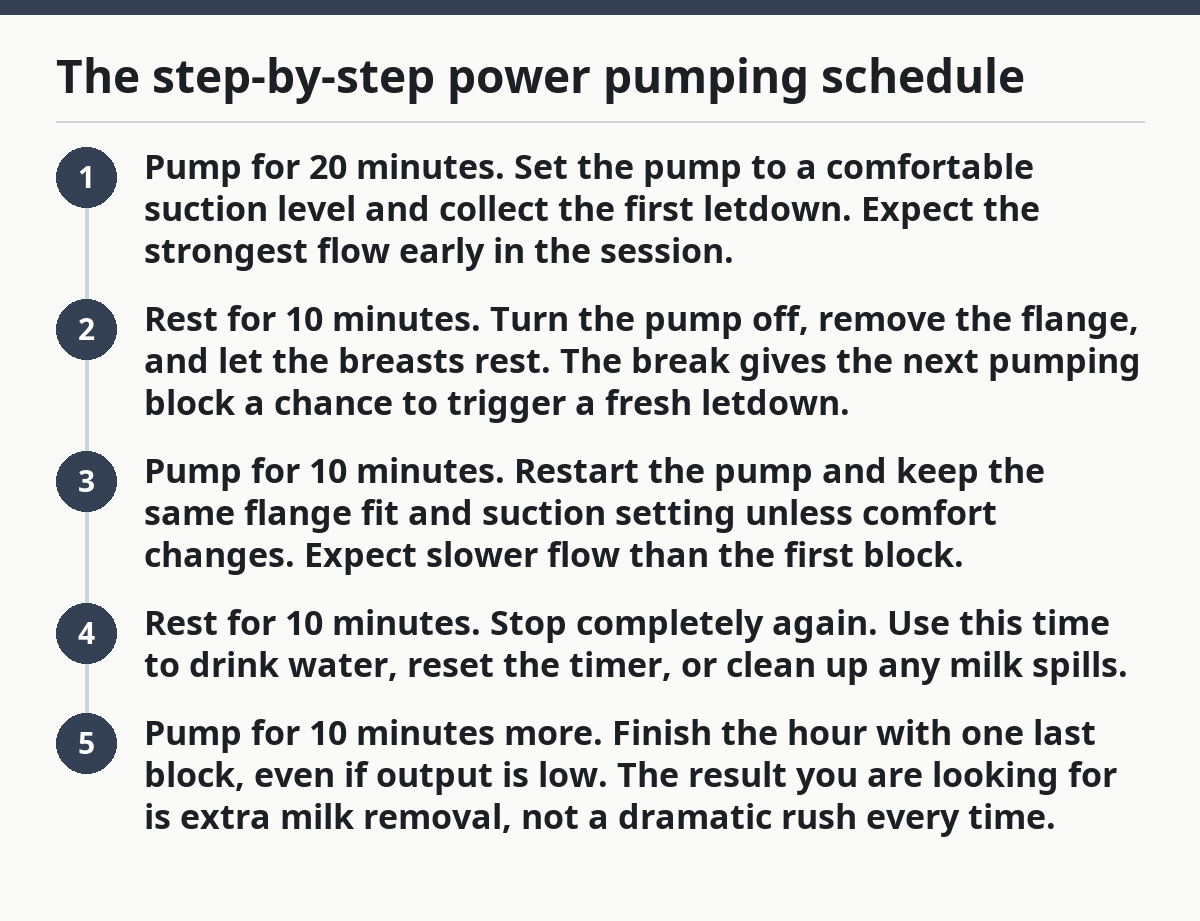
- Pump for 20 minutes. Set the pump to a comfortable suction level and collect the first letdown. Expect the strongest flow early in the session.
- Rest for 10 minutes. Turn the pump off, remove the flange, and let the breasts rest. The break gives the next pumping block a chance to trigger a fresh letdown.
- Pump for 10 minutes. Restart the pump and keep the same flange fit and suction setting unless comfort changes. Expect slower flow than the first block.
- Rest for 10 minutes. Stop completely again. Use this time to drink water, reset the timer, or clean up any milk spills.
- Pump for 10 minutes more. Finish the hour with one last block, even if output is low. The result you are looking for is extra milk removal, not a dramatic rush every time.
There are variations, but this structure is the clearest starting point because it is easy to track and easy to repeat. Some people prefer to power pump once a day, often at the same time each day, for a short run of days. Others do it after a missed pumping session or during a stretch when supply feels less responsive.
The schedule is most useful when you keep the rest of the day steady. If you are pumping randomly outside the session, it becomes hard to tell whether the clustered pattern is helping. Consistency matters more than intensity here.
A common mistake is to chase pain with more suction. That usually costs comfort and can reduce adherence to the plan. Another mistake is to stop early because the second or third block looks “empty.” Power pumping is about repeated stimulation and milk removal, not just the amount collected in one burst.
When to use a power pumping schedule, and when not to
A power pumping schedule is worth trying when you want a short, structured way to increase milk removal without changing the whole day. It is often used when supply seems to need a stronger stimulus, after a few disrupted pumping sessions, or when a person wants to test whether clustered pumping helps. The method fits best when the rest of the pumping routine is already fairly organized.
It is not the right first step if the real issue is pain, obvious flange mismatch, or pump parts that are worn out. If the nipples look compressed, rub, or blanch during the session, the setup needs attention before any schedule can do useful work. The same is true if the pump no longer seems to seal well, because valves, membranes, and connectors can affect milk removal more than the exact timer pattern.
This schedule is also a poor fit for anyone who cannot reliably block out about 60 minutes. A half-done power pumping routine rarely tells you much. It may also be the wrong tool if the goal is a full-time pumping plan; that calls for a different structure than a short cluster of sessions.
A useful rule of thumb is to try power pumping as a limited trial rather than a lifestyle change. A few days of the 1-hour pattern can show whether clustered pumping helps your milk supply at all. If nothing changes, continuing indefinitely usually just adds frustration. At that point, the issue may be elsewhere, and the schedule has done its job by ruling out one option.
If you are dealing with a medical condition, a recent birth complication, medication changes, or ongoing pain, ask a qualified clinician or lactation professional before treating this as a solo experiment. For clinical breastfeeding support, consult the CDC and La Leche League International, and ask a clinician or lactation professional when symptoms are involved.
Common power pumping mistakes that waste the hour
The biggest mistake is treating power pumping like a longer normal session. That costs you the whole point of the method. The breaks are not dead time; they are part of what makes the next pumping block more useful. If you never stop, you are just doing a long pump, not a clustered pumping session.
Another mistake is using the wrong flange size and hoping the schedule will make up for it. That costs comfort and can make milk removal less effective. The better move is to adjust the flange first, then try the 20/10/10/10/10 pattern. A session that hurts is usually not the session to copy for a week.
A third mistake is changing too many variables at once. If you swap a pump, change the flange, change the time of day, and add power pumping all on the same day, you will not know what helped. Keep the pump model, settings, and schedule steady long enough to see a pattern.
A fourth mistake is expecting immediate proof from the first session. Some people notice more output in the cluster session itself. Others do not. The schedule may be doing its work through repeated milk removal over several days, not through a single dramatic bottle or container measurement.
Finally, do not keep power pumping when it clearly makes the rest of the day worse. If a 1-hour session means you skip meals, miss sleep, or dread the pump, the cost may outweigh the possible benefit. A schedule that cannot be repeated is not much of a schedule.
What results to expect from power pumping
Power pumping usually gives you a stronger pumping pattern than a single normal session, but not always a huge one. It may or may not lead to a measurable increase in output. Some people see more milk collected during the hour itself. Others notice only that the breasts feel more fully drained or that the next few pumping sessions feel more productive.
A better sign than one lucky day is a repeatable pattern. If the clustered pumping session is repeated at roughly the same time for several days, you can compare it with your usual routine and judge whether it is doing anything useful. That is why many people keep the trial short and specific.
Power pumping can also reveal useful information. If a session that follows the 20/10/10/10/10 pattern is still uncomfortable, or if output remains very low despite proper setup, the issue may not be the schedule at all. It may be the pump, the flange, or another factor affecting milk removal.
Do not expect the same response from every body. A schedule that helps one person with a breast pump may do very little for another. That is not failure; it is a sign that pumping plans have to be matched to the situation, not copied blindly.
If you want the larger context for supply, pumping routines, and where this tool fits, the main milk supply and pumping guide is the better next read. This page is for the schedule itself: what it is, how to run it, and when to stop trying to force it.
How often should I power pump?
Once a day is the most common starting point for a power pumping schedule. The goal is a repeatable clustered pumping session, not constant pumping. Many people try it for a few consecutive days and then reassess based on comfort, time, and whether milk removal seems different.
How many days should I power pump?
A short trial of about 3 to 7 days is a practical way to judge whether power pumping is helping. The schedule is meant to test the body’s response, not to become a permanent extra hour every day. If nothing changes after a reasonable trial, continuing usually adds work without clear payoff.
Does power pumping work for everyone?
No, power pumping does not work for everyone. It depends on why milk supply feels low, how well the pump fits, and how consistent the rest of the pumping routine is. It may help some people with clustered pumping, while others need a different fix or a professional assessment.
Drafted with AI; not yet reviewed by a person.