Last updated: November 19, 2026
These advantages of breast feeding for babies and mothers are especially important in the first 24 hours after birth and through the first 6 months, when early milk can support both baby and mother. For a premature baby, breast milk is easier to digest and brings antibodies, while the mother may gain practical support from pumping, feeding decisions, and some long-term health benefits. In related questions about breastfeeding support, the catch is that it is not always simple, and a NICU or lactation plan may be needed.
Key takeaways
- Breast milk gives a premature baby early protection that formula cannot copy in the same way.
- The first days matter most because colostrum is concentrated and made for a newborn’s small stomach.
- Mothers also benefit, but the early weeks can be hard and may require pumping, support, and patience.
- Breastfeeding is not “all or nothing”; expressed milk, direct nursing, and donor milk can each play a role.
- If the baby is medically unstable, the feeding plan should come from the NICU team or pediatric clinician.
What makes breast milk good for a newborn?
Breast milk is good for a newborn because it is designed to match a baby’s needs in the first months of life. It contains antibodies, living cells, and nutrients in a form that is easy to digest, which matters even more for a premature baby with a small stomach and immature gut.
That early milk, especially colostrum in the first days, is thick and concentrated. It is not “just a little milk”; it is the first food nature built for a newborn’s size and timing. The World Health Organization recommends exclusive breastfeeding for the first 6 months when possible, and the CDC lists breast milk as a major source of protection against infections.
For a preterm baby, this can matter in a very practical way. Babies born early are at higher risk of feeding problems and infection, so any milk the baby can tolerate is doing more than filling a stomach. It is also giving the gut something gentle to work with.
The main limit is that breast milk alone may not be enough at the start if the baby is very small, sleepy, or medically unstable. In that case, the benefit still stands, but the delivery method may need to change: pumping, tube feeding, or donor milk can be part of the plan.
Sources worth checking:
- CDC breastfeeding basics: https://www.cdc.gov/breastfeeding/
- WHO infant and young child feeding: https://www.who.int/health-topics/infant-and-young-child-feeding
How does breastfeeding help a premature baby?
Breastfeeding helps a premature baby by offering milk that is easier to handle than a lot of formula-based feeding plans at the start. A premature baby often cannot coordinate suck, swallow, and breathe well right away, so the form of feeding may matter as much as the milk itself.
The advantage is strongest in the first days and weeks. Colostrum is small in volume but rich in protective factors, which suits a baby who can only take tiny feeds. Human milk also tends to be gentler on the gut, which is one reason NICU teams often push for mother’s milk when it is available.
However, breastfeeding is not always possible immediately. A baby on respiratory support, a baby with low tone, or a baby who is too sleepy may need expressed milk through a tube or bottle first. That does not mean breastfeeding has failed; it means the baby is not ready for direct nursing yet.
For families of premature babies, the real win is flexibility. Direct breastfeeding, expressed breast milk, and donor milk can all support the baby at different stages. If the baby’s care team gives a fortifier or other nutrition plan, that is not a contradiction either. It is common in preterm care and can help keep growth moving.
What does breastfeeding do for mothers?
Breastfeeding helps mothers by lowering the need for formula prep and by supporting the body’s natural recovery after birth. Right after delivery, breastfeeding triggers hormones that help the uterus contract, which can reduce bleeding and help the uterus return to its usual size.
The longer-term benefits also matter. Breastfeeding is linked with lower risk of some health problems later in life, including certain cancers and type 2 diabetes, according to major health organizations such as the CDC and WHO. The exact size of that benefit varies from person to person, but the direction is clear enough that clinicians still encourage breastfeeding when it is safe and realistic.
There is also a daily-life benefit that gets overlooked: fewer bottles to wash, mix, and store. That matters in the middle of the night, and it matters even more when a baby is in the NICU and the mother is already split between home, hospital, and recovery. For many mothers, expressed milk is the most practical version of breastfeeding in the first 2 to 6 weeks.
The drawback is real. Breastfeeding can hurt at first, especially if latch is poor, nipples are damaged, or milk supply is slow to come in. It can also be exhausting if the mother is pumping around the clock. A feeding plan only works if it is physically and emotionally doable.
Breast milk or formula: what actually changes?
Breast milk usually wins for immune protection and digestion, while formula can be the better choice when breast milk is not available or not enough. That is the plain answer, and it matters because the decision is not about pride; it is about what the baby can safely take and what the mother can sustain.
| Criteria | Breast milk | Formula | Winner for condition |
|---|---|---|---|
| Immune factors | Contains antibodies and other protective components | Does not contain the same live protective factors | Breast milk for infection-prone newborns |
| Digestion | Usually easier for a small baby to handle | Can be harder for some babies to digest | Breast milk for premature babies |
| Preparation | Can be pumped, stored, and used in many ways | Must be mixed correctly every time | Breast milk for flexibility after birth |
| Availability | Depends on milk supply and pumping support | Available when milk supply is low or absent | Formula when milk is not enough |
| Early newborn feeding | Colostrum is tailored to the first days | Formula is a substitute, not a match for colostrum | Breast milk in the first 24 hours |
| Mother recovery | Supports uterine contraction after birth | Does not trigger lactation hormones | Breast milk for postpartum recovery |
| NICU use | Often preferred when a baby is premature | Sometimes necessary as a backup or bridge | Breast milk when available, formula when required |
| Emotional load | Can feel demanding if supply is uncertain | Can reduce pressure when breastfeeding is not working | Formula when breastfeeding is becoming unsustainable |
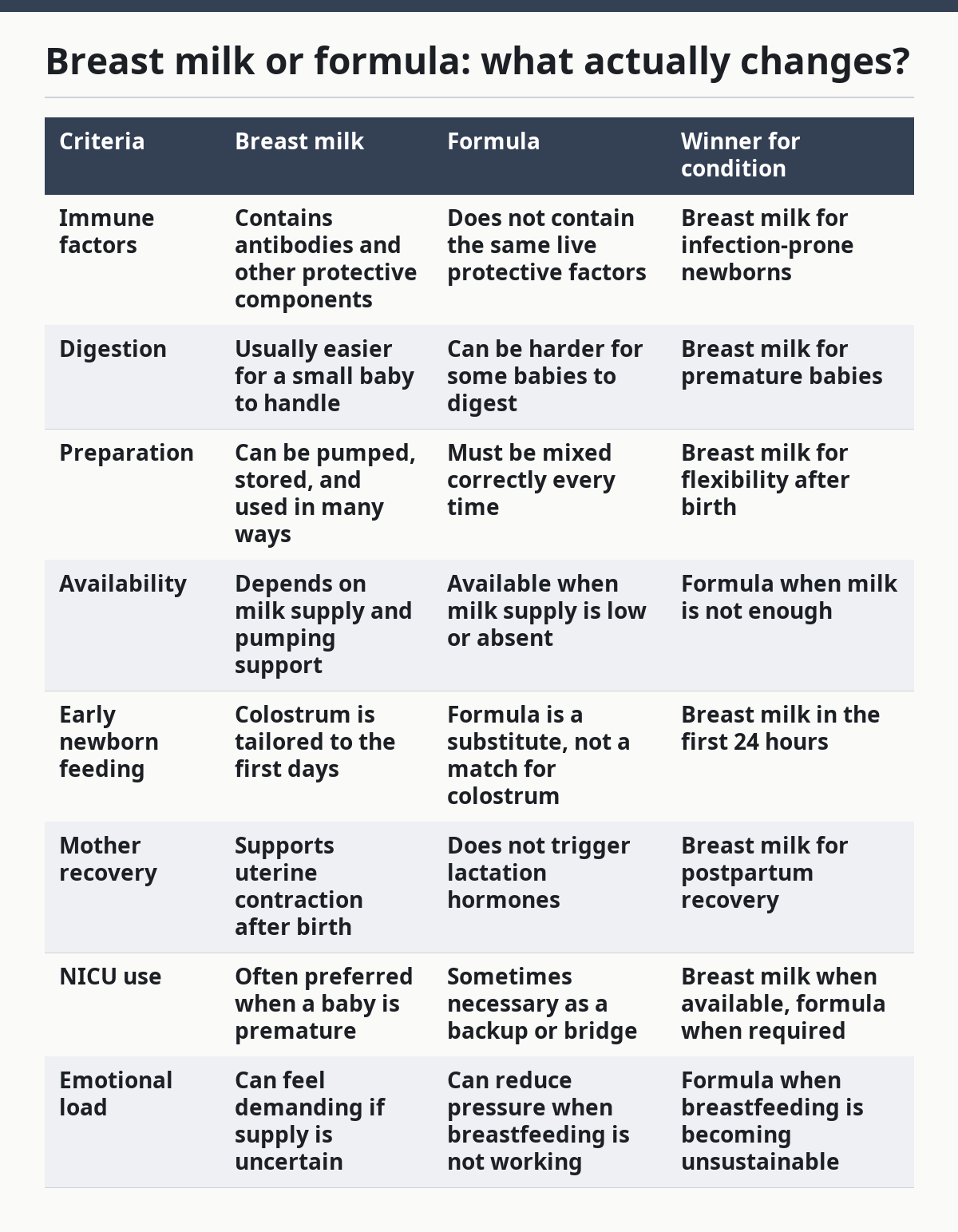
The table does not mean formula is “bad.” It means breast milk has a different profile, especially in the first weeks. For a premature baby, the choice often starts as “Can the baby tolerate mother’s milk or donor milk?” and only then becomes “How much direct breastfeeding is possible?”
What makes breastfeeding hard at first?
Breastfeeding is hard at first because newborn feeding is a skill, not a switch. A baby born at 35 weeks, 32 weeks, or earlier may not latch well, may tire quickly, and may need time before direct nursing becomes reliable.
A common mistake is assuming pain means failure. It does not. Pain usually means the latch, positioning, or feeding timing needs adjustment. Another mistake is waiting too long to ask for help. In the early days, the difference between “mild discomfort” and “this is not working” can be the difference between keeping milk supply up or losing it.
Pumping can help bridge that gap, but it is work. The mother may need a pump schedule, storage containers, and help with cleaning and transport. That is especially true if the baby is in the hospital and direct feeds are limited. The process is often temporary, but the first 7 to 14 days can feel long.
Breastfeeding is not the right answer if the mother has a medical reason to avoid it, if the baby cannot safely feed by mouth, or if the setup is causing more harm than good. In those cases, the goal is not to “push through.” The goal is to keep the baby fed and the mother supported.
When should breastfeeding plan change?
Breastfeeding should change when the baby’s growth, safety, or feeding ability changes. That can happen in the first 24 hours, during a NICU stay, or weeks later when the baby becomes stronger and can feed more directly.
A few exception scenarios flip the usual advice:
- The baby cannot coordinate sucking and breathing yet. In that case, expressed milk or tube feeding may be the safer route for now.
- The mother’s pain is severe or supply is falling fast. Then the plan may need lactation support, pumping changes, or a partial formula bridge.
- The baby is not gaining as expected. Breastfeeding may still continue, but the team may add fortifier or another feeding method.
- A clinician has flagged a medical reason not to breastfeed. That rule comes before any general benefit.
For premature babies, the plan that keeps milk moving into the baby in the safest way possible is often the most useful one. Direct nursing is a goal, not a requirement on day 1.
What should a parent do in the first 24 hours?
A parent should focus on getting milk started, getting help early, and not judging success by latch alone. The first 24 hours are about laying a foundation, not proving anything.
If the baby is stable, skin-to-skin contact and early feeding attempts can help. If the baby is in the NICU, ask about pumping, storage, and whether mother’s milk or donor milk is preferred for that unit’s feeding protocol. A lactation consultant, pediatric clinician, or NICU nurse can help translate the plan into real steps.
Therefore, the best next move is often simple: keep the baby fed, keep the milk flowing, and keep the plan flexible. That matters more than aiming for a perfect feeding story in the first 2 days. For more practical steps, see NICU feeding plans and how to start pumping after birth.
Should you choose breastfeeding for a premature baby?
Choose breastfeeding if the baby can take mother’s milk safely, the mother wants to provide it, and support is available for pumping or direct nursing. Choose formula if breast milk is unavailable, the baby needs a medically directed backup, or breastfeeding is harming the mother’s recovery or mental health. Neither if the baby is unstable and the feeding plan has not been cleared by the NICU or pediatric team.
Questions parents ask most
Is breast milk really better than formula for a premature baby?
Yes, breast milk is usually the preferred first milk for a premature baby because it brings protective factors and is often easier to digest. That said, formula can still be the right bridge or backup when breast milk is not available or not enough. The safest choice depends on the baby’s medical status and growth.
What if my baby cannot latch yet?
That is common in premature babies and does not mean breastfeeding is off the table. Expressed milk, donor milk, or temporary tube feeding may be used until the baby is strong enough to nurse. The key is keeping milk available while the baby learns to feed. See also how to support latch and breast milk storage.
Does breastfeeding help the mother right away?
Yes, it can help right away by triggering hormones that support uterine contraction after birth. It also helps set up milk production in the first days, which matters if the baby is early or in the NICU. The process can still be tiring, so support matters.
Can I still benefit if I pump instead of nurse directly?
Yes, pumped breast milk still gives the baby the main nutritional and immune benefits of human milk. It may be the most realistic option when the baby is premature, sleepy, or hospitalized. Direct nursing can come later if and when the baby is ready.
When should I stop trying to breastfeed?
Stop or change the plan when breastfeeding is causing more harm than help, when the baby cannot safely feed this way, or when a clinician advises another approach. A mixed plan is still a valid plan. For a premature baby, flexibility usually works better than an all-or-nothing rule.
Drafted with AI; not yet reviewed by a person.