Last updated: November 19, 2026
For the topic Can I Refrigerate Breast Milk After Feeding? Everything You Need to Know: related questions, the short answer is yes — you can refrigerate breast milk after feeding, but only if it has not been left out too long and you move it to the fridge fast; once a baby has started drinking from a bottle, leftover milk should be used within 2 hours or thrown away. For a premature baby, follow the NICU or pediatric team’s rule if it is stricter than the general guidance. If you are unsure, check with a pediatrician or NICU team. CDC breast milk storage and handling
Key takeaways
- Leftover milk from a bottle is not the same as milk that was never offered to the baby.
- The 2-hour rule matters most after the baby’s mouth has touched the bottle or nipple.
- Freshly pumped milk can go into the refrigerator right away at about 40°F / 4°C.
- Milk that stayed out too long should not be saved for the next feed.
- For a premature baby, hospital storage rules may be tighter than home storage rules.
- If you are unsure, ask your pediatrician or NICU team.
Can I refrigerate breast milk after feeding?
Yes, but only in a narrow situation: if the milk has not been sitting out for long and the baby has not already contaminated it with saliva for too long. The most useful rule is the one used by the Centers for Disease Control and Prevention: once a baby has begun feeding from a bottle, any leftover milk should be used within 2 hours, then discarded. CDC’s handling guidance is here: CDC breast milk storage and handling.
That means the answer changes depending on what “after feeding” means. If a parent means a bottle that the baby drank from and did not finish, the safe move is not to refrigerate it for later use after the 2-hour window. If the parent means milk that was pumped and then set aside before the feed, it can usually go straight into the refrigerator.
The reason is simple: once a baby drinks from the bottle, bacteria from the mouth can get into the milk. Refrigeration slows growth, but it does not reset the clock. For a premature baby, the margin for error is smaller, so a NICU may tell parents to discard leftovers sooner than 2 hours.
What if the baby only drank a little?
If the baby only drank a little, the milk still follows the same 2-hour rule after the feed starts. A half-full bottle may look wasteful, but it is not safe to save indefinitely just because there is a lot left.
The CDC and many pediatric handouts treat any bottle the baby has begun drinking from as time-limited; if you are unsure, check with your pediatrician or NICU team. That includes bottles with one sip taken, not just bottles that are nearly empty. The practical cost of ignoring that rule is not only waste; it is also a higher chance that the baby will get milk that has sat warm with saliva in it.
Here is the line that matters: if the milk was in the baby’s mouth, refrigeration is not a do-over. If the baby did not drink from the bottle at all, the milk is handled like fresh milk, not leftover milk.
Leftover milk or fresh milk: what changes?
| Criteria | Leftover milk after a feeding | Freshly pumped milk not yet offered | Winner for safety |
|---|---|---|---|
| Can it be saved for later? | Only within 2 hours after the feed starts | Yes, within normal refrigerator storage limits | Freshly pumped milk |
| Risk of mouth bacteria | Higher | Lower | Freshly pumped milk |
| Best use | Short delay only | Normal storage | Freshly pumped milk |
| Typical home rule | Discard after 2 hours | Refrigerate promptly at about 40°F / 4°C | Freshly pumped milk |
| Good for a premature baby? | Often not preferred | Usually better, if handled correctly | Freshly pumped milk |
| Can it be frozen later? | Usually no, once it has sat out too long after feeding | Yes, if stored properly first | Freshly pumped milk |
| Does cold storage undo contamination? | No | Not needed | Freshly pumped milk |
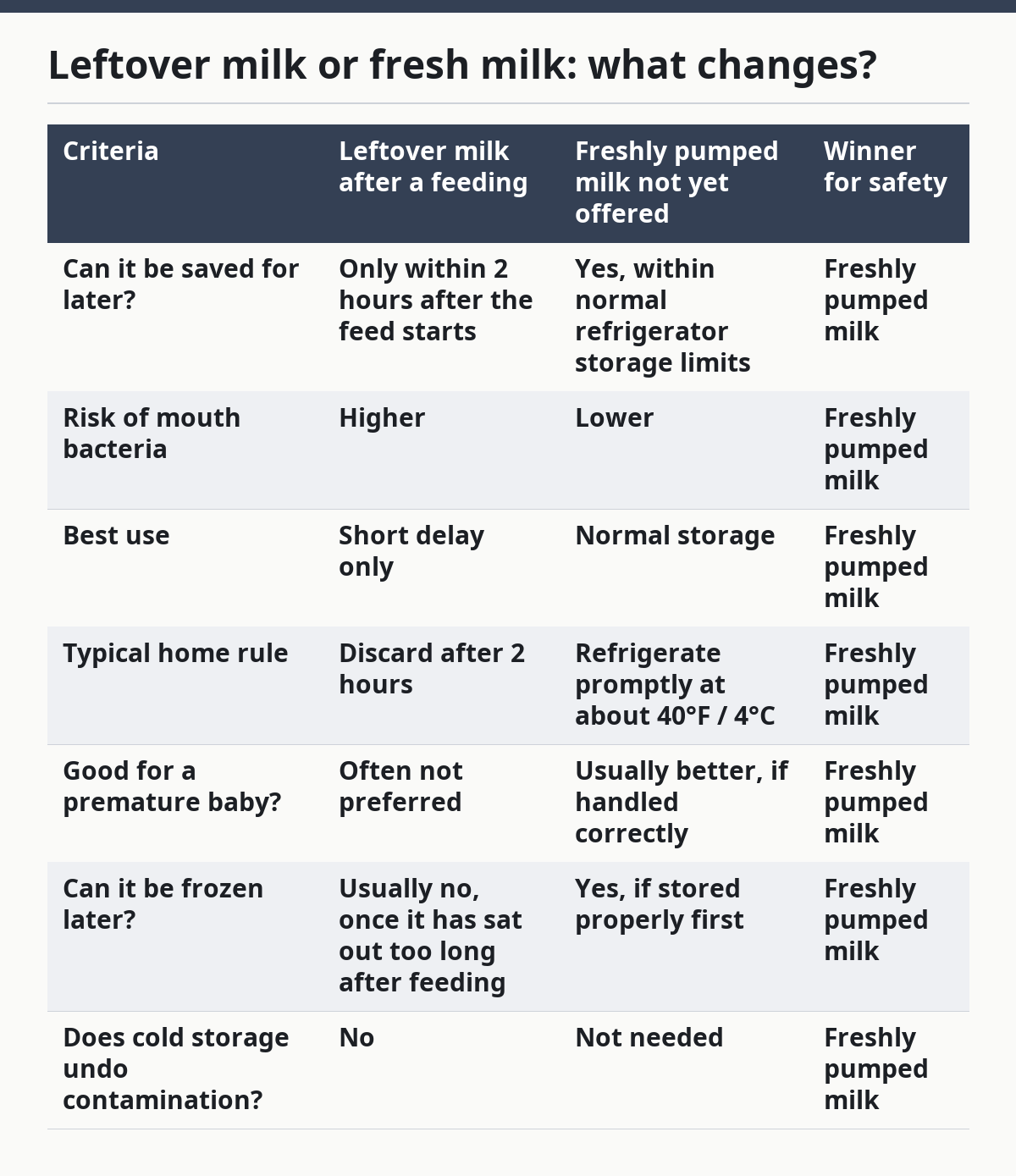
The table is blunt on purpose: once a feeding has started, the milk is on a short timer. If you want the simplest safe rule, treat leftover milk as time-limited and ask a pediatric professional when a situation feels unclear.
How long can breast milk stay in the fridge?
Fresh breast milk can usually stay in the refrigerator for up to 4 days if the fridge is cold enough and the milk is stored cleanly. The common target is about 40°F / 4°C or colder. The American Academy of Pediatrics also gives parents similar storage guidance on HealthyChildren.org: AAP breast milk storage guidance.
That 4-day window applies to milk that was pumped and never offered to the baby. It does not override the separate 2-hour rule for leftovers from a bottle. Those are two different situations, and confusing them is where many parents get tripped up.
A fridge drawer can be less stable if the temperature swings each time the door opens. The back of the main shelf is often steadier. If the milk is for a premature baby, steadier storage matters even more, because tiny temperature shifts and sloppy handling matter more when the baby is more vulnerable.
Should you save leftover milk or toss it?
Toss it if the baby has already fed from the bottle and 2 hours have passed. Save it only if the feed was very recent and the milk has not crossed that line.
Parents often hope the refrigerator will rescue a bottle that the baby did not finish. That hope is understandable, but it is the wrong default. The better question is not “Can cold make it safe again?” It is “Has it been exposed long enough that the safe-use window has already closed?”
For a bottle that was offered but barely touched, the answer is still the same: the clock started when feeding started, not when the bottle became empty. A fridge can slow spoilage, but it cannot turn old leftover milk back into fresh milk.
The main trade-off is waste versus safety. Saving every last ounce looks efficient, yet the real cost is that a baby may drink milk that has sat too long after contact with saliva. That matters most for premature babies, whose feeding plans are often more conservative.
What about a premature baby?
For a premature baby, it is often safest to follow the hospital’s milk-handling rules first, because they may be stricter than general home guidance. NICU teams often care much more about exact timing, container cleanliness, and labeling than a parent does at home.
This is one place where a generic parenting tip can go wrong. A premature baby may have a weaker immune system, may tire during feeds, and may take smaller amounts. That means leftover milk can happen often, but it also means the safest storage rule is the one given by the baby’s care team, not the loosest rule found online.
If the baby is in the NICU or recently discharged, ask three things and write them down: how long a bottle may sit out, whether leftover milk can be refrigerated after a partial feed, and whether the unit wants any milk discarded after a single feeding attempt. Some units accept the general 2-hour rule; others are stricter. If the guidance is close, ask the team to clarify rather than guessing.
When does the rule change?
The rule changes when the milk has never been in the baby’s mouth, when the baby is medically fragile, or when the milk has been left out too long. Those are the main exception scenarios.
-
The bottle was pumped but never offered.
This is the simplest case. The milk can usually go straight into the refrigerator and stay there for up to 4 days at about 40°F / 4°C. -
The baby took only a few sips, but the bottle was left on the counter.
The 2-hour window still applies from the start of the feeding. Refrigerating it after that does not make it safe for later. -
The baby is premature or immunocompromised.
A NICU or pediatric team may tell the family to be stricter than general storage rules. When that happens, the hospital rule wins. -
The milk smells odd or has obvious contamination.
Smell alone is not a complete safety test, but if the milk has been mishandled, looks wrong, or was stored in a dirty container, it should not be saved.
The cleanest rule is also the least confusing: fresh milk can be refrigerated, leftover milk from a feeding is time-limited, and premature babies may need tighter handling than either.
What should you do right now?
If the baby has already fed from the bottle, check the clock first and act on the 2-hour rule. If less than 2 hours have passed, many families choose to keep it only for the next immediate feed; if more time has passed, discard it.
If the milk was freshly pumped and not offered yet, refrigerate it right away in a clean container, ideally toward the back of the fridge. Label it with the date and use it within the refrigerator window your care team recommends. If the baby is premature, use the hospital’s instructions even if they are stricter than general guidance.
A useful habit is to separate “milk to store” from “milk already offered.” That one distinction can prevent many mistakes, especially when you are comparing fresh milk with leftover milk and deciding what to refrigerate. One is a storage problem. The other is a leftover problem.
Frequently asked questions
Can I put breast milk back in the fridge after the baby drinks from it?
Yes, but only for a short time and only if the 2-hour limit has not passed. Once a baby has started drinking from the bottle, the milk is no longer treated like fresh stored milk. If the clock has run out, it should be discarded rather than chilled for later. If you are unsure, ask a pediatrician or NICU team.
Can I save milk that my baby did not finish?
Yes, for a limited time. The usual guidance is to use or discard leftover milk within 2 hours after the feeding begins. After that, refrigeration does not make it safe enough to keep for the next feed.
How long can breast milk stay in the refrigerator?
Freshly pumped breast milk can usually stay in the refrigerator for up to 4 days if the fridge is about 40°F / 4°C or colder. That rule is for milk that has not already been offered to the baby. It does not apply to bottle leftovers after a feeding.
Is the rule different for a premature baby?
Often yes. Premature babies may need tighter handling rules from the NICU or pediatric team. If a hospital gives a shorter time limit or a different storage rule, follow that instruction instead of the general home guideline.
What if the milk was out on the counter for a while after feeding?
If the milk sat out beyond the safe window after the baby started feeding, it should not be saved. Cold storage is not meant to repair milk that has already sat too long with saliva in it. When in doubt, the safer call is to discard it and start fresh.
Drafted with AI; not yet reviewed by a person.