
Last updated: November 19, 2026
Quick answer: 1 clinician review is the safest first step before you change breastfeeding on HRT. Breastfeeding on HRT: What You Need to Know is the question here, and the answer depends on the exact hormone, the reason you need it, and your baby’s age and medical needs; according to the Cleveland Clinic, breast milk is still the recommended first food for about 6 months whenever possible.
Key takeaways
- HRT by itself is not a reason to make a rushed feeding change.
- The exact medicine matters more than the word “HRT” on its own.
- If your baby is premature or small, the threshold for caution is lower.
- If you need to protect milk supply, do not wait until after a feed gap to ask for help.
- If the plan is unclear, get the medication name, dose, and route checked before making a decision.
Can you breastfeed while on HRT?

Yes, sometimes you can, but the answer depends on the exact treatment and your baby’s situation, so you should check with a clinician before changing feeds. HRT is not one single thing, and a “yes” for one medicine does not mean “yes” for every estrogen or progesterone product. If you are breastfeeding a newborn or a premature baby, that caution matters even more. For medication-specific guidance, NIH LactMed is a useful source to review with your prescriber.
The mistake people make is treating HRT like a yes-or-no label. That is too crude, and it is best handled with a clinician review rather than guesswork. What matters is the actual medicine, how it is taken, why it is prescribed, and whether your baby is getting breast milk as the main food right now. Experts recommend breast milk as a baby’s only source of nutrition until 6 months old whenever possible, and that goal should stay on the table while you sort out the medication question.
If you have already started HRT, the next move is not panic. It is a quick fact check with the prescriber and the baby’s clinician. If the medicine is one that can fit with breastfeeding, the plan may be to keep nursing and monitor the baby. If the medicine is a poor fit, the plan may shift to timing, dose review, or a different treatment, but that should be decided with a clinician.
- Write down the exact HRT name, dose, and how you take it.
- Check whether the HRT was started for symptoms that can wait a few days or 1 visit.
- Ask whether your baby’s age, prematurity, or low birth weight changes the advice.
- Ask whether breastfeeding can continue as-is, needs a temporary pause, or needs timing changes.
- If milk supply is at risk, ask what to do the same day to keep pumping or nursing on schedule.
Quick check: If you know only the phrase “HRT” and not the exact drug, you do not have enough information yet to make a safe feeding decision.
What actually changes the answer?
The answer changes most when the hormone, the baby’s age, and the feeding goal do not line up. A mother nursing a healthy older infant has more room to adjust than someone feeding a premature baby who still depends on human milk as the main nutrition.
The right question is not “Is HRT safe?” It is “Is this specific HRT compatible with breastfeeding for this specific baby?” That is the difference between useful advice and guesswork. The baby’s stage matters because breastfeeding guidance is built around age and nutrition, and the first 6 months are a major line in the sand.
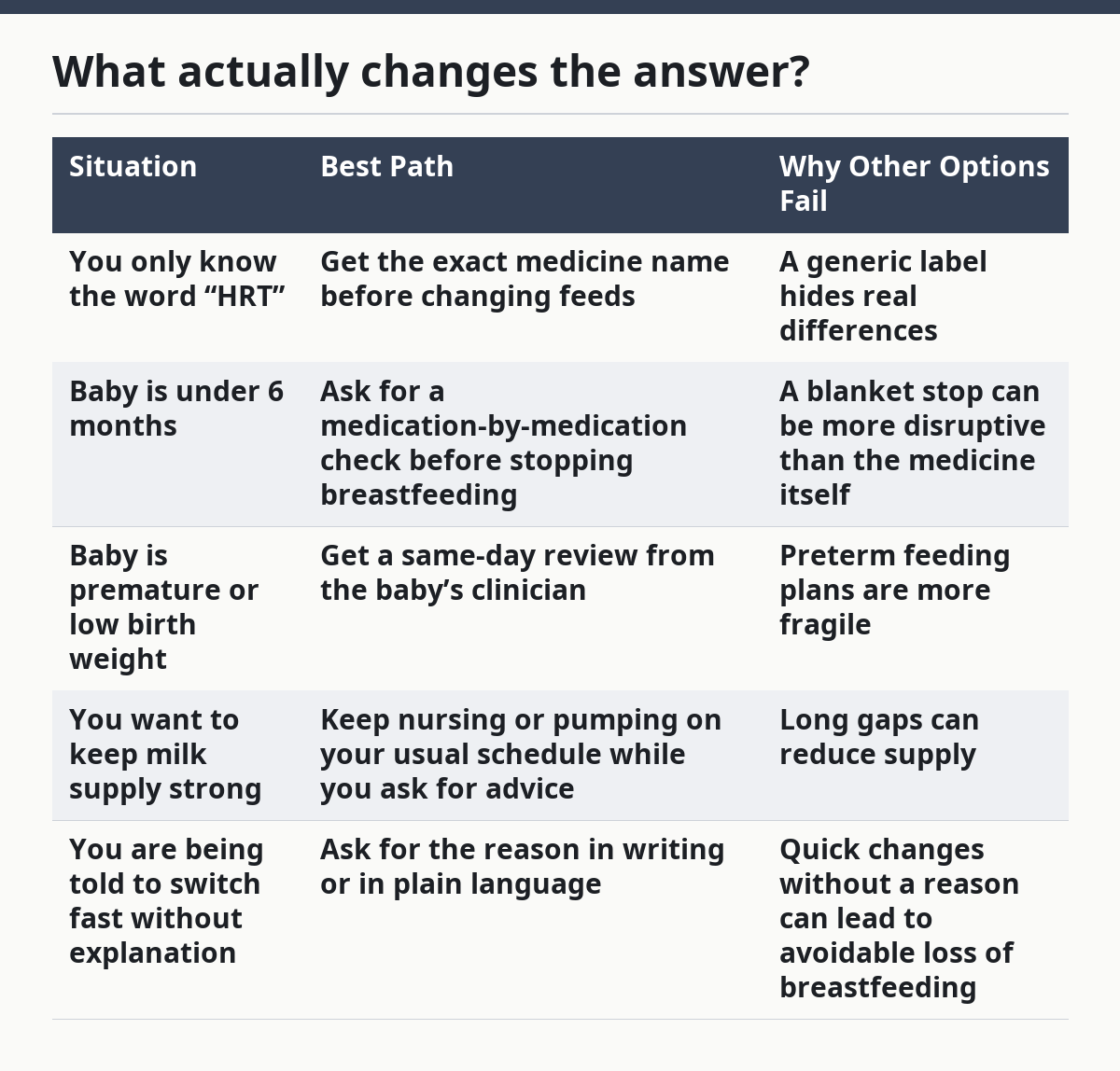
Use the table below to sort the common situations before you make a move.
| Situation | Best Path | Why Other Options Fail |
|---|---|---|
| You only know the word “HRT” | Get the exact medicine name before changing feeds | A generic label hides real differences |
| Baby is under 6 months | Ask for a medication-by-medication check before stopping breastfeeding | A blanket stop can be more disruptive than the medicine itself |
| Baby is premature or low birth weight | Get a same-day review from the baby’s clinician | Preterm feeding plans are more fragile |
| You want to keep milk supply strong | Keep nursing or pumping on your usual schedule while you ask for advice | Long gaps can reduce supply |
| You are being told to switch fast without explanation | Ask for the reason in writing or in plain language | Quick changes without a reason can lead to avoidable loss of breastfeeding |
Breastfeeding initiation has risen to 86% in 2023, according to the CDC, but that does not mean every family gets the support they need when medication questions come up. If the plan feels rushed, slow it down long enough to get the exact facts.
Quick check: If your baby is under 6 months, premature, or small, you should treat HRT decisions as a feeding safety question, not a routine medication refill issue.
If your baby is premature, what should you do?

If your baby is premature, you should get a more cautious answer before making any breastfeeding or HRT change. Premature babies have less room for feeding mistakes, and that makes the “just keep going” answer less automatic.
A premature baby is not the same as a full-term baby, and the feeding plan may already be more delicate. If mother’s own milk is unavailable for a preterm or low-birth-weight infant, WHO recommends donor human milk, which shows how seriously experts treat milk access in this group. For the broader feeding background, see WHO infant and young child feeding guidance.
If you are on HRT and your baby is premature, do not assume the best move is to stop breastfeeding on the spot. The better move is to ask what the medication means for your specific feeding plan. If you can keep pumping or nursing while the team reviews the medicine, that may protect supply and keep options open. If a pause is needed, you need a replacement plan, not just a warning.
- Tell the baby’s clinician that the baby is premature and that you are on HRT.
- Give the exact medicine name, dose, and route.
- Ask whether breast milk should continue, be timed differently, or be paused.
- If you are told to pause, ask how to maintain supply over the next 24 hours.
- Ask whether donor human milk is part of the backup plan if your own milk is not available.
The main trade-off is plain: a cautious medication review can feel slower, but it is often safer than a fast yes-or-no decision made without the baby’s full context. That matters most in the first months of life.
Quick check: If your baby was born early, the HRT question needs a more careful review than a standard “can I breastfeed?” search result can give you.
What if you are trying to keep exclusive breastfeeding?
If you want to keep exclusive breastfeeding, the goal is to protect both milk supply and your medication plan at the same time. That matters because only about 1 in 3 infants is exclusively breastfed as recommended until 6 months old, according to the CDC, so losing supply unnecessarily is worth avoiding.
The trap here is waiting until the medication question is settled before you do anything. If breastfeeding or pumping stops for too long, supply can drop, and then the HRT question becomes harder because now you are dealing with both medication review and milk loss. That is especially frustrating if your original plan was to keep breast milk as the main food through 6 months.
If the HRT is still under review, the safer move is usually to keep the feeding rhythm steady unless a clinician tells you otherwise. That means nursing or pumping on your normal pattern while you wait for a real answer. If you are told to change the schedule, ask what that means for supply and how long the change is expected to last.
- Keep your current nursing or pumping pattern unless you are told to stop.
- Ask whether the HRT plan can be adjusted rather than ending breastfeeding.
- Ask whether a short pause is temporary or part of a longer plan.
- Before any change, ask what protects milk supply during the next 24 to 48 hours.
A generic “just keep breastfeeding” answer fails here because it ignores the medication side. A blanket “stop breastfeeding” answer fails because it ignores the supply side. The real job is to hold both questions together until someone with the right training reviews the specific medicine.
Quick check: If your main goal is to keep breast milk as the baby’s main food, do not make a medication change that also knocks out your supply without a backup plan.
When does the standard advice break down?
The standard advice breaks down when the baby is medically fragile, the medication is not clearly identified, or the feeding plan is already under strain. These are the cases where “ask your doctor” is not enough on its own, because you need a specific next step.
Here are the situations that change the plan:
-
Situation: You do not know the exact HRT name.
What changes: The risk cannot be judged from the word HRT alone.
What to do instead: Get the label, dose, and route before making any breastfeeding change. -
Situation: Your baby is premature or low birth weight.
What changes: Feeding choices matter more, and milk access is harder to replace.
What to do instead: Ask the baby’s clinician for same-day guidance. -
Situation: You are already struggling with supply.
What changes: Even a short pause can matter.
What to do instead: Protect the feeding schedule while the medication question is reviewed. -
Situation: You were told to stop breastfeeding without a reason.
What changes: The plan may be incomplete.
What to do instead: Ask which part of the HRT is the problem and whether there is a feeding-safe alternative. -
Situation: You are still within the first 6 months postpartum.
What changes: Breast milk is still doing the heaviest nutritional work.
What to do instead: Treat any change as a nutrition decision, not just a medication decision.
The common failure in these cases is speed without detail. If the answer comes back too quickly and does not mention the baby’s age, the exact medicine, or the feeding plan, it is not done yet.
Quick check: If your situation includes prematurity, poor supply, or an unnamed hormone, the usual advice is too vague to trust.
What should you ask at the appointment?
You should ask for a yes-or-no answer tied to the exact HRT, the baby’s age, and the feeding plan. That is the fastest way to get a decision you can actually use. For more background, the CDC breastfeeding guidance and NIH LactMed are both useful references to bring into the discussion.
Bring a short list so the visit does not drift. The point is not to sound prepared; the point is to leave with a clear plan you can follow the same day. Since about 1 in 3 infants are exclusively breastfed by 6 months, according to the CDC, it makes sense to protect a breastfeeding plan when it can be protected.
Ask these questions:
- Is this exact HRT compatible with breastfeeding for my baby?
- If not, is there another treatment that fits better?
- Do I need to change anything right away, or can I keep feeding while this is reviewed?
- Does my baby’s prematurity change the answer?
- If I have to pause, what keeps my milk supply from dropping?
If you leave with only “check back later,” that is not enough. You need the exact medicine name, the reason for the recommendation, and the next feeding step. Without those pieces, you are guessing.
Quick check: If you cannot repeat the plan back in one sentence, the appointment did not answer the real question.
FAQ
Is breastfeeding on HRT always unsafe?
No, it is not always unsafe. The answer depends on the exact hormone, the dose, and your baby’s situation, so a blanket yes or no is not reliable. If your baby is premature or under 6 months, get a more careful review before changing feeds.
Should I stop breastfeeding until I get advice?
Not automatically. If you stop too fast, you may lose supply before you know whether the HRT truly requires a change. If possible, keep your usual nursing or pumping pattern while you get the exact medication checked, and ask a clinician for advice.
Does a premature baby change the answer?
Yes, it usually makes the decision more cautious. Premature babies have less margin for feeding changes, and if mother’s own milk is unavailable, WHO recommends donor human milk for preterm or low-birth-weight infants. That makes a feeding-safe plan especially important.
What if I was told “HRT and breastfeeding don’t mix”?
Ask which HRT they mean and what the concern is. A broad warning is not enough to guide a real feeding plan, because “HRT” covers different medicines. You need the exact drug, the baby’s age, and a clear next step before you act, and it is reasonable to ask a professional to explain that.
Can I keep breastfeeding while the plan is being reviewed?
Often yes, but not always, and the baby’s condition matters. If the baby is premature, low birth weight, or medically fragile, get same-day guidance rather than waiting. The best interim plan is the one that protects both safety and supply.
Sources
- CDC, About Breastfeeding – Breastfeeding – CDC (checked 19 Nov 2026)
- WHO, Breastfeeding (checked 19 Nov 2026)
- Cleveland Clinic, Breastfeeding: How To Start, Concerns & Tips (checked 19 Nov 2026)
- CDC, Breastfeeding Benefits Both Baby and Mom – Breastfeeding – CDC (checked 19 Nov 2026)
Drafted with AI; not yet reviewed by a person.