
Last updated: November 18, 2026
Quick Answer: In many cases, flat or inverted nipples can be managed with 1 to 3 minutes of hand expression or gentle nipple shaping before latching. The aim in How to breastfeed with flat or inverted nipples is not to “fix” the nipple. It is to make latching easier for the baby and less painful for you.
Flat nipples do not make breastfeeding impossible, but they can slow that first latch and make it feel maddening. Usually, the issue is not “bigger nipples”; it is getting the nipple more available for the baby to grasp and bringing milk forward before the latch. That small shift changes a lot.
What flat or inverted nipples change for a latch
Flat nipples change the starting point, not the goal. A baby still needs enough breast tissue in the mouth to compress milk ducts, and a nipple that stands out more after stimulation often gives the mouth a clearer target. Inverted nipples can work too, but they sometimes need more help than flat nipples because the nipple retracts instead of projecting.
The basic problem is plain: a newborn has to build a seal around soft tissue. When the nipple stays flush with the breast or pulls inward when touched, the baby may slip off, fuss, or stay attached shallowly. The first 5 to 10 minutes can feel like a wrestling match.
Two things matter more than shape alone: how soft the breast is at latch time and how much areola the baby can get into the mouth, not just nipple. A very full breast can make any nipple harder to grasp. By contrast, a breast softened a little — even by hand expression for a minute or two — is often easier to latch onto.
Think of flat nipples as a latch challenge, not a verdict. This page stays focused on nipple shape, nipple shaping, hand expression before latching, nipple shields, and positioning tips. For the broader latch and comfort piece, the hub on latch, positioning, and comfort is the better next stop.
How to breastfeed with flat nipples

Make the nipple more prominent, soften the areola, and offer the breast in a way that helps the baby take a deeper mouthful. That is the whole job here. Most of the time, a short prep routine before each feed works better than a long setup.
Start with the least invasive option. Many parents need only 1 to 3 minutes of preparation before the nipple is easier to grasp. When that still does not help enough, move to a nipple shield or a breast pump for brief stimulation. The point is to make latching possible now, not to build a routine you will hate at 2 a.m.
-
Check the nipple shape when the breast is relaxed. Gently roll or touch the nipple with clean fingers for a few seconds and see whether it projects more. When it does, you likely have flat nipples rather than strongly inverted nipples, and simple stimulation may be enough.
-
Hand express for 1 to 2 minutes. Use a small amount of pressure around the areola until a few drops appear. This softens the area and can make the nipple easier to draw out before the baby latches.
-
Shape the breast for the baby’s mouth. Hold the breast so the nipple points toward the baby’s nose, not straight into the mouth. A breast that is gently compressed into a “sandwich” shape is often easier to take than a round, tight breast.
-
Bring the baby in close, chin first. Aim the baby so the chin meets the breast before the nose. That helps the mouth open wider and gives the lower jaw more room to draw in breast tissue.
-
Try a short reset if the latch slips. When the baby only stays on briefly, break suction and try again rather than letting a painful, shallow latch continue for several minutes. A clean restart often works better than forcing the same attempt.
When the nipple flattens again after every attempt, do not keep repeating the same hold for 20 minutes. A few minutes with hand expression or a shield can save the whole feed. If you need a deeper refresher on body setup, link over to the latch, positioning, and comfort hub rather than trying to solve every angle here.
Nipple shaping that can help before latching
Nipple shaping gives the baby a clearer target for a few minutes, which is often enough to get milk transfer started. The simplest methods are brief stimulation, hand expression, and temporary suction from a breast pump or suction device.
A common mistake is trying to force the nipple outward with repeated hard pinching. That can make the areola sore without solving the latch. Better to keep it gentle and brief just before the feed. Think 30 to 60 seconds of coaxing, not 15 minutes of poking.
A breast pump can sometimes help when the nipple stays flat. Even a short session on a standard double electric pump can pull the nipple out temporarily. You do not need a marathon pumping session for this purpose; the point is shape, not output. Keep the suction low enough to avoid pain. Pain is a sign the setting is too aggressive, not a sign that the method is working better.
Hand expression has one advantage over a pump: it softens the areola in the exact spot the baby must latch to. That can be enough on a breast that feels firm after a longer stretch between feeds. A few drops on the nipple also give the baby a scent and taste cue, which can help a reluctant feeder stay engaged.
For inverted nipples, shaping may only help partway. When the nipple still retracts inward when touched, a nipple shield may be the more useful tool for the first days or weeks. That is not failure. It is a way to feed the baby while the breast and baby learn the pattern.
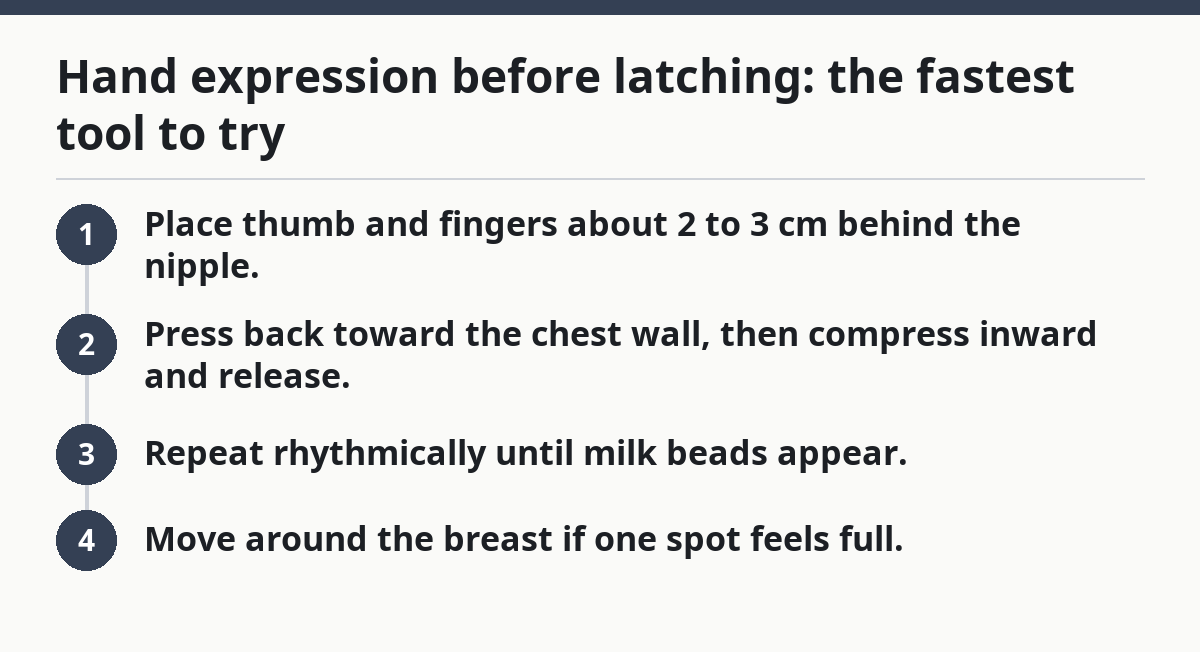
Hand expression before latching: the fastest tool to try

Hand expression before latching is often the quickest thing to try because it needs no equipment and can soften the breast in under 2 minutes. It is especially useful when the nipple is flat because the areola is too full or tight for the baby to latch easily.
Here is the practical sequence:
- Place thumb and fingers about 2 to 3 cm behind the nipple.
- Press back toward the chest wall, then compress inward and release.
- Repeat rhythmically until milk beads appear.
- Move around the breast if one spot feels full.
The result you want is a slightly softer areola and a nipple that stands out a bit more. No milk after several compressions does not mean the method failed. Some breasts need only softening, not visible drops, to improve the latch. What matters is whether the nipple becomes easier for the baby to grasp.
Hand expression is also useful when a baby is hungry and upset. A few drops on the nipple can buy you a better first attempt. That can be the difference between a 30-second frustration spiral and a workable latch. It is not meant to replace feeding; it is a setup step.
The drawback is time and hand fatigue. When you have to do it every single feed, the routine can become annoying. In that case, move to an adjunct such as a nipple shield for a while, especially if the baby is very young and still learning. The goal is to make feeding possible on day 1, not to prove that you can do everything by hand forever.
When a nipple shield helps, and when it gets in the way
A nipple shield can help when flat or inverted nipples keep the baby from staying latched long enough to feed. It gives the baby a firmer target and can turn a broken latch into a workable one, especially in the early newborn period.
It is most useful when the baby can latch only briefly, slips off repeatedly, or seems unable to maintain suction on a flat nipple. It may also help if the nipple is inverted enough that hand expression alone does not bring it forward. A typical shield is a thin silicone cover that sits over the nipple and part of the areola.
The trade-off is real: a shield can make feeding more manageable, but it can also hide a shallow latch, add cleaning, and feel like one more thing to manage at 3 a.m. Some parents find it essential for a week and then phase it out. Others rely on it longer. Both paths are normal.
What I would not do is treat a shield as a casual default without a reason; when the baby can latch without it after 1 to 3 minutes of hand expression, that is usually simpler, and a lactation consultant or breastfeeding professional can help you decide whether the shield is still needed. If you do use one, watch for signs that the baby is sucking on the tip only instead of taking enough breast tissue. If pain is sharp, persistent, or worsening, get a lactation check rather than assuming the shield has solved everything. The La Leche League and NHS guidance on breastfeeding problems both recommend getting support when feeds remain painful or ineffective.
A shield is wrong for the parent who wants zero extra gear and already has a baby who latches well with brief nipple shaping. It is also not a substitute for help if the baby is not transferring milk, staying sleepy at the breast, or causing nipple trauma.
Positioning tips that matter when nipples are flat or inverted
Positioning matters because flat nipples are easier to latch when the baby can come in close and take the breast from underneath the nipple line. A good angle can make a bigger difference than another round of stimulation.
Keep the baby’s body aligned so the ear, shoulder, and hip face the breast. That makes it easier for the baby to open wide and stay close. When the baby has to turn the head hard to reach the nipple, the latch often slips. A baby who can tilt the head slightly back usually has more room for the mouth to open.
Use the breast as a target, not the nipple as a dart board. That means bringing the baby to the breast, not leaning the breast toward the baby. A stable hold for 10 to 20 seconds can help the baby stay organized while the mouth opens. If the nipple is flat, this extra second matters.
Do not press the breast so hard that the nipple gets flattened again. That defeats the point. A gentle breast compression is enough. When the areola is very firm, hand express first for 1 to 2 minutes, then try again. If the baby keeps slipping, reset before frustration builds.
One honest limitation: positioning alone does not fix every flat or inverted nipple. If the nipple retracts strongly, or if the breast is swollen, a positional tweak may not be enough. That is when a shield, hand expression, or a brief pump session becomes part of the plan.
Common mistakes that waste energy and make latching harder
The biggest mistake is waiting too long to change tactics. When a feed has gone on for 10 minutes with repeated slipping, the baby is often more frustrated and less organized. A short reset is better than grinding through the same failed attempt.
Another mistake is using too much suction with a pump in hopes of “pulling out” the nipple faster. That can leave the breast sore and make the next feed harder. The safer move is lower suction for a shorter time, just enough to evert the nipple or soften the areola.
A third mistake is assuming flat nipples mean the baby cannot breastfeed at all. That belief can push parents toward unnecessary panic or unnecessary switching. Many babies feed well once the breast is softened and the baby is brought in correctly. Flat nipples are a problem to work around, not a sentence.
A fourth mistake is staying silent when pain persists. Sharp pain, damaged skin, or a baby who never seems satisfied after feeds deserves a professional look. Lactation support can spot whether the problem is nipple shape, breast fullness, a shallow latch, or something else. That matters because the fix changes depending on the cause.
When one method has failed for several feeds in a row, do not keep repeating it as if persistence will magically convert it. Move through the tools in a sensible order: hand expression, nipple shaping, shield if needed, and outside help if the pattern does not improve.
When to get help and what kind to ask for
Get help if feeding hurts beyond the first few seconds, if the nipple stays damaged, or if the baby cannot stay attached long enough to feed. Flat and inverted nipples are usually manageable, but persistent pain or poor milk transfer deserves a qualified eye.
A lactation consultant, midwife, or clinician familiar with breastfeeding can check whether the issue is truly nipple shape or something layered on top of it. They can also show you how to use a nipple shield correctly and when to stop using it. That kind of hands-on help is often more useful than reading more general advice.
This is also the right time to ask for help if the breast is very engorged, because swelling can make any nipple look flatter than it really is. A swollen breast may need a short period of hand expression before the latch becomes possible. That is a different problem from a permanently flat nipple, and the fix changes with it.
The main takeaway is practical: when a 1 to 2 minute prep routine does not improve the latch, do not assume nothing can work. It may just mean you need a different tool or a trained set of eyes.
Key Takeaways
- Flat nipples usually need preparation, not a different feeding goal.
- A short round of hand expression can soften the breast and make the nipple easier to grasp.
- A nipple shield is useful when the baby cannot stay latched without help, but it adds complexity.
- Strong inverted nipples may need more support than simple shaping.
- If repeated attempts hurt or fail, stop forcing the same approach and get skilled breastfeeding help.
Can you breastfeed with flat nipples?
Yes, many parents with flat nipples breastfeed successfully. The first latch may take more preparation, such as hand expression or brief nipple shaping, but flat nipples alone do not prevent breastfeeding. When the baby still struggles after several feeds, a lactation consultant can check technique and help you choose the right tool.
Do flat nipples make breastfeeding impossible?
No, flat nipples do not make breastfeeding impossible. They can make latching slower, especially when the breast is full or tight, but most babies can feed with the right setup. The problem is usually mechanics, not milk production. When feeds are painful or the baby cannot stay attached, get help sooner rather than later.
Should I use a nipple shield?
A nipple shield can help when the baby cannot latch or keep a seal on a flat or inverted nipple. It is most useful as a temporary tool or bridge, not a cure-all. When you use one, make sure milk transfer is still happening and ask a breastfeeding professional to check the fit and plan.
Drafted with AI; not yet reviewed by a person.