
Last updated: November 18, 2026
Key Takeaways
- Measure nipple diameter first, then match it to the flange tunnel.
- A good fit keeps most of the areola outside the tunnel and reduces rubbing.
- A correct fit feels comfortable, stays centered, and leaves the nipple looking normal.
- If the flange is too big or too small, adjust the tunnel size or use an insert.
A breast pump flange fits correctly when your nipple moves freely in the tunnel, the areola does not get pulled in much, and pumping feels like suction rather than rubbing or pinching. If the flange size is off by even a few millimeters, the difference shows up fast in comfort and milk flow. How to fit a breast pump flange correctly starts with the nipple, not the box size.
Start with the right measurement, not the box size

The quickest way to get close is to measure nipple diameter, then compare that number with the flange tunnel. A nipple ruler, caliper, or sizing guide from a lactation professional can help you measure the nipple alone, not the areola, because the tunnel is sized around the nipple shaft.
Use the measurement after a pumping session or a warm shower, when the nipple is not unusually tight. If your nipple measures 17 mm, for example, a common starting point is a flange with a tunnel around 19 mm to allow a small amount of space. That extra room matters because the nipple expands during pumping. A tunnel that matches your exact measurement is often too snug.
Here is the basic sizing process:
- Measure one nipple at the base, across the widest part of the nipple itself, with a nipple ruler or caliper. The result should be in millimeters, such as 15 mm or 18 mm.
- Add a little room for movement. Many people start with a flange about 1 to 3 mm larger than the measured nipple width, not because that number is magical, but because the nipple needs space to stretch without rubbing the sides.
- Check the breast pump flange tunnel, not the outer rim. The tunnel is the narrow channel the nipple enters, and that is the part that determines fit.
- If the pump came with one default size, treat it as a starting point, not a verdict. A standard kit often includes a size that fits many people poorly; if sizing is unclear, consult a lactation professional. [source: https://llli.org/breastfeeding-info/pumping-milk/]
- Test one side at a time if your nipples are different sizes. It is normal to need two different flanges or an insert on one side.
A generic “medium” or “standard” label tells you very little. Breast pump flange sizing is mechanical, not cosmetic. The tunnel diameter is the number that matters. If you only remember one thing, remember this: the flange should guide the nipple, not squeeze it.
What a correctly fitting breast pump flange looks and feels like
A correctly fitting breast pump flange lets the nipple move in and out of the tunnel with little rubbing, while most of the areola stays outside the tunnel. The feeling should be a steady pull, not a scrape, pinch, or tugging at the skin around the nipple. In a 15- to 20-minute session, that difference is noticeable quickly.
A few signs point in the right direction:
- The nipple centers in the tunnel instead of hitting one side.
- The tunnel does not blanch the nipple immediately.
- The areola may move slightly, but it is not being dragged far into the tube.
- Suction feels firm but not sharp.
- Your nipple comes out round or oval in a normal way, not flattened like a lipstick tip.
A flange that is too large can look comfortable at first and still perform badly. Too much areola can get pulled into the tunnel, which can reduce efficient milk removal and leave the nipple swollen after a 15- to 20-minute session. A flange that is too small often feels worse right away: rubbing, pinching, or a burning sensation starts within minutes.
Some people look for a dramatic visual cue and miss the more useful one: how the nipple looks after pumping. If the nipple is pale, compressed, ridged, or painfully swollen, the fit is off. If the nipple is elongated but not damaged, and the breast feels more fully drained after a normal pumping session, the size is probably closer.
This is also the point where many readers overcorrect. They see a little areola movement and assume the flange is wrong. Small areola movement can be normal, especially during letdown. The real problem is excess pull, discomfort, or a nipple that does not move freely.
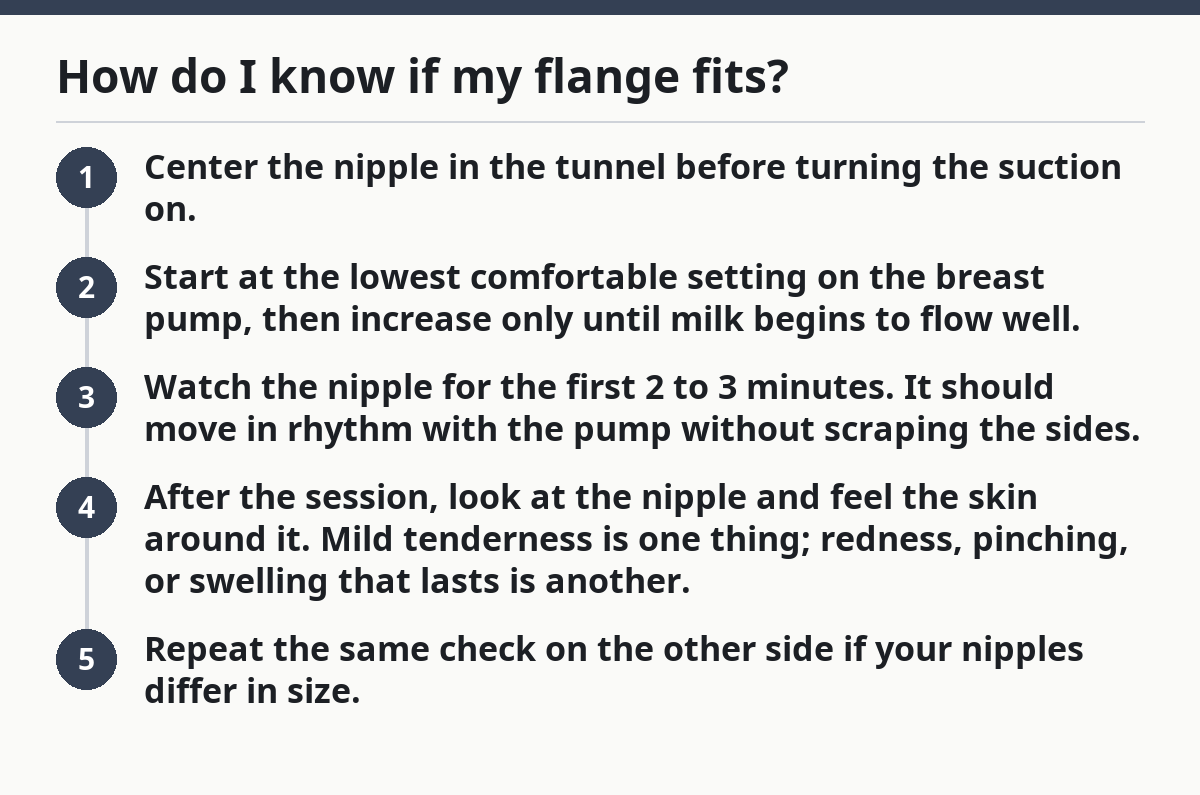
How do I know if my flange fits?
Your flange fits if pumping feels comfortable, the nipple stays centered, and the nipple comes out without rubbing marks, blanching, or a lipstick-shaped tip. That is the simplest test, and it matters more than the number on the package.
Use this quick check during a real pumping session, not before one:
- Center the nipple in the tunnel before turning the suction on.
- Start at the lowest comfortable setting on the breast pump, then increase only until milk begins to flow well.
- Watch the nipple for the first 2 to 3 minutes. It should move in rhythm with the pump without scraping the sides.
- After the session, look at the nipple and feel the skin around it. Mild tenderness is one thing; redness, pinching, or swelling that lasts is another.
- Repeat the same check on the other side if your nipples differ in size.
A good fit usually means less fiddling with the shield and fewer breaks to reset suction. It can also mean a more predictable pumping session. If you need to hold the flange in a strange angle, tilt your torso a lot, or press the shield hard into the breast to keep the nipple centered, the size is probably wrong or the breast pump setup is not matching your anatomy.
The most common mistake here is chasing suction strength instead of fit. Turning the vacuum up on a bad flange does not fix the flange. It often makes soreness worse. The better move is to adjust the size first, then use a suction level that stays comfortable. The breast does not need maximum pull to work well.
If the flange seems close but not perfect, note the symptom rather than guessing: “too much areola pulled in,” “nipple rubs one side,” or “nipple pinches at the base.” That symptom tells you whether to go larger, smaller, or add an insert.
Fixing a flange that is too big or too small
A flange that is too big usually needs a smaller tunnel or a breast shield insert; a flange that is too small usually needs a larger tunnel, not tighter suction. Those are different problems, and mixing them up wastes time and causes more soreness.
Use the symptom, not the label, to decide what to change:
- Too big: too much areola drawn into the tunnel, nipple feels stretched far into the cone, and milk flow may be less efficient. Try a smaller flange or a sizing insert that reduces the tunnel diameter.
- Too small: nipple rubs the sides, the tunnel feels tight at the base, and the nipple may come out compressed or irritated. Move up one size, often by 1 to 3 mm.
- Only one side hurts: the two nipples may simply need different sizes. Asymmetry is common and does not mean the pump is defective.
Breast shield inserts are useful when you are between sizes or when a full-size flange is hard to find. An insert changes the tunnel diameter without changing the whole shield. That can be a practical fix if you need 17 mm on one side and 19 mm on the other. It is not ideal if the insert slides around, traps moisture, or makes the shield harder to clean and assemble.
A common trap is assuming the largest opening is the safest choice. A too-large flange can look gentle because it does not squeeze the nipple, but it can still drag in too much areola and make the nipple do extra work. The result can be more swelling, not less.
Another trap is expecting one size to fit forever. Nipple size can change with pumping stage, engorgement, healing, or the first weeks after birth. A size that works in week one may not be the best one by week four, so recheck if comfort changes.
For people who pump several times a day, a correct fit is not a luxury. It is part of getting through the session without building pain into every feed. If the flange needs constant adjustment, it is not fitted yet.
Why pain from the wrong flange size is a real problem
Pain from the wrong flange size is real because repeated rubbing and compression can make pumping less effective and leave the nipple more irritated after each session. The problem is mechanical, not dramatic: the wrong tunnel shape keeps putting pressure on the same tissue.
Pain patterns help separate a sizing problem from normal pump pressure:
- Sharp pinching at the tunnel edge usually points to a flange that is too small.
- Burning, dragging, or rawness often points to rubbing from poor centering or a bad size.
- A swollen, elongated nipple after pumping can happen when the tunnel is too tight or the suction is too strong.
- A pale or blanched nipple suggests the nipple is being compressed too much.
The cost of ignoring this is not just discomfort. A poor fit can make someone avoid pumping, cut sessions short, or turn suction down so far that milk removal becomes inefficient. That can snowball into more engorgement and more pain. The solution is not to “push through” for another week.
This is one place where a professional opinion can help if the problem does not improve after a size change. A lactation consultant, especially one familiar with flange sizing, can check the fit, the pump settings, and the way the breast shield sits against the breast. That advice matters most if pain is severe, the nipple has visible damage, or pumping suddenly becomes much less effective.
I would not treat persistent pain as something to simply tolerate. The flange is a small plastic part, but if it is wrong, it can shape every pumping session around discomfort. If pain continues, consult a lactation professional or clinician. [source: https://www.who.int/health-topics/breastfeeding]
Using a breast shield insert without making the fit worse
A breast shield insert works best when it reduces the tunnel just enough to center the nipple and stop rubbing. It should not create a second tight spot, and it should not force you to overuse suction to compensate.
Insert use is straightforward:
- Choose an insert size based on the measured nipple, just as you would with a full flange.
- Seat the insert fully inside the tunnel so the nipple does not catch on the edge.
- Check that the insert stays put before pumping starts.
- Pump at a low-to-moderate suction first and watch whether the nipple moves smoothly.
- Inspect the shield after a session for slipping, twisting, or residue that suggests the insert is not sitting flat.
The main advantage is flexibility. An insert can make a 24 mm shield usable for someone whose nipple size falls closer to 17 mm or 19 mm. That is especially helpful when the pump brand does not sell many flange sizes or when you need to adjust one side only.
The trade-off is cleanup and fit stability. Inserts can add a seam, and seams can collect milk film if the part is not seated well. They can also alter the shape of the tunnel enough that a person thinks the size is right when the real issue is a bad insert position. If the insert bunches, tilts, or feels loose, it is not helping.
A generic article often skips this and tells people to “buy smaller flanges.” That is too simple. Many people do better with a full-size shield plus an insert than with a completely new shield, especially when they are close to the right size. The goal is not the smallest possible tunnel. It is the tunnel that lets the nipple move without damage.
For readers comparing options across a pumping setup, the main hub on pumping, breast care, and equipment can help organize the broader choices without turning this page into a pump-buying guide. For more fitting detail, see the breast pump sizing guide and the pump cleaning guide.
The short checklist to use before each pumping session
A good flange fit passes the same check every time: centered nipple, minimal rubbing, and a comfortable session that does not leave the nipple angry afterward. That checklist takes less than a minute and catches most problems early.
Before pumping, ask:
- Does the nipple sit in the middle of the tunnel?
- Is the flange size still the same as last week, or has swelling changed it?
- Does the suction feel like a pull rather than a pinch?
- Is the breast shield seated flat against the breast?
- Do I need a different size on one side?
If the answer to any of those is no, adjust before starting a full 15- to 20-minute session. Small corrections early are easier than repairing sore nipples later. Keep the measured size written down in millimeters if you are troubleshooting several parts; that makes it easier to compare a 17 mm nipple to a 19 mm insert without guessing.
The most honest rule is simple: the right flange is the one that lets you pump without pain and without wasting milk-removal efficiency. That is more useful than chasing a brand label, a default size, or what worked for someone else.
How do I know if my flange fits?
Your flange fits if the nipple moves in the tunnel without rubbing, the areola is not pulled in too far, and pumping does not leave lasting pain or pinching. The best sign is a comfortable session with a nipple that comes out looking normal, not flattened, blanched, or swollen.
Can the wrong flange size hurt pumping?
Yes, the wrong flange size can make pumping painful and less effective. A flange that is too small can pinch and rub, while one that is too large can pull in too much areola and stress the nipple. If pain keeps happening, the size should be reassessed rather than the suction turned up.
Do I need different flange sizes?
You might need different flange sizes if your nipples measure differently or one side stays sore while the other side feels fine. It is common for one breast to need a different tunnel diameter or a breast shield insert. Matching each side individually often improves comfort more than forcing one size to fit both.
Drafted with AI; not yet reviewed by a person.