
Last updated: November 19, 2026
Ten to fifteen minutes is often enough. Quieter rooms help. Earlier in the wake window helps too. Fewer sights and sounds mean better feeds. Many babies feed better with less going on. This guide on how to breastfeed a baby with a distracted feeding pattern lays out the basics and explains when to get help if feeding, weight gain, or diaper output looks off.
Key Takeaways
- Distraction at the breast usually shows up as short feeds, popping on and off, and lots of head-turning.
- A quieter room and fewer visual triggers often help more than trying to force a longer feed.
- Timing matters: many babies feed better before they are fully alert and ready to study the world.
- Some babies do well with a nursing cover. Others fuss more with it.
- If weight gain, diaper output, or feeding comfort looks off, get personalized help from a lactation consultant or pediatric clinician.
What a distracted feeding pattern looks like

A distracted feeding pattern means your baby starts, stops, looks around, and treats the breast like a pit stop instead of a meal. Around 2 to 6 months, that behavior often shows up because babies get easier to distract by noise, light, and motion. For families trying to breastfeed a baby with a distracted feeding pattern, the first move is usually to spot the pattern before changing everything else.
Picture this: you sit down to feed, and your baby latches, takes a few swallows, then cranes toward a door, a sibling, or the TV. That is the pattern this guide is for. Not sleepy. Not upset. Just distracted.
A few signs point toward distraction rather than another feeding problem:
- short, scattered feeds tied to the environment
- turning the head away between swallows
- pulling off to watch or listen
- one place works, then a busier one does not
- nursing better when the house is quieter or the room is dim
Here’s the catch: if the baby is also coughing, arching, refusing every latch, or seems in pain, distraction may not be the whole story. One broad pattern is manageable; a feeding problem is a different beast. If you are unsure, consult a lactation consultant or pediatric clinician for advice tailored to your baby.
How do I breastfeed a baby with a distracted feeding pattern?
Make the feeding scene boring, predictable, and brief. That is the job. The goal is not a perfect hour; it is a calm feed with enough milk transfer to satisfy the baby.
Picture this: phones ringing, light pouring in, someone walking past, and a baby whose head swivels at every sound. In that setting, the room usually wins. A quieter setup changes the odds.
Use this core routine:
- Move to a quiet room with low light and fewer people, then start the feed before the baby gets fully distracted.
- Dim the room by closing blinds, turning off the TV, and reducing conversation so the baby has fewer things to follow.
- Position the baby skin-to-skin or close to your chest, then support a deep latch so the baby can get milk fast once attached.
- Offer the breast at the earliest hunger cues—stirring, rooting, hand-to-mouth motion—rather than waiting for a big, noisy cry.
- Pause the feed the moment the baby starts scanning the room, then relatch or switch sides before the feed unravels.
- Repeat in short, calm stretches instead of forcing a long session when the baby is already done looking around.
That routine works best for many families when you treat distraction as an environment problem first. Still, if feeds stay short or stressful, consult a lactation consultant or pediatric clinician. Many babies take a much better feed in 10 to 15 minutes in a plain room than they do in a noisy half-hour session.
Two practical details matter here. Keep the bottle, phone, and extra stimulation out of sight while you nurse if you can; babies often follow the strongest movement. Also, if your baby feeds better in the early part of a wake window, use that timing and stop trying to rescue the feed once attention is gone. If you are unsure whether timing is the issue, ask a lactation consultant or pediatric clinician what fits your baby.
Set up a quiet feeding space that is boring on purpose

A quiet feeding space works because a distracted baby needs less to look at, not more effort from you. One chair. One spot. As few moving parts as possible.
Picture this: you settle into the same corner each time, the light is soft, the TV is off, and your baby has fewer reasons to twist away. That consistency can matter more than a special gadget. A cover can help if outside sights are the main problem, but some babies hate the fabric over their face or hands.
Try these changes first:
- sit in a room with the door closed if that’s realistic
- face away from windows, mirrors, and busy walkways
- dim overhead lights or use a lamp
- silence alerts on your phone for the feeding window
- keep siblings and pets from crowding the space
- use a nursing cover only if it truly calms the baby
Here’s the truth: a cover is a tool, not a cure. If the fabric traps heat, blocks your view of latch, or makes the baby more upset, skip it and rely on the room instead.
A home that feels calm to an adult can still be full of visual bait for a baby. TV motion, ceiling fans, bright lamps, and even a patterned shirt can pull attention. The cleaner the field of view, the easier the feed. Like a moth to a porch light, the baby will go for whatever flashes.
Time feeds around wake windows before distraction peaks
Feeding earlier in the wake window often helps because a baby who is rested, alert, and mildly hungry may focus better than one who is already overstimulated. That timing is usually more useful than waiting until the baby is frantic.
Picture this: the baby has just woken, stretched, and given a small cue. Wait too long, and the feed may turn into a sightseeing tour. Move early, and the breast has a better chance of winning attention.
Use these timing cues:
- feed soon after waking, before the baby is wide open to every sound
- watch for light hunger cues instead of waiting for crying
- offer the breast before a car ride, visit, or busy household stretch
- aim for calmer feeds after naps when possible
- if evenings are chaotic, shift more nursing to quieter parts of the day
A lot of families do better when they stop treating the feed as a fixed event and start treating it as a window. That window may be 10 to 20 minutes wide, and once it closes, the baby may be too keyed up to settle.
This is also where short feeds can be normal. A distracted baby may take enough milk in bursts, then return later. The problem is not every brief feed; the problem is a baby who can’t finish because the room keeps winning.
What to do when your baby keeps popping off the breast
Popping on and off is often a sign that the baby is checking the room, not rejecting the breast outright. The fix is to make relatching fast and boring, then reduce the trigger that broke the latch.
Picture this: your baby latches, sucks, then releases as soon as a door closes or a sibling laughs. Keep chasing the latch in the same loud spot, and the pattern usually repeats. Change the setting first, then try again.
Use this sequence:
- Stop the feed the moment the baby turns away more than once.
- Shift to a quieter spot rather than keeping the same chair.
- Relatch with steady breast support so the baby does not have to work to find the nipple again.
- Switch sides if the baby seems done with one side but still willing to nurse.
- End the session cleanly if the baby is alert and content, then offer again later in the wake window.
A few mistakes make distraction worse:
- talking or singing through every feed
- bouncing between rooms during the session
- forcing the baby to stay latched after attention is gone
- waiting until the baby is overtired and noisy
Those habits cost time and usually leave both of you frustrated. A calmer restart in a different room usually beats a stubborn rescue attempt.
The role of covers, position changes, and side-switching
The right tool or position can help a distracted baby stay with the feed, but only if it lowers stimulation instead of adding it. Side-switching, nursing in a quieter hold, and using a cover selectively are the main levers.
Picture this: one side of the room catches sunlight, the other is darker; one hold lets the baby see the whole room, another keeps the face tucked close. Small changes like that can change the whole session. A baby who is busy looking around often does better when the visual field narrows.
A few practical options:
- try a cradle, cross-cradle, or laid-back position and see which keeps the baby closer
- switch sides if the baby loses interest on the first side
- use a cover only when it lowers outside stimulation
- keep clothing and blankets light enough that the baby does not get too warm
- avoid busy fabrics and dangling objects near the baby’s face
The best part? You do not need every feed to look the same. A baby may nurse best in one position at home and another in public. What matters is whether the setup helps the baby stay engaged long enough to drink.
One caution: a nursing cover can create heat and block your view of the latch. If you cannot see the baby well enough to tell whether the latch is deep and comfortable, it may not be the right choice for this feed.
When distraction is probably more than distraction
Distraction is usually a normal behavior phase, but it should not hide a deeper feeding problem. If feeds are consistently too short to satisfy, or if the baby seems uncomfortable every time, the pattern deserves a closer look.
Picture this: the baby is turning away, but also coughing, grimacing, or refusing to feed even in a quiet room. That is not a simple attention problem. A distractible baby is still usually willing to nurse once the room calms down.
Get extra help if you notice:
- fewer wet diapers than expected
- a baby who never settles into a feed, even in a quiet room
- pain with nursing
- poor weight gain or a sudden drop in intake
- repeated choking, gulping, or persistent coughing
For a broader breastfeeding roadmap, the hub on breastfeeding and baby behavior at the breast is the right next stop. It keeps this page focused on distraction without mixing in sleepy-feeding or fussy-at-breast problems.
The truth is, if quieting the room, changing timing, and adjusting position do not help, the issue may not be distraction at all. That is the point where a lactation consultant or pediatric clinician can sort out what the pattern really means.
Why does my baby keep looking around while nursing?
Your baby keeps looking around while nursing because the world has become more interesting than the feed. Bright light, voices, motion, and familiar faces can all pull attention away from the breast, especially once a baby is past the newborn stage. A quiet room and an earlier feed often help more than trying to hurry the session.
How do I get a distracted baby to eat well?
Lower stimulation and offer the breast before the baby is fully alert and social. Feed in a calm space, keep the setup boring, and stop the session when attention drops hard. A deep latch and a quick start also help the baby get milk before the next distraction hits.
Is distraction normal while breastfeeding?
Yes, distraction is normal while breastfeeding for many babies, especially as they get more aware of their surroundings. It often peaks when babies become better at tracking sound and movement, which can make feeds shorter and choppier. If the baby still feeds well in a quiet setting, that pattern is usually part of normal development.
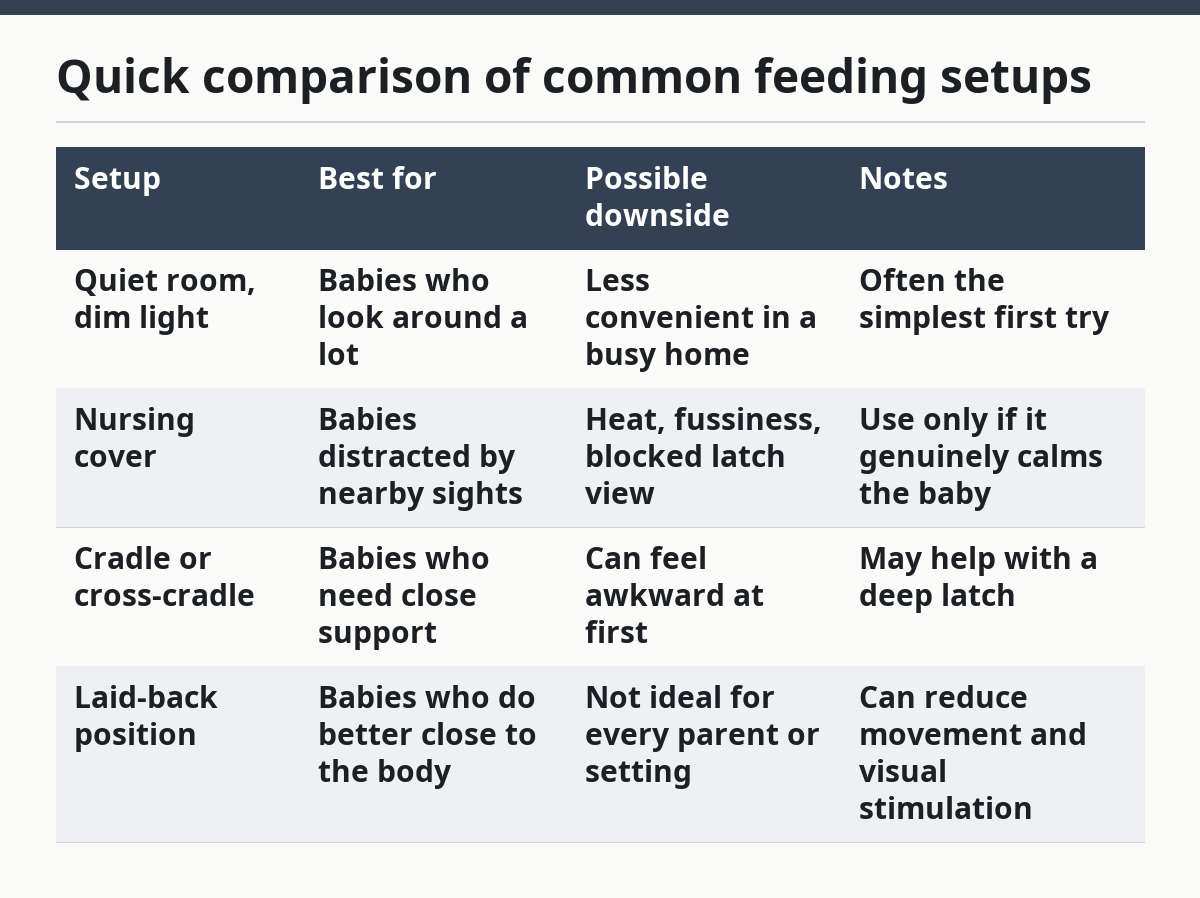
Quick comparison of common feeding setups
| Setup | Best for | Possible downside | Notes |
|---|---|---|---|
| Quiet room, dim light | Babies who look around a lot | Less convenient in a busy home | Often the simplest first try |
| Nursing cover | Babies distracted by nearby sights | Heat, fussiness, blocked latch view | Use only if it genuinely calms the baby |
| Cradle or cross-cradle | Babies who need close support | Can feel awkward at first | May help with a deep latch |
| Laid-back position | Babies who do better close to the body | Not ideal for every parent or setting | Can reduce movement and visual stimulation |
Helpful sources
- American Academy of Pediatrics: https://www.healthychildren.org
- Academy of Breastfeeding Medicine: https://www.bfmed.org
- La Leche League International: https://llli.org
Drafted with AI; not yet reviewed by a person.