
Last updated: November 19, 2026
Key Takeaways
- Toddler nursing works best when the adult sets the schedule and limits.
- Build a repeatable routine and protect your body from constant switching.
- Short, physical boundaries are easiest to repeat.
- Night nursing is often the hardest part because toddlers are tired and less able to handle “later.”
Quick Answer

Quick answer: how to breastfeed with a toddler still nursing comes down to 3 things: set 2 or 3 nursing windows, keep one repeatable phrase, and use the same bedtime and night response every time. That keeps the routine predictable for a toddler and easier on the adult.
Breastfeeding a toddler while a new baby is nursing means managing two different needs, one body, and a lot of boundary-setting. The fix is a clear routine, calm limits, and a plan for night nursing. The steps below show how to keep feeding workable without turning every day into a standoff.
Start with the part most parents miss: toddler nursing needs rules
Toddler nursing works best when the adult sets the terms. A toddler can still nurse, but the feedings need shape: where it happens, when it happens, and what happens when you say no. That keeps nursing from running your whole day.
Picture this: you are trying to feed a newborn, answer a toddler, and keep your shirt on at the same time. If nursing has become the answer to every protest, you need a simple rule set, not a long speech. A 2-minute plan beats a 20-minute negotiation.
Use these ground rules:
- Choose 2 or 3 nursing windows you can live with, such as wake-up, nap time, and bedtime.
- Name the place: couch, bed, glider, or a quiet chair.
- Keep one short phrase ready, like “Milk later” or “Milk after books.”
- If the toddler is old enough, offer a choice: water, snack, or a hug.
That structure matters even more if you are also feeding a sibling. The older child learns that milk is still available, but not on demand every time the baby cries. That is the whole game.
For general family logistics around feeding, the hub on breastfeeding and family logistics can sit beside this guide without repeating the same advice.
How do I breastfeed with a toddler still nursing?

You breastfeed with a toddler still nursing by building a repeatable routine and protecting your body from constant switching. The routine does not need to be perfect. It needs to be predictable enough that your toddler can learn it in a week or two.
Picture this: your toddler reaches for nursing the second you sit down, and the baby needs the other side. You do not need a perfect script. You need a sequence you can repeat even when you are tired, hungry, and touched out.
Follow this core procedure:
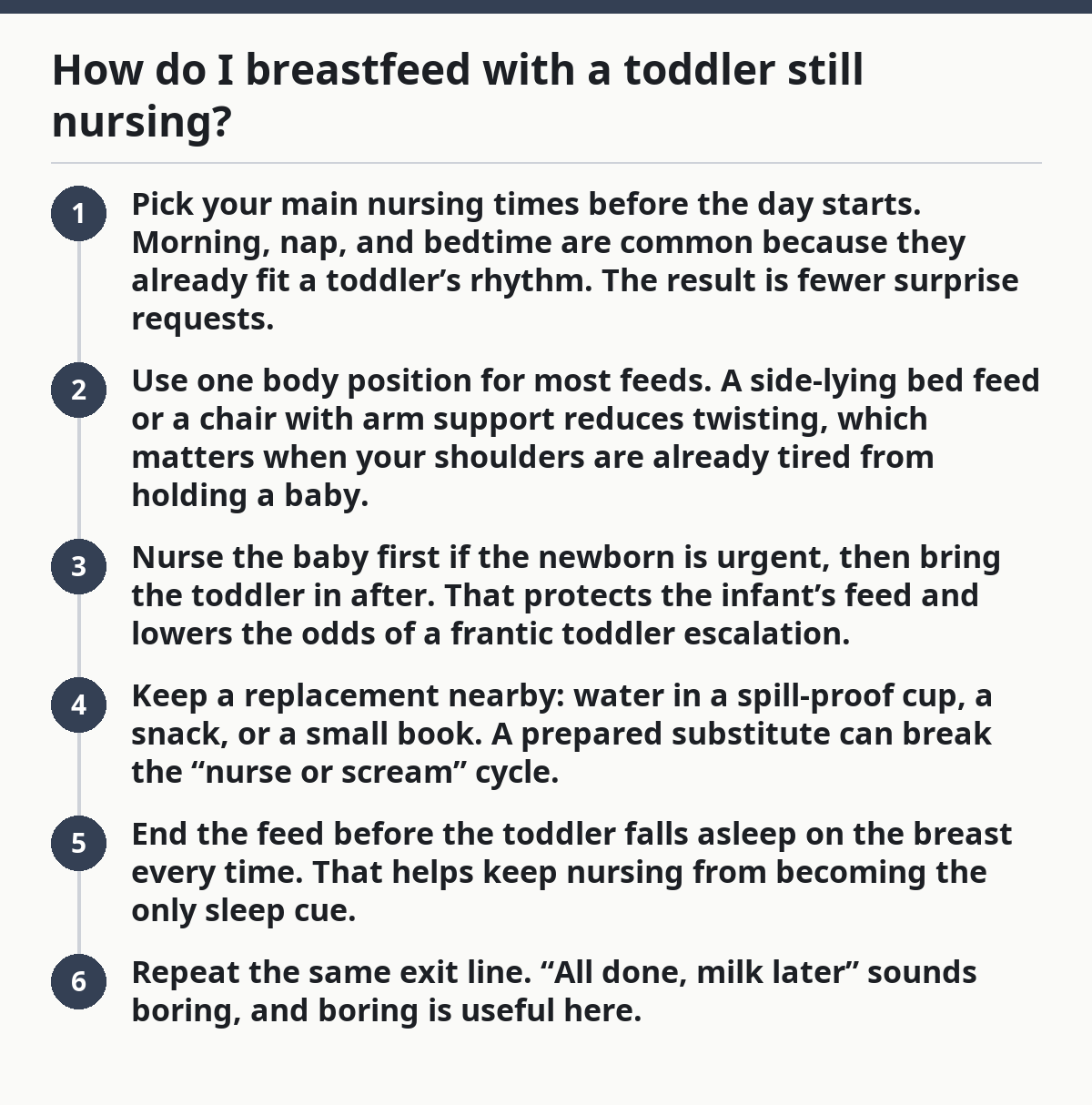
- Pick your main nursing times before the day starts. Morning, nap, and bedtime are common because they already fit a toddler’s rhythm. The result is fewer surprise requests.
- Use one body position for most feeds. A side-lying bed feed or a chair with arm support reduces twisting, which matters when your shoulders are already tired from holding a baby.
- Nurse the baby first if the newborn is urgent, then bring the toddler in after. That protects the infant’s feed and lowers the odds of a frantic toddler escalation.
- Keep a replacement nearby: water in a spill-proof cup, a snack, or a small book. A prepared substitute can break the “nurse or scream” cycle.
- End the feed before the toddler falls asleep on the breast every time. That helps keep nursing from becoming the only sleep cue.
- Repeat the same exit line. “All done, milk later” sounds boring, and boring is useful here.
That pattern gets easier once your toddler knows what happens next. A child who can predict the routine usually protests less than a child who gets a different answer every time.
If the toddler still nurses many times a day, start by trimming one feed, not all of them. A sudden change can backfire into more clinginess at night and more battles at nap time. In many families, a smaller change works better than a fast one.
What boundaries work without turning every feed into a fight?
The right boundaries are short, physical, and easy to repeat. Long explanations do not work well with a tired toddler, especially when the breast is the thing they want most. A boundary that changes by mood will not hold.
Picture this: you are in a grocery parking lot, the baby is fussing, and your toddler wants to nurse right now. This is where a boundary needs to be easy to say out loud, not clever. Keep it simple enough to say in one breath.
Use these boundary tools:
- Time boundary: “We nurse after lunch” or “Not now, after books.”
- Place boundary: only on the couch, chair, or bed.
- Body boundary: no pinching, slapping, or poking while nursing.
- End boundary: you decide when the feed ends, not the toddler.
A few practical details make these rules stick:
- If the toddler arches, kicks, or keeps unlatching, end the feed and try again later.
- If the toddler wants to nurse out of boredom, offer a snack, water, or movement first.
- If the toddler tries to lift your shirt in public or in front of guests, cover up and restate the rule in one sentence.
Here’s the catch: boundaries work better when they are paired with connection. A toddler who is getting a lot of “no” may need more cuddle time, a snack schedule, or one-on-one attention that is not nursing. That can lower the fight rate without making the breast the only comfort tool in the house.
A calm boundary is not cold. It is a safety rail.
Night nursing changes the whole picture
Night nursing is often the hardest part because the toddler is tired, half-asleep, and less able to handle “later.” The answer is not to fake perfect sleep hygiene. It is to decide what you want nights to look like before midnight makes the choice for you.
Picture this: the toddler wakes at 2 a.m., the baby is stirring, and you have already been up twice. Night feeds can become a reflex. If that happens, the toddler may start expecting milk every time they surface between sleep cycles.
A better plan looks like this:
- Decide which wakes are feeds and which are comfort only.
- Keep the same response for each wake-up.
- Use the same light, the same chair, or the same side of the bed when possible.
- If a partner is present, let them handle one wake-up response so the toddler does not always expect the breast.
Night nursing often changes more slowly than daytime nursing. That is normal. A toddler who nurses to sleep may also want milk again at each wake. If that is the pattern, start by separating milk from the final falling-asleep moment once or twice a week.
The trade-off is plain: keeping night nursing can feel easier in the short term, but it often leaves you more touched out the next day. Reducing one night feed can help, yet it may bring 2 or 3 rough nights before things settle. That is the part many generic guides leave out.
If sleep is already fragile, do not make three changes at once. Change the bedtime feed, the wake response, and the nap routine on different weeks, not the same night. One change at a time is easier to repeat.
How to handle sibling nursing without crowding out the toddler
Sibling nursing works best when each child has a known place in the line. The toddler does not need to get every feed first, but they do need to know they have a place and will not be erased by the baby.
Picture this: the newborn is at the breast, the toddler climbs into your lap, and everyone wants the same nipple at once. This is where sibling jealousy starts if you make up the rules on the fly. A simple order reduces that tension.
Use one of these setups:
- Baby first, toddler after: best when the newborn needs frequent feeds.
- Toddler first, baby after: useful if the toddler is older and the baby can wait a few minutes.
- Alternate by routine: toddler at wake-up and bedtime, baby on demand.
Make the toddler’s role concrete. They can fetch a burp cloth, choose the story, or sit next to you with a cup of water. That gives them a job without turning them into the boss of the feed.
The point is clear: clarity matters more than fairness in the emotional sense. A toddler who knows “baby first at this time, me after” often does better than one who keeps getting surprised. Surprises feel like rejection to a small child.
If the toddler starts acting out only when the baby nurses, increase their special time away from nursing. Ten focused minutes of undivided attention can do more than a whole afternoon of vague reassurance.
Common mistakes that make toddler nursing harder
The biggest mistake is letting nursing become the answer to every mood. That can create a loop where the toddler asks to nurse for hunger, boredom, fatigue, hurt feelings, and delay. Then you end up nursing constantly and resenting it.
Picture this: your toddler wants milk before breakfast, after breakfast, before a drive, after a drive, and again the second you sit down. The habit is not the problem by itself. The problem is that nothing else has a job.
Watch for these common errors:
- No routine: every feed becomes a negotiation.
- No end point: the toddler stays on the breast until they decide it is over.
- No replacement: there is no snack, cup, toy, or cuddle to bridge the gap.
- Mixed signals: some days nursing is fine, other days it is banned without warning.
A better replacement does not need to be fancy. A cold cup of water, a banana, a book, or 5 minutes of lap time can cover many of the same needs. The point is to meet the need without making nursing the only tool.
Another mistake is trying to solve every nursing issue at once. If you want fewer night feeds, fewer day feeds, and fewer shirt-pulling moments, start with one target. Otherwise the toddler just feels the change everywhere and fights harder.
If you need a way to judge whether your plan is realistic, ask one question: can I repeat this on a bad day? If the answer is no, the plan is too brittle.
When toddler nursing is working, and when it is not
Toddler nursing is working when it fits your family’s rhythm instead of ruling it. You should be able to leave the house, feed a newborn, and say no to a nursing request without every moment turning into crisis management.
Picture this: the toddler still nurses, but the feeds happen around meals, sleep, and comfort—not in the middle of every routine. That is usually the sign that boundaries are doing their job. You still have nursing, but it has shape.
Signs the plan is working:
- The toddler can wait a little.
- You can end a feed without a meltdown every time.
- Night waking is becoming less tied to nursing.
- The baby’s feeds are no longer constantly interrupted.
Signs the plan needs a reset:
- Nursing is the only way the toddler settles.
- You dread every request because the answer is always a battle.
- Night feeds are multiplying.
- You feel trapped in a loop you cannot repeat for another week.
If that second list sounds familiar, change one routine, not the whole system. Shift the bedtime feed, add a snack before nursing, or narrow the nursing window to one part of the day. Small changes are easier for a toddler to absorb.
For background on the wider family side of this, the breastfeeding and family logistics hub is the right place to branch out next. This guide stays focused on toddler nursing, boundaries, and the day-to-day rhythm that makes it livable.
How long can i breastfeed a toddler?
You can breastfeed a toddler for as long as it still fits your family and feels workable for you. There is no single clock that tells you when toddler nursing must end. The better question is whether the feeds still have a place, a pattern, and a boundary you can keep.
How do i set boundaries while nursing a toddler?
You set boundaries by choosing when, where, and how nursing happens, then repeating the same limit every time. Short phrases work better than long explanations. A toddler usually responds more to a steady rule than to a new argument each day.
Is toddler breastfeeding normal?
Yes, toddler breastfeeding is normal in many families. It often shows up as comfort nursing, sleep nursing, or a few routine feeds a day. What matters most is not the age alone, but whether the pattern still works for the child and the adult who is doing the nursing.
Drafted with AI; not yet reviewed by a person.