
Last updated: November 19, 2026
Breastfeeding storage is simplest when you keep milk cold as soon as you can, use room-temperature milk quickly, and be stricter with thawed or warmed milk than with fresh milk. If soap and water are not available, use alcohol-based hand sanitizer with at least 60% alcohol, and if freshly expressed milk will not be used within 4 days, freeze it right away, according to the CDC.
Key takeaways
- Fresh milk can sit at room temperature, 77°F or colder, for up to 4 hours.
- Refrigerated milk is the easiest option for milk you plan to use within 4 days.
- Frozen milk gives more flexibility, but thawed milk has a shorter clock.
- Once milk is thawed in the refrigerator, use it within 24 hours.
- Warmed milk and leftover bottle milk need fast use: within 2 hours.
How long can breast milk safely sit out?
Breast milk can sit at room temperature, 77°F or colder, for up to 4 hours, according to the CDC. That is the first rule to remember because it sets the pace for pumping, feeding, and cleanup.
If the milk will be used soon, room temperature is fine for a short stretch. If the milk will not be used within that window, move it to the refrigerator or freezer instead of leaving it on the counter and hoping it will still be okay later.
This is where many people lose milk without meaning to. A bottle left out while a baby naps, a bag forgotten after pumping, or milk warmed too early can all shorten the time you have left. For a premature baby, that shorter window matters even more because milk handling often has to fit around smaller, more frequent feeds.
A simple breastfeeding storage rule helps: if the milk is fresh and you know it will be used soon, room temperature works for a few hours. If you are unsure, chill it sooner rather than later. If you already know it will not be used within 4 days, freeze it right away, according to the CDC.
Should I refrigerate or freeze milk?
Refrigerate milk if you plan to use it within 4 days; freeze it if you will not, according to the CDC. That is the cleanest split and the one that keeps decision-making simple on busy days.
Refrigeration wins for convenience. It keeps milk ready for the next feed, avoids thaw time, and makes rotating the oldest milk easier. Freezing wins for time. It gives you a bigger buffer when pumping output is uneven, when travel is coming up, or when a supply needs to be set aside.
The drawback of the freezer is obvious: frozen milk is not immediately usable. It must be thawed, and once thawed in the refrigerator, it must be used within 24 hours. That makes frozen milk a better long-term holding option, not a casual backup for the same day.
The honest choice is this: use the refrigerator for milk that will be used soon, and use the freezer for milk that will not be used within 4 days. If the milk is fresh and the use date is uncertain, freezing is often the safer option. For practical guidance on storage timing, see the CDC breastfeeding storage guidance.
What is the difference between fresh, chilled, thawed, and warmed milk?
The difference is the clock, because each state has its own time limit. Fresh milk can stay at room temperature, 77°F or colder, for up to 4 hours, refrigerated milk can stay cold for up to 4 days, frozen milk can be kept for about 6 months and up to 12 months is acceptable, thawed milk from the refrigerator must be used within 24 hours, and warmed or room-temperature milk must be used within 2 hours, according to the CDC.
That sounds like a lot, but the rule becomes easier if you track the state instead of the date alone. “Fresh” means just expressed and not yet chilled. “Chilled” means in the refrigerator. “Frozen” means in the freezer. “Thawed” means completely defrosted after freezer storage. “Warmed” means no longer cold enough for long storage.
The mistake most likely to waste milk is treating all of these states the same, so it helps to follow the state-specific limits in the CDC storage chart. A bottle that has been thawed in the refrigerator is not the same as a fresh bottle from the pump. A warmed bottle is not the same as a chilled bottle waiting in the fridge. Once the milk changes state, the clock changes with it.
Room temperature, fridge, or freezer: which one should you choose?
Choose the refrigerator for most day-to-day milk, because it gives up to 4 days of storage and keeps the milk ready to use. Choose the freezer for milk you will not use within 4 days, because it extends storage to about 6 months and up to 12 months is acceptable, according to the CDC.
The room-temperature option is useful only for a short gap. It is the easiest option when a feed is imminent, but it is the least forgiving if plans change. A nap runs long, an appointment runs late, or another caregiver forgets the timer, and the 4-hour window is gone.
The refrigerator is the practical middle ground. It fits ordinary feeding routines and gives room for the day to change. The freezer is the long-range option. It is best for surplus milk, travel planning, or times when pumping and feeding schedules do not line up.
| Criteria | Room temperature | Refrigerator | Freezer | Winner for the condition |
|---|---|---|---|---|
| Safe holding time | Up to 4 hours at 77°F or colder | Up to 4 days | About 6 months; up to 12 months acceptable | Freezer for long holding |
| Speed of use | Fastest | Fast | Slowest because thawing is needed | Room temperature for immediate feeding |
| Flexibility if plans change | Low | Medium | High | Freezer for uncertain schedules |
| Risk of forgetting the milk | High | Medium | Lower for long storage, but thawing needs tracking | Refrigerator for everyday use |
| Best for milk needed the same day | Yes, if used within 4 hours | Yes | No | Room temperature or refrigerator |
| Best for milk not needed soon | No | Sometimes | Yes | Freezer |
| Requires extra planning | No | Some | Yes | Refrigerator for simple routines |
| Wastes the least milk in routine use | Sometimes | Often | Sometimes, if thaw timing is missed | Refrigerator |
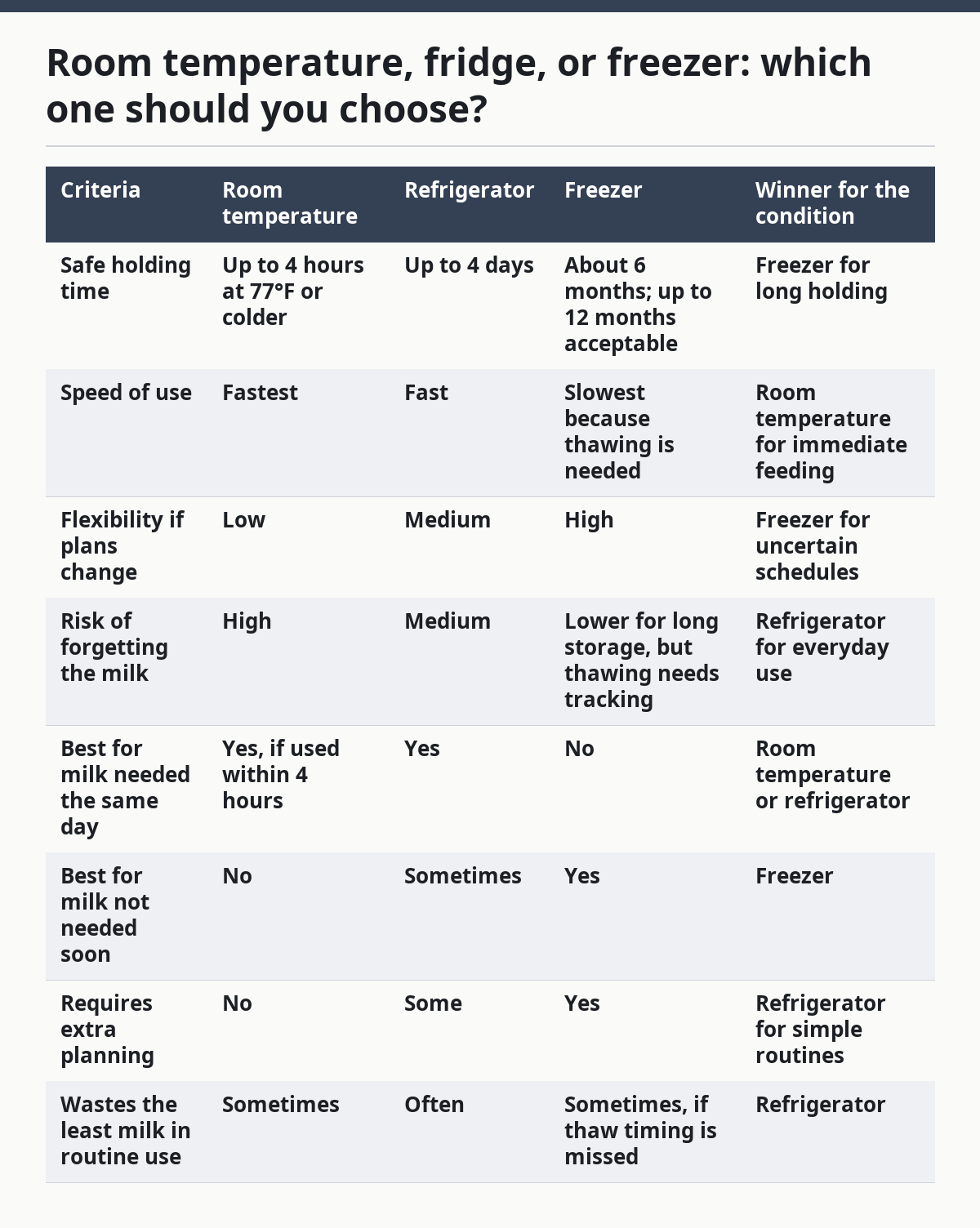
The table does not make one method “best” for every home. It shows the real trade-off: the more time you want, the more planning you must do. For many families, the refrigerator is the default and the freezer is the backup. For a family with a very irregular schedule, the freezer wins more often because it protects milk that would otherwise go unused. For related feeding and storage basics, you may also find the CDC storage guidance useful.
How should milk be handled before feeding?
Milk should be handled with clean hands, clean containers, and a clear plan for how soon it will be used. If soap and water are unavailable, use alcohol-based hand sanitizer with at least 60% alcohol, according to the CDC.
That matters before pumping, before pouring, and before feeding. Clean handling lowers the chance that the milk becomes contaminated while it is being transferred from one container to another. It also helps when several people are caring for the baby, because milk often changes hands during the day.
The most useful habit is to avoid extra transfers. Move milk into the container you plan to store it in, label it if needed for your own sorting, and put it where it belongs without leaving it out. Every extra minute on the counter eats into the safe window.
Keep the handling plan simple if you are tired. The best breastfeeding storage routine is usually the one you can still follow at 2 a.m. with one hand free. If the milk is fresh and not needed right away, chill or freeze it promptly. If it has already been warmed, use it within 2 hours.
What should I do with thawed milk?
Thawed milk should be used within 24 hours if it was thawed in the refrigerator, and that 24 hours starts when the milk is completely thawed, not when it came out of the freezer, according to the CDC. That detail is easy to miss and it changes the real deadline.
A milk bag that still has ice crystals is not fully thawed yet. The clock does not start until the milk is completely thawed. Once it is fully thawed and sitting in the refrigerator, the 24-hour window begins.
This is one of the most important rules for preventing waste. If thawed milk gets pulled out too early, it can become unusable much sooner than expected. If it stays in the refrigerator after thawing, it still must be used within that 24-hour period.
The drawback of thawed milk is that it gives less room for error than frozen or fresh milk. It is best used when the next feed is already planned. It is not the right choice for a bottle you may need “sometime tomorrow.” For more detail, see the WHO guidance on donor human milk for preterm infants, and use the CDC timing rules for home storage.
What happens once milk is warmed?
Once breast milk is at room temperature or warmed, it should be used within 2 hours, according to the CDC. That shorter window is the reason warming should happen close to the feed, not long before it.
Warmed milk is useful because many babies accept it more easily, but warmth changes the storage plan. A warmed bottle should not be treated like chilled milk that can sit around for hours. It is now on a short timer.
The same rule applies to leftovers from a bottle your baby did not finish: use that milk within 2 hours, according to the CDC. That can be frustrating, but it is safer to set a short limit than to guess later.
The practical takeaway is simple. Warm only what you expect the baby to take soon. If the bottle has already been warmed and the feed is interrupted, the 2-hour window starts then. That is not the time to save the milk for the next round.
How do I travel with breast milk?
Breast milk can be kept in an insulated cooler with frozen ice packs for up to 24 hours when traveling, according to the CDC. That makes a cooler the right choice for short trips, not a loose bag with no cold source.
A travel cooler works because it keeps milk cold away from home while still allowing access during the day. It is a useful middle option when a refrigerator is not available. The limit is important, though: this is a 24-hour solution, not a multi-day storage plan.
The simplest travel setup is usually the one that keeps milk cold from start to finish. If the trip is longer than 24 hours, or if the cooler will be opened often, the milk handling plan needs more care. At that point, move milk to a refrigerator or freezer when you can. See the CDC breastfeeding travel and storage advice for the cold-chain basics.
For a parent of a premature baby, travel planning often matters because feeds can be more frequent and more tightly timed. A cooler helps only if the ice packs stay frozen and the milk stays properly cold. If that cannot be guaranteed, it is often wiser to shorten the trip, simplify the milk plan, or avoid carrying milk that cannot be kept cold.
What changes when the baby was born premature?
For a premature baby, the safest choice is often the one that keeps milk cold, labeled, and available on time. The CDC storage limits still matter, but premature infants may have tighter feeding plans and less room for mistakes.
That is why a simple storage system is worth more than a complicated one. Fresh milk should be moved quickly if it will not be used within 4 days. Thawed milk should be tracked carefully because the 24-hour clock starts only when it is completely thawed. Warmed milk and leftover milk need to be used within 2 hours.
There is also a feeding-specific point that matters here: when mother’s own milk is unavailable, WHO recommends donor human milk for preterm or low-birth-weight infants. That recommendation is specific to this group and reflects the fact that the milk choice can matter as much as the storage rule.
This is the point where “close enough” is not good enough. For a premature baby, do not stretch a storage window, do not guess on thaw timing, and do not keep warmed milk around longer than the CDC advises. If there is any question about the feeding plan, a clinician should be consulted.
What are the biggest mistakes people make?
The biggest mistakes are leaving milk out too long, thawing it too early, warming it too early, and forgetting that leftover milk has a short life. Each of those mistakes cuts into a rule that is already fairly short: 4 hours at room temperature, 4 days in the refrigerator, 24 hours after full thawing in the refrigerator, and 2 hours once warmed.
A common error is to assume that all milk is handled the same way. It is not. Fresh milk, chilled milk, frozen milk, thawed milk, and warmed milk each have their own deadline. That is why one written note on the fridge or freezer can help more than memory alone.
Another mistake is planning around convenience instead of the milk’s actual condition. A bottle taken out of the freezer is not ready for the same kind of use as a chilled bottle. A bottle warmed early for “later” becomes a short-term bottle immediately.
The fix is boring but effective: keep the time limits visible and use the oldest usable milk first. That reduces waste and keeps the routine predictable, which is often what matters most when feeding is already demanding. Good breastfeeding storage habits also make overstocking less likely, because the milk gets used or frozen before it becomes a problem.
When should I throw milk away?
Milk should be discarded when it has passed the safe time limit for its state, because the storage clock does not pause. That means fresh milk left out beyond 4 hours, refrigerated milk kept longer than 4 days, thawed milk kept longer than 24 hours after it is completely thawed, and warmed or leftover milk kept longer than 2 hours should not be saved, according to the CDC.
Throwing milk away is disappointing, but stretching it past the limit is a worse trade. The point of storage rules is to give a clear endpoint, not a flexible one.
If the milk’s history is unclear, that is also a warning sign. If no one can tell how long it sat out, when it was thawed, or whether it was already warmed, the safest path is not to guess. The milk needs a known time line to be usable with confidence.
A simple habit helps here too: write down or remember the state of the milk, not just the date. “Pumped at 3 p.m.” is useful, but “thawed at 8 a.m.” or “warmed at 6:20 p.m.” is better because it tells you when the clock started.
What is the best storage plan for most families?
The best breastfeeding storage plan for most families is to refrigerate milk you will use within 4 days and freeze milk you will not, then keep thawed and warmed milk on a much shorter clock. That plan is the most practical because it follows the CDC’s time limits without making the routine overly complicated.
This approach works because it matches the way milk is actually used. Some milk is for the next feed, some is for tomorrow, and some is reserve milk. The refrigerator fits the first two. The freezer fits the third.
A good plan also prevents the two most common problems: overstocking the fridge with milk that should have been frozen, and warming milk before it is truly needed. Both mistakes shrink the usable time without giving any benefit back.
There is one clear exception. If the milk is for a premature or low-birth-weight infant and mother’s own milk is unavailable, donor human milk is the option WHO recommends for that group. That is a medical decision, not a storage preference, and it should be handled with professional guidance.
FAQ
How long can breast milk sit out before it needs to be cooled?
Breast milk can sit at room temperature, 77°F or colder, for up to 4 hours, according to the CDC. After that, it should not stay on the counter. If it will not be used soon, move it to the refrigerator or freezer instead of letting the clock run out.
How long is breast milk good in the fridge?
Breast milk can be stored in the refrigerator for up to 4 days, according to the CDC. That makes the fridge the best choice for milk you plan to use soon but not immediately. If you know it will sit longer than that, freeze it right away.
How long does frozen breast milk last?
Breast milk can be kept in the freezer for about 6 months, and up to 12 months is acceptable, according to the CDC. Freezing is the right option when you will not use the milk within 4 days. It gives you more time, but it also means you must plan for thawing later.
How long is thawed breast milk safe to use?
If breast milk is thawed in the refrigerator, use it within 24 hours, according to the CDC. Count that 24 hours from when the milk is completely thawed, not from the moment it left the freezer. That timing detail matters because partially thawed milk has not started the full clock yet.
Can I save leftover milk from a bottle my baby did not finish?
Leftover milk from a bottle your baby did not finish should be used within 2 hours, according to the CDC. After that, it should not be kept for later. The safest habit is to warm only what you expect the baby to take soon.
Sources
- CDC, Breast Milk Storage and Preparation | Breastfeeding
- WHO, Breastfeeding
Drafted with AI; not yet reviewed by a person.