
Last updated: November 19, 2026
Key Takeaways
- Your baby usually moves from small colostrum feeds to louder, faster milk feeds, sometimes in under a week.
- After your milk comes in, feed early, keep the latch deep, and let the first breast finish before switching.
- Swallowing should become easier to hear after let-down, then slow as the breast empties.
- Treat engorgement early, and consult a lactation professional if a too-full breast makes nursing harder for you or your newborn.
Your milk coming in can change feeding fast: breasts may feel fuller, babies may swallow differently, and feeds may get shorter. How to breastfeed after your milk comes in is mostly about feeding on cue, watching for a deep latch, and adjusting for engorgement early. The steps below show what changes, what stays normal, and what to do when the new pattern looks odd in the first 2 to 5 days after birth.
What changes after your milk comes in
Your baby usually goes from small, sleepy colostrum feeds to fuller milk feeds that look louder, faster, and sometimes shorter. That shift often happens around day 2 to 5 after birth, and it can feel abrupt.
According to the CDC, colostrum in the first days is small in volume, while milk increases as feeding continues after birth. That change can be noticeable within 48 to 72 hours.
Picture this: you’re holding a newborn who nursed for what felt like forever yesterday, and now the feed is shorter but filled with swallows. That is often the new normal, not a sign that something went wrong.
- Colostrum is thick and comes in small amounts.
- Milk coming in means volume rises and breasts feel heavier.
- Let-down may feel like a tingle, a sudden flow, or nothing at all.
- Engorgement can make breasts tight enough that latch gets harder for a day or two.
What changes most is the rhythm. A baby may pause less, swallow more, and unlatch sooner once the milk is flowing well.
How do I breastfeed after my milk comes in?
You breastfeed after your milk comes in by offering the breast early, keeping the latch deep, and letting the baby finish the first side before you switch. That usually works better than clock-watching.
The American Academy of Pediatrics and the CDC both recommend feeding on cue in the early weeks. Early feeding can help avoid a frantic latch.
Picture this: you’re trying to feed a newborn whose mouth opens wide, then shuts down when the breast is too full or too firm. The answer is not to push harder; it is to soften the breast, start the feed when hunger is early, and let the baby settle into the flow.
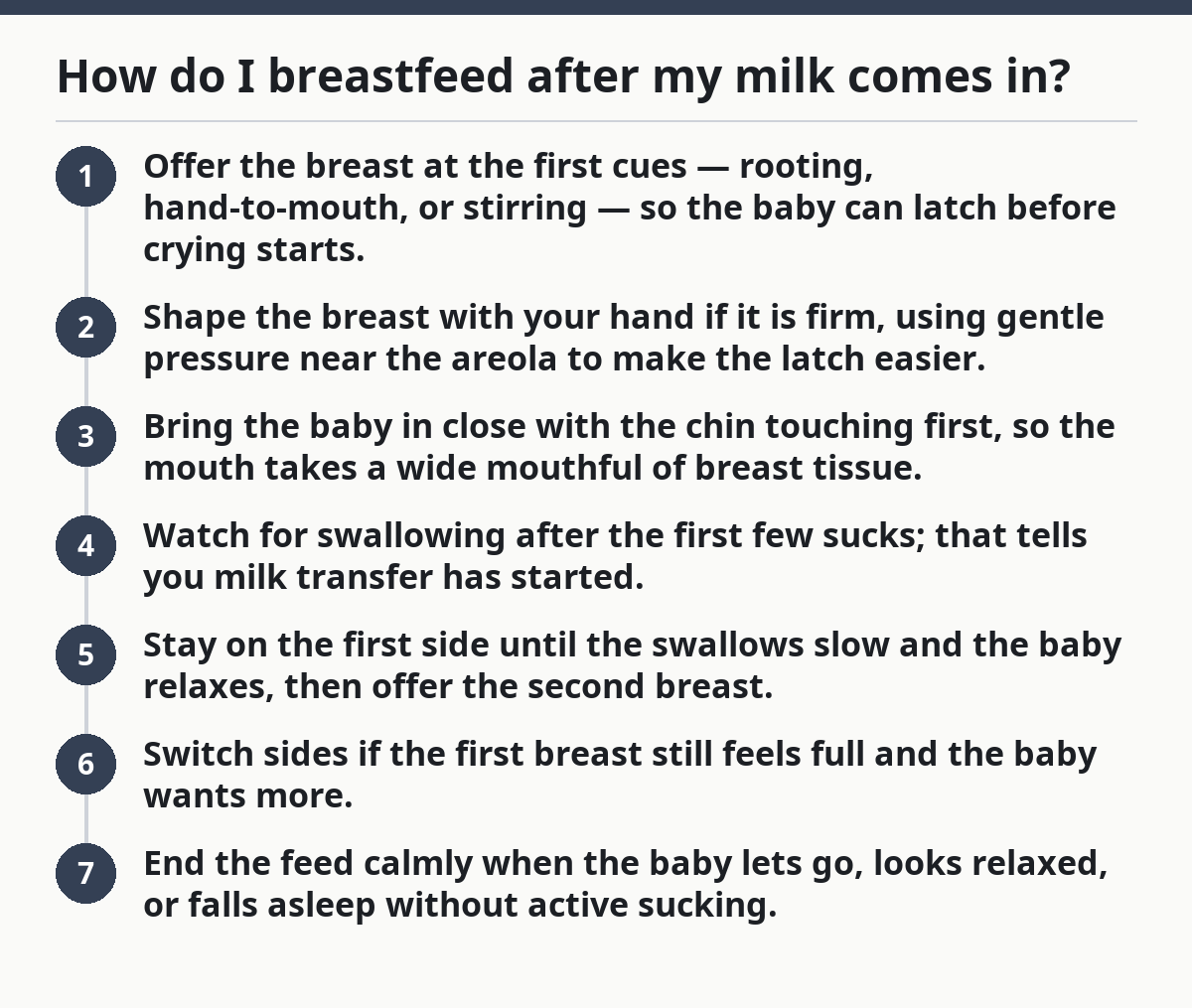
- Offer the breast at the first cues — rooting, hand-to-mouth, or stirring — so the baby can latch before crying starts.
- Shape the breast with your hand if it is firm, using gentle pressure near the areola to make the latch easier.
- Bring the baby in close with the chin touching first, so the mouth takes a wide mouthful of breast tissue.
- Watch for swallowing after the first few sucks; that tells you milk transfer has started.
- Stay on the first side until the swallows slow and the baby relaxes, then offer the second breast.
- Switch sides if the first breast still feels full and the baby wants more.
- End the feed calmly when the baby lets go, looks relaxed, or falls asleep without active sucking.
Here’s the catch: a baby who nurses 8 minutes with regular swallows may be feeding better than a baby who stays on the breast for 25 minutes with no real milk transfer. Time alone does not tell the story.
- Use a pillow if it helps bring the baby to breast level.
- Try a laid-back position if the flow feels too fast.
- If the breast is too full to latch, hand express just enough to soften the areola.
What swallowing should sound and look like now
You should hear a suck-suck-swallow pattern that becomes more obvious after let-down, then slows as the breast empties. That change is the clue many parents miss.
Picture this: you’re listening closely and wondering if every tiny pause means the feed is over. It doesn’t. Early in the feed, the baby may suck in bursts. Once milk starts flowing, the jaw movement gets deeper and the swallow becomes easier to hear.
A normal feed after milk comes in often includes:
- A burst of quick sucks at the start.
- A pause for milk flow.
- Audible swallows, sometimes with a soft swallow sound.
- Slower sucking near the end.
A baby may also unlatch, sigh, and then relatch on the same breast. That can be normal.
One mistake is expecting the same pattern every time. Feeds vary with time of day, breast fullness, and how long it has been since the last feed. Another mistake is confusing silence with failure; not every swallow is loud enough to hear across a room.
If you want a practical marker, look for a mouth that opens wide, cheeks that stay rounded, and a jaw that moves all the way down toward the chest. Those are better signs than counting every minute.
What to do about engorgement, short feeds, and too much milk
You should treat engorgement early, because a too-full breast can make nursing harder for both you and the newborn. If the breast stays very full, consult a lactation professional about the next step. The goal is comfort and flow, not emptying the breast just because it feels full.
A review in breastfeeding medicine notes that engorgement commonly appears in the early postpartum period and can interfere with latch. That is why small fixes work better than waiting for the problem to grow.
Picture this: you’re awake with heavy, tight breasts and a baby who keeps slipping off the nipple. That is the moment to make the breast easier to latch, not to wait it out.
Use these fixes:
- Feed often so milk does not keep piling up.
- Hand express a small amount before latching if the areola feels hard.
- Use brief cold packs after a feed if swelling is the bigger problem than milk removal.
- Avoid long pumping sessions unless a clinician has told you to do that for a reason.
Short feeds can be normal after milk comes in. Once the milk flows well, some babies get what they need faster and stop sooner. The trade-off is that a short feed with good swallowing is very different from a short feed with sleepy nibbling.
Early oversupply can show up as forceful let-down, coughing, pulling off, or lots of milk leaking. A very full breast is not always the best breast. It can make latch shallow and feeding messy.
- If the baby coughs at the breast, try a more upright position.
- If milk sprays hard at let-down, let the first rush spray into a cloth for a few seconds.
- If both breasts stay painfully full after repeated feeds, ask a lactation professional for help with a plan.
Is it normal for feeds to feel different after milk comes in?
Yes, feeds often feel different after milk comes in, and that change alone is usually normal. The breast gets fuller, the baby may swallow more clearly, and the feed can feel less like dribbling and more like active drinking.
According to the NIH MedlinePlus breastfeeding guidance, milk supply rises after birth as feeding continues. That shift often makes the first week feel different from the colostrum days.
Picture this: you’re used to the quiet, small-volume days, and suddenly the breast feels heavy before every feed. That can be startling. It can also make the baby act differently at the breast, especially if the flow is faster than it was with colostrum.
Here are the most common differences:
- Breasts feel heavier or firmer between feeds.
- Let-down is easier to notice or happens more than once in a feed.
- Baby may finish faster than in the first days.
- Spit-up or milk dribble may appear more often.
The first few days after milk comes in are a transition, not a final pattern. Some babies need a little time to adjust to the faster flow. Some breasts need a little time to soften before latching feels easy again.
What this does not mean is that every change is harmless. Pain that is severe, a breast that is red and hot, or a baby who cannot stay latched deserves a closer look from a lactation professional or medical clinician.
Common mistakes after milk comes in
The biggest mistakes are waiting too long to feed, switching sides too fast, and treating fullness like a problem to drain completely. Each one can make the next feed harder.
Picture this: you’re trying to “empty” the breast on a schedule, but the baby is sleepy and the latch gets worse as the areola stays tight. That approach can backfire fast.
Common errors and what they cost:
- Waiting until crying: the baby latches worse and gulps more air.
- Cutting feeds short too soon: the baby may miss the richer milk that comes later in the feed.
- Pumping a lot for comfort: the body may read that as a cue to make more.
- Ignoring engorgement for a full day: the latch can become harder, not easier.
The better move is a small correction at the right time. Offer the breast early. Soften the areola if needed. Let the baby stay on the first side long enough to get the steady milk flow.
This is also the point where support matters. The guide to breastfeeding routines and day-to-day management can help once the early transition settles into a daily pattern.
- Keep a simple feed log if the pattern feels scrambled.
- Try one change at a time so you can see what helps.
- Get help sooner if every feed turns into a battle.
How do I know if my baby is handling the change?
Your baby is usually handling the change if feeding settles into a repeatable pattern, swallowing is present, and the baby relaxes after feeds. The overall picture matters more than one noisy or sleepy session.
The AAP notes that early feeding patterns can vary, but steady intake and normal behavior over time are the better markers. One feed is a snapshot, not the whole story.
Picture this: you’re staring at a feed and wondering whether the baby is getting used to the faster milk flow or struggling with it. Look for how the baby behaves across the day, not just in one moment.
Signs the transition is going well:
- The baby latches with a wide mouth.
- Swallowing shows up during the feed.
- The baby comes off looking calmer or sleepy, not frantic.
- Feeds stop feeling like constant wrestling.
Signs the transition is not going smoothly:
- The baby cannot stay latched.
- The breast stays too firm for a good latch, even after a little softening.
- The baby coughs, sputters, or pulls off repeatedly at let-down.
- Every feed feels chaotic instead of gradually easier.
One hard truth: the first week after milk comes in can look messy even when things are okay. The body and the baby are both adjusting. If the pattern stays rough, or if you feel stuck on the same problem for more than a couple of days, a lactation professional can help sort out latch, position, and flow without guesswork.
What changes after milk comes in?
Breasts usually feel fuller, let-down becomes more noticeable, and the baby may swallow more clearly and finish feeds faster. The early colostrum pattern gives way to a milk flow pattern that can feel louder and less predictable at first.
Is it normal for feeds to feel different after milk comes in?
Yes, that change is normal for many parents. The breast is fuller, the baby may take in milk faster, and engorgement can make latch feel different for a short time. A brief adjustment period is common.
How do I know if my baby is handling the change?
The baby is likely handling it if the latch stays wide, swallowing is present, and the baby relaxes after feeds. If the baby keeps slipping off, coughing at the breast, or never seems settled, the pattern needs a closer look from a feeding professional.
Drafted with AI; not yet reviewed by a person.