
Last updated: November 19, 2026
Key Takeaways
- Build a plan around your real workday, not an ideal schedule.
- Protect the feeds at the start and end of the day, and treat milk access at work like a normal break.
- Keep morning and evening feeds steady, and make the rest of the routine simpler.
- Make sure the caregiver knows the feeding routine, container system, and usual amount per feed.
Returning to work while breastfeeding an older baby is a schedule problem, not a breastfeeding failure. How to breastfeed and care for an older baby while returning to work starts with feeds anchored to the parts of the day you control—before work, after work, and the handoff in between. In the first week, a 30-minute lunch break or an 8-hour workday can feel tight, so the plan has to fit the real hours first.
The steps below settle how to keep nursing, manage milk at work, and keep your baby fed when you are not there.
Build a return-to-work breastfeeding plan that fits real work hours
Picture this: you’re looking at your calendar, a daycare drop-off, a commute, and a work schedule that leaves no room for guesswork. You need a plan that fits the day you actually live, not an ideal one.
A good return-to-work breastfeeding plan starts with the times you can reliably feed, not with what sounds perfect. For most families, that means nursing before you leave, during any break you can predict, and again as soon as you’re back home. If your workday is 8 hours, your commute adds 30 minutes each way, and daycare closes at 6 p.m., your plan has to fit those fixed edges first.
Use a simple mapping exercise:
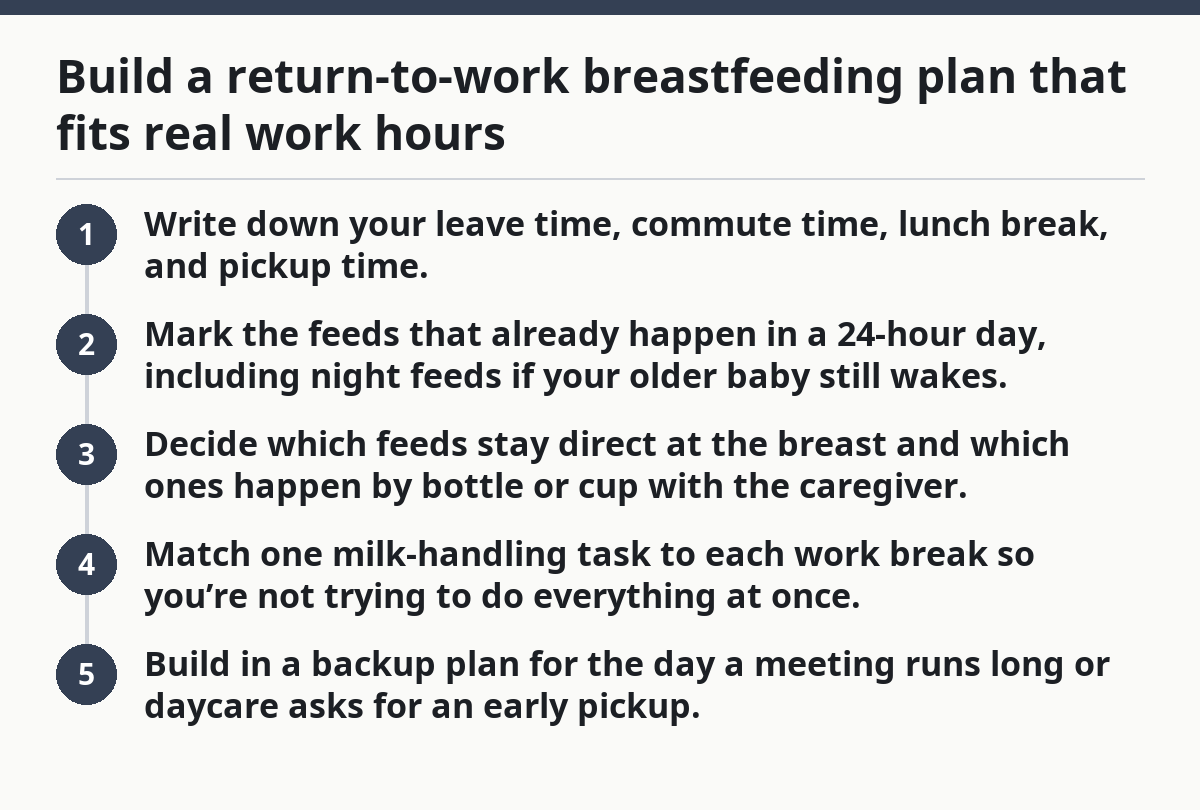
- Write down your leave time, commute time, lunch break, and pickup time.
- Mark the feeds that already happen in a 24-hour day, including night feeds if your older baby still wakes.
- Decide which feeds stay direct at the breast and which ones happen by bottle or cup with the caregiver.
- Match one milk-handling task to each work break so you’re not trying to do everything at once.
- Build in a backup plan for the day a meeting runs long or daycare asks for an early pickup.
That last step matters. A plan that only works on paper falls apart the first time your day slides by 45 minutes. The truth is, older babies are more flexible than newborns, but they still need a predictable pattern. A 30-minute lunch break is useful only if you know what happens in those 30 minutes.
A plan like this belongs alongside the rest of your family logistics, not as a separate crisis. That’s the same reason the broader breastfeeding and family logistics hub is useful: it keeps the workday, the caregiver, and the home routine in one picture.
How do I keep breastfeeding after going back to work?
You keep breastfeeding after going back to work by protecting the feeds that bookend the day and making milk access at work as ordinary as a lunch break. Even so, that routine can take a few days to settle, and it helps to check a lactation consultant or CDC guidance if the schedule feels hard. Picture this: you’re out the door before your baby is fully awake, and you get home right when the evening rush starts. The older your baby gets, the more the routine depends on timing, not willpower.
The biggest shift is accepting that your feeding pattern may look different on workdays than on weekends. Some babies nurse more at night or early morning when the parent is back at work. Others take more milk during the day from a caregiver and keep nursing at home. Both patterns can work if your baby keeps getting fed and the breast stays part of the routine.
A practical workday feeding plan usually looks like this:
- Nurse right before leaving, even if the feed is short.
- Keep milk available for the caregiver in labeled containers.
- Use a pump bag only for transport and cleaning, not as a place for loose gear.
- Feed again as soon as you reconnect after pickup or once you get home.
- Expect a few days of adjustment when the schedule changes.
The baby’s age changes the rhythm, too. An older baby may take larger, less frequent feeds during the day and make up for it with comfort nursing in the evening. That is normal. What matters is that your plan can flex without breaking.
Here’s the catch: if you try to keep the home routine exactly the same as leave, you’ll spend all day fighting the clock. It’s better to treat workdays as a second routine, not a failed version of the first. A predictable handoff beats a perfect one.
Setting up morning and evening feeds around a work schedule
You set up morning and evening feeds by making them the anchors of the day and keeping the rest of the routine lighter. The goal is not to cram in every possible nursing session; it’s to make the first and last feeds steady.
Picture this: you’re getting dressed while your baby is still sleepy, and the kitchen already has daycare bottles, a lunch bag, and your work tote waiting by the door. If the morning is chaotic, the whole day feels harder.
Morning feeds work best when they happen before the rush. Some parents nurse right after waking, then again just before leaving. Others do one longer feed and leave enough time for burping, diaper change, and the commute. The right pattern is the one that lets you walk out the door without panic.
Evening feeds deserve the same care. After pickup, many older babies want a quick reconnect before dinner, bath, or bed. If your baby is used to nursing to sleep, you may need a short bridge: nurse, then snack, then play, then bedtime. That keeps the evening from turning into one long loop of hunger and overtiredness.
Use this order of operations:
- Feed before departure so your baby starts the day settled.
- Offer expressed milk or other age-appropriate milk at daycare or with the caregiver, following your usual plan.
- Nurse or offer milk again soon after pickup.
- Keep the evening feed quiet and low-pressure so your baby can settle faster.
- Repeat the same pattern for at least several workdays before changing it.
A lot of families stumble here by aiming for a full reset on Monday. That rarely works. Once the pattern is in place, babies like repetition, and adults do too. If your commute is 20 minutes or 60 minutes, the same rule holds: protect the transition points, not every minute in between.
What should the caregiver know about feeding and handoff?
The caregiver should know the feeding routine, the container system, and how much your baby usually takes in one sitting. That handoff is what keeps the day from falling apart.
Picture this: you’re leaving for work with a pump bag, a diaper bag, and two bottles labeled for daycare. If the caregiver has to guess what goes where, every morning becomes a small emergency.
I like a handoff sheet because it removes the guesswork. It can be a note in your phone, a printed card, or a daycare form. Keep it plain and practical: what milk goes first, whether your baby prefers warm or cool milk, how your baby likes to be held, and whether the bottle should be paced.
Use this checklist for the caregiver:
- Feeding times that usually work.
- Bottle or cup preference.
- How much milk is typically offered per feed.
- What to do if the baby refuses a feed.
- How to label and return unused milk.
- When to call you about a skipped feed or a full day of low intake.
The handoff also includes behavior, not just ounces. An older baby may want a specific song, a familiar blanket, or a quick cuddle before feeding. That does not make the caregiver “spoiling” the baby. It means the baby is old enough to notice the change in setting.
A good caregiver handoff lowers stress for everyone. A baby who knows what to expect often feeds better. A parent who knows the routine is being followed can focus on work instead of checking the clock every hour. A clear handoff is worth more than a fancy setup.
Managing milk storage at work without turning your day into a logistics mess
You manage milk storage at work by keeping the process boring, labeled, and repeatable. The less decision-making you need at 3 p.m., the better.
Picture this: you’ve just finished a meeting, and your milk is in a cooler, your pump parts are in a bag, and you still have two hours left in the workday. The system has to be easy enough that you can follow it on your worst day.
This is where people often overcomplicate the routine. You do not need a dramatic cooler setup or a giant bag that takes over your desk. You need a clean container system, a place to put the milk, and a routine for getting it home safely. If your workplace has a fridge, that may help. If not, a chilled cooler in a pump bag can keep the process manageable during the workday.
Keep the handling simple:
- Label each container with the date and your baby’s name if daycare requires it.
- Put freshly expressed milk where it will stay cold right away.
- Keep clean pump parts separate from used parts.
- Pack the bag the same way every day so nothing gets left behind.
- Bring home all containers at the end of the shift.
Here’s the catch: workplace storage can become the weak link if you rely on memory. A small notebook, checklist, or phone reminder can save you from leaving a bottle in the office fridge or forgetting a lid. That kind of mistake is common and fixable, but it costs time and milk.
On the other hand, if your job has no private space, no steady break time, or no place to store milk, the plan gets harder fast. That doesn’t mean breastfeeding has failed. It means the work setup needs a workaround, and sometimes that takes a conversation with HR or a supervisor. For workplace rights and practical pumping setup, see the U.S. Department of Labor and the CDC.
Common mistakes that make workday breastfeeding harder
The most common mistakes are overpacking the day, under-sharing the plan, and expecting your baby to adapt faster than the routine does. These mistakes cost time, milk, and patience.
Picture this: you’ve made it through the first week back, but every day feels scrambled because the bottles aren’t labeled the same way, the caregiver has different instructions, and your own meals happen whenever there’s a spare minute. That is not a breastfeeding problem. It’s a system problem.
A few mistakes show up again and again:
- Leaving no margin. If your schedule has zero slack, one delayed train can wreck the whole day.
- Skipping the handoff talk. The caregiver cannot follow a plan that nobody explained.
- Changing the routine daily. Older babies settle better when the pattern stays the same for several days in a row.
- Using the pump bag as a catchall. That leads to lost parts, forgotten milk, and more cleanup at night.
- Assuming weekends will “fix” weekdays. They help, but they do not replace a workable workday rhythm.
The better move is to trim the routine until it fits a normal Tuesday. If that means one shorter morning feed, one dependable lunch break, and one evening nursing session, that may be enough. A simple routine is easier to repeat than a perfect one.
Not every family needs the same level of milk handling or the same number of feeds at work. An older baby may nurse mostly morning and evening and do fine with that pattern. The goal is a plan that holds up under ordinary stress, not one that only works in a calm house on a day off.
How to make the first two weeks back at work easier
You make the first two weeks easier by treating them as a transition period, not a final verdict. That gives you room to adjust the workday feeding plan without panic.
Picture this: you’re back at your desk, trying to answer messages while your phone buzzes with daycare updates. The first 10 workdays are often the roughest because nobody in the house has muscle memory yet.
Start with one stable routine and change only one piece at a time. If the morning feed is going well, leave it alone and work on the daycare handoff first. If your commute is the hard part, make the bag ready the night before so the morning is lighter. If evenings are rough, move the bath earlier or make the post-work feed the first thing you do when you walk in.
A few anchors help a lot:
- Prepare the daycare bag and work bag the night before.
- Put pump parts, labels, and containers in the same pocket every day.
- Keep a spare shirt or scarf at work in case of leaks.
- Eat and drink on a schedule that matches your breaks.
- Review the week on Friday and adjust one thing only.
The truth is, the first two weeks often reveal what the original plan missed. Maybe the 45-minute commute is the real problem, or the lunch break is too short, or the caregiver needs more detail about bottle amounts. That is useful information, not failure.
If the routine still feels unworkable after a few weeks, that is the point to revisit the schedule, not to blame yourself. A return-to-work breastfeeding plan should bend with real life. It should not snap when real life shows up.
How do I keep breastfeeding after going back to work?
You keep breastfeeding after going back to work by protecting the feeds you control and making the handoff as clear as possible. Nurse before work, feed again after work, and keep milk and instructions simple for the caregiver. A predictable routine matters more than a perfect one.
How many times should I pump at work?
You should pump often enough to match your day’s separation from your baby and your usual feeding pattern. For many working parents, that means fitting pumping into the breaks already built into the schedule, such as a lunch break and one other pause. If the workday is long or the commute is heavy, ask a lactation consultant for a plan that fits your situation. For practical pumping guidance, see the American Academy of Pediatrics.
How do I manage morning and evening feeds?
You manage morning and evening feeds by using them as anchors and keeping the rest of the day flexible. Feed before leaving, then again after pickup or once you get home. Keep the evening calm and repeat the same order for several days so your baby can settle into the pattern.
Drafted with AI; not yet reviewed by a person.