
Last updated: November 24, 2026
Quick answer: the fastest practical way to get help is to ask for lactation support in the hospital, keep pumping every 2 to 3 hours if baby cannot nurse yet, and use trusted sources like the CDC, WHO, La Leche League, and your baby’s care team. Premature babies often need a different plan than full-term babies, and the right help can make feeding safer, steadier, and less stressful. This article is a guide to Breast Feeding Resources: Support, Tips, and Where to Find Help: Related Questions for parents who need clear next steps.
Key takeaways
- Premature babies often start with pumping, hand expression, or mixed feeding before direct nursing works well.
- Hospital lactation staff, NICU teams, and pediatric follow-up visits can solve different problems, so one source is rarely enough.
- Trust sources that speak clearly about milk supply, latch, tube feeds, and weight gain, not just general breastfeeding slogans.
- If feeding hurts, milk is not coming in, or baby is too sleepy to feed, get help the same day.
- Online advice can help with basics, but premature babies need medical guidance for safety.
What help should I ask for first?
The first help to ask for is a lactation consultant, the baby’s nurse or neonatology team, and the pediatrician who will follow weight and feeding after discharge. Premature feeding plans change fast, and the people in the room can often adjust the plan the same day instead of sending you to search on your own.
Because this is one of the most common Breast Feeding Resources: Support, Tips, and Where to Find Help: Related Questions situations, the first question is not “How do I breastfeed like everyone else?” It is “What feeding method is safest right now?” Some babies can latch early, some need pumped milk by bottle or tube, and some switch back and forth as stamina improves. That is normal in NICU care.
If the baby is in the hospital, ask whether the team wants milk by pumping every 2 to 3 hours, skin-to-skin time, a nipple shield, or a weighted feed later on. The exact plan depends on gestational age, breathing support, and how well the baby handles suck-swallow-breathe coordination. If any of those are unclear, ask the bedside nurse to explain them in plain words. CDC breastfeeding guidance and WHO breastfeeding guidance both support using clear, practical feeding advice.
How do I build milk supply for a preterm baby?
Milk supply for a preterm baby usually depends on early and regular milk removal, not on waiting for the baby to nurse perfectly. When a baby cannot feed well yet, pumping and hand expression are the main tools that protect supply.

The first days matter because the body is learning how much milk to make. If the baby is too small or too sleepy to nurse, a pump can do the job while the baby gets stronger. Many parents do best with a simple schedule they can repeat instead of a perfect plan they cannot keep.
Specifically, a practical routine often includes:
- hand expression in the early hours if milk is not flowing yet,
- pumping on a steady schedule,
- saving every drop of colostrum,
- asking whether the hospital has a milk storage plan,
- getting help with flange fit and pump settings.
The drawback is plain: pumping is work. It can feel mechanical, lonely, and tied to the clock. It does not always build supply evenly at first, which is why support matters. If pain, low output, or long gaps between sessions are part of the picture, get help quickly instead of assuming the problem will fix itself.
For general breastfeeding guidance, the CDC breastfeeding pages are a solid starting point: https://www.cdc.gov/breastfeeding/
For global guidance on breastfeeding support and health benefits, the WHO breastfeeding topic page is also reliable: https://www.who.int/health-topics/breastfeeding
Which support source fits which problem?
The best source depends on the problem in front of you, because no single helper covers every feeding issue. A lactation consultant is usually strongest on latch, pump use, and milk supply. A NICU nurse or neonatologist is stronger on safety, feeding readiness, and when a premature baby can take more by mouth. A pediatrician is the right person for growth checks after discharge.
| Criteria | Lactation consultant | NICU team / hospital staff | Pediatrician / follow-up clinic | Winner for this condition |
|---|---|---|---|---|
| Latch help | Strong for positioning, latch, and comfort | Helpful if baby is too unstable for full feeds | Usually less detailed than lactation support | Latch pain or shallow latch |
| Pumping plan | Strong for schedule, flange fit, and milk supply | Can fit pumping into NICU routine | Can adjust if supply is dropping at home | Building supply for a preterm baby |
| Feeding safety | Not the main role | Strong for breathing, fatigue, and readiness | Strong after discharge and at follow-up | Baby is still inpatient or medically fragile |
| Weight checks | Indirect | Monitors in hospital | Strong for ongoing growth checks | Baby is home and needs follow-up |
| Tube or bottle transition | May support technique | Strongest for step-by-step transition | Follows progress over time | Baby is moving from tube to oral feeds |
| Skin-to-skin advice | Strong | Strong | Helpful, but less hands-on | Early bonding and milk support |
| Milk storage questions | Helpful | Often very helpful in hospital | Can reinforce home routines | NICU pumping parents |
| Reflux, choking, color change | Not the right source | First call for urgent feeding safety | Important after discharge | Breathing or swallowing concerns |
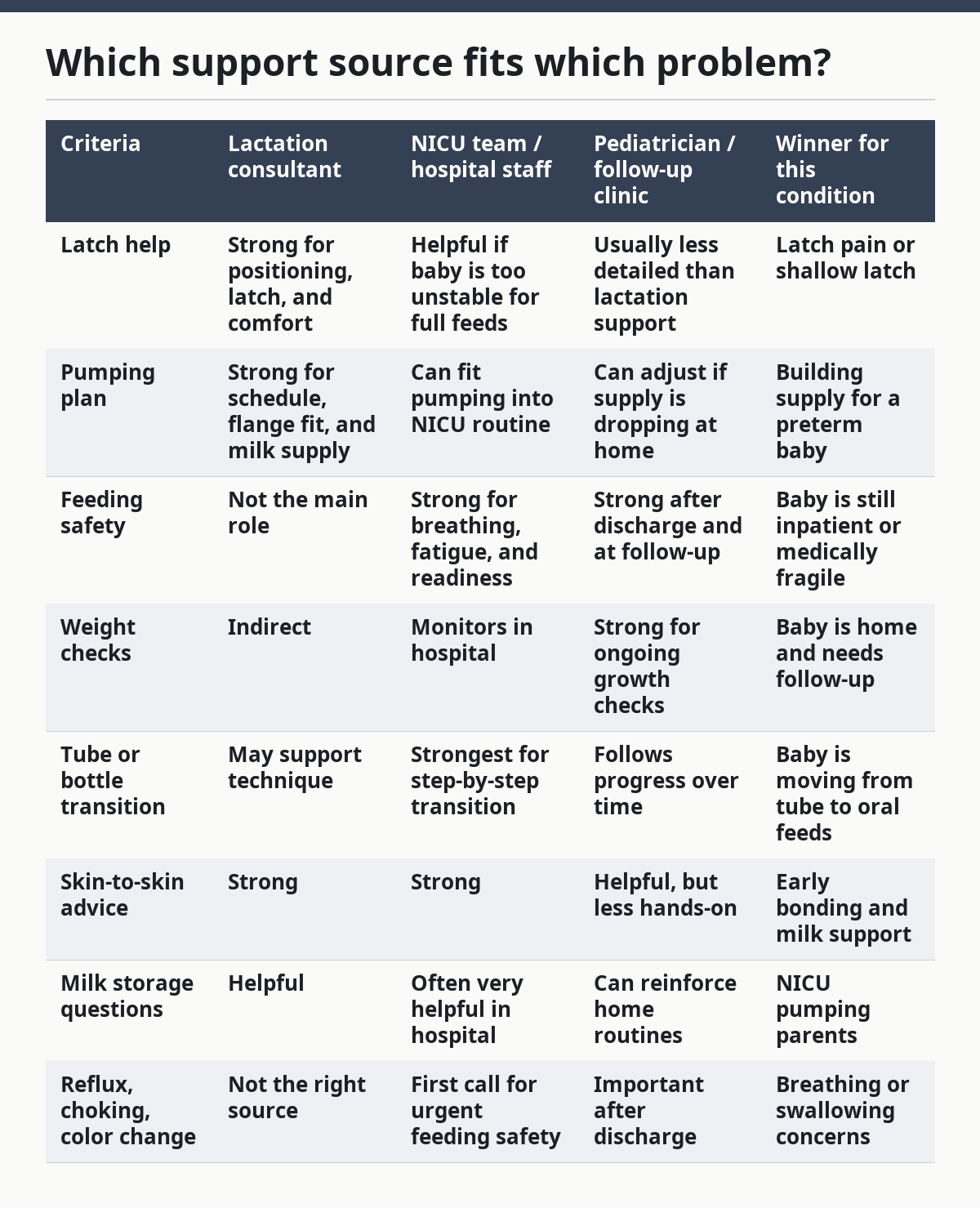
The table shows the real pattern: lactation support helps most with technique, hospital staff help most with safety, and the pediatrician helps most with growth over time. If one source seems vague, that is a sign to ask a different one, not a sign that the problem is minor. For related Breast Feeding Resources: Support, Tips, and Where to Find Help: Related Questions, the right helper depends on the issue.
What tips actually help a premature baby feed?
The tips that help most are the ones that protect stamina, milk supply, and safety at the same time. Premature babies often tire quickly, so short, calm feeds work better than long sessions that end in stress.

For example, useful habits include:
- offering skin-to-skin contact when the care team says it is safe,
- watching for early hunger cues instead of waiting for crying,
- stopping when the baby gets sleepy, shaky, or breathy,
- asking about paced bottle feeding if bottles are part of the plan,
- tracking wet diapers, stools, and weight changes as instructed.
A common mistake is pushing a premature baby to finish a feed. That can backfire because a sleepy baby may burn more energy than the feeding gives back. Another mistake is treating one bad session as proof that breastfeeding will never work; if that happens, consult a lactation professional or the baby’s clinician, because preterm babies often improve in steps rather than all at once. For preterm babies, feeding often improves in steps, not in a straight line.
If the baby is already at the breast, comfort matters. A parent who sits well, uses pillows, and keeps the baby close is usually in a better position to get a useful latch than a parent fighting pain or posture problems. The goal is not a perfect look; it is an effective feed with less strain.
Where can I find trusted breastfeeding help?
Trusted help comes from people and organizations that give clear guidance, not guilt. The safest place to start is often the hospital NICU team, board-certified lactation support if available, the pediatrician, the CDC, the WHO, La Leche League, and local hospital breastfeeding classes or support groups.
Here is the practical difference:
- Hospital NICU staff: best for feeding readiness, tube feeding, and safety signs.
- Lactation support: best for latch, pumping, sore nipples, and milk supply.
- Pediatrician: best for weight gain, jaundice follow-up, and home feeding changes.
- CDC and WHO: best for general breastfeeding guidance backed by public health standards.
- La Leche League: useful for peer support and real-life feeding questions, especially when you need a human answer after hours.
The trade-off is that online groups can be kind but inconsistent. Some posts are based on a single family’s story, not on medical advice for a premature baby. That matters because preterm infants can have feeding limits that do not apply to full-term babies. If advice sounds dramatic, absolute, or shame-based, skip it. The CDC and WHO both provide authoritative starting points for breastfeeding support, and the National Institutes of Health also hosts public health research on infant feeding: https://www.nih.gov/
When should I get help right away?
Help is needed right away if feeding hurts badly, milk suddenly drops, the baby cannot stay awake for feeds, or the baby seems to struggle with breathing while eating. Those signs are more than a confidence problem; they can point to a feeding issue that needs a clinical check.

A same-day call is also smart if the baby is not gaining as expected, has fewer wet diapers than the care team said to expect, or is vomiting in a way that worries you. For a premature baby, small changes can matter quickly, so waiting a week can be too long.
The honest limit here is that not every feeding problem can be fixed with a better position or a different nipple. Some babies need time, medical reassessment, or a change in the feeding route. That is not a failure. It is part of premature infant care.
What are the most common questions parents still ask?
The biggest follow-up questions are usually about timing, pain, and whether the baby is getting enough milk. Those questions deserve direct answers, because they shape what a parent does at the next feed.
How do I know if my premature baby is getting enough milk?
Your baby’s care team should tell you what to watch, and weight gain, diaper counts, and alertness are usually part of that plan. A premature baby may feed in small amounts at first, so “enough” depends on the baby’s medical situation, not on a general rule.
Is pumping as good as nursing for a premature baby?
Pumping is a valid and often necessary bridge when a baby cannot nurse well yet. It helps protect milk supply and lets the baby get human milk until direct breastfeeding becomes easier.

Can I breastfeed and use formula too?
Yes, mixed feeding is common for premature babies when the care team thinks it is needed. The right balance depends on weight gain, milk supply, and how much energy the baby can spend on feeds.
What if breastfeeding hurts?
Pain is a reason to ask for help, not a reason to push through. Shallow latch, poor positioning, pump issues, and nipple injury are common causes, and many of them can be fixed with faster support.
Where should I start if I feel overwhelmed?
Start with the baby’s nurse, lactation support, or pediatrician and ask for one clear feeding plan for the next 24 hours. A simple plan beats ten conflicting tips from the internet, especially with a premature baby.
Drafted with AI; not yet reviewed by a person.