
Last updated: November 26, 2026
Quick answer: call the pediatrician or NICU team right away if a premature baby has trouble feeding, breathes hard during feeds, refuses several feeds in a row, or shows dehydration signs; if the baby turns blue, pauses breathing, or seems too weak to wake for a feed, seek emergency care and follow the baby’s care plan or call a professional immediately. The topic of When to Call a Doctor About Breastfeeding a Premature Baby is about spotting the line between a rough feed and a feeding problem that needs medical help.
Key takeaways
- A preemie does not need to “power through” a bad feed. Breathing trouble, color change, or limpness are the clearest signs to get help fast.
- A single skipped or messy feed may not be an emergency on its own, but repeated refusal, weak sucking, or a dry mouth can point to a bigger issue.
- Poor weight gain matters because premature babies have little reserve and can slip behind quickly.
- If the feeding problem feels urgent at 10 p.m., call the NICU team, pediatrician, or emergency care line instead of waiting for morning.
- This page is about warning signs, not latch fixes or feeding schedules.
If you are also working on the bigger feeding plan, the main guide to breastfeeding a premature baby belongs on the hub page, not here.
What are the warning signs that need a doctor?
The warning signs that need a doctor are breathing changes, feeding refusal, dehydration signs, and poor weight gain. A premature baby can look “just sleepy” and still need medical help, so the pattern matters more than one messy session.
A call is warranted when the baby cannot stay coordinated at the breast, coughs or gulps as if milk is going down the wrong way, or seems stressed within minutes of starting. It also matters if the baby had been feeding and then suddenly stops taking the breast for 2 feeds or more, especially after a change in color, energy, or tone.
The same rule applies if you see dry lips, fewer wet diapers than usual, no tears when crying, or a soft spot that looks sunken. Those are common dehydration signs in young babies. In a preemie, dehydration can come on faster than it does in a term baby because reserve is smaller and feeds may already be hard work.
A lot of generic articles miss the real trap: not every problem is loud. A baby who is too tired to eat can be just as concerning as a baby who cries hard and arches away. If the pattern changes over 24 hours, do not wait for the next routine visit.
When should i worry about a preemie not feeding well?
You should worry about a preemie not feeding well when refusal or weak feeding lasts through more than one feed or comes with breathing, color, or alertness changes. One sleepy feed can happen after a hard night; a repeated pattern needs a pediatrician or NICU team call.
Here is a simple way to sort the problem before you call:
| What you see | What it may mean | What to do |
|---|---|---|
| Baby latches then quits quickly, several times in a row | Fatigue, poor coordination, or illness | Call the pediatrician or NICU team the same day |
| Baby refuses the breast after starting feeds normally | Pain, congestion, stress, or another medical issue | Ask for advice before the next feed |
| Baby is hard to wake and stays limp at the breast | Low energy or feeding intolerance | Seek urgent medical guidance |
| Baby takes a feed but looks short of breath or sweaty | Feeding is too hard | Stop the feed and get help |
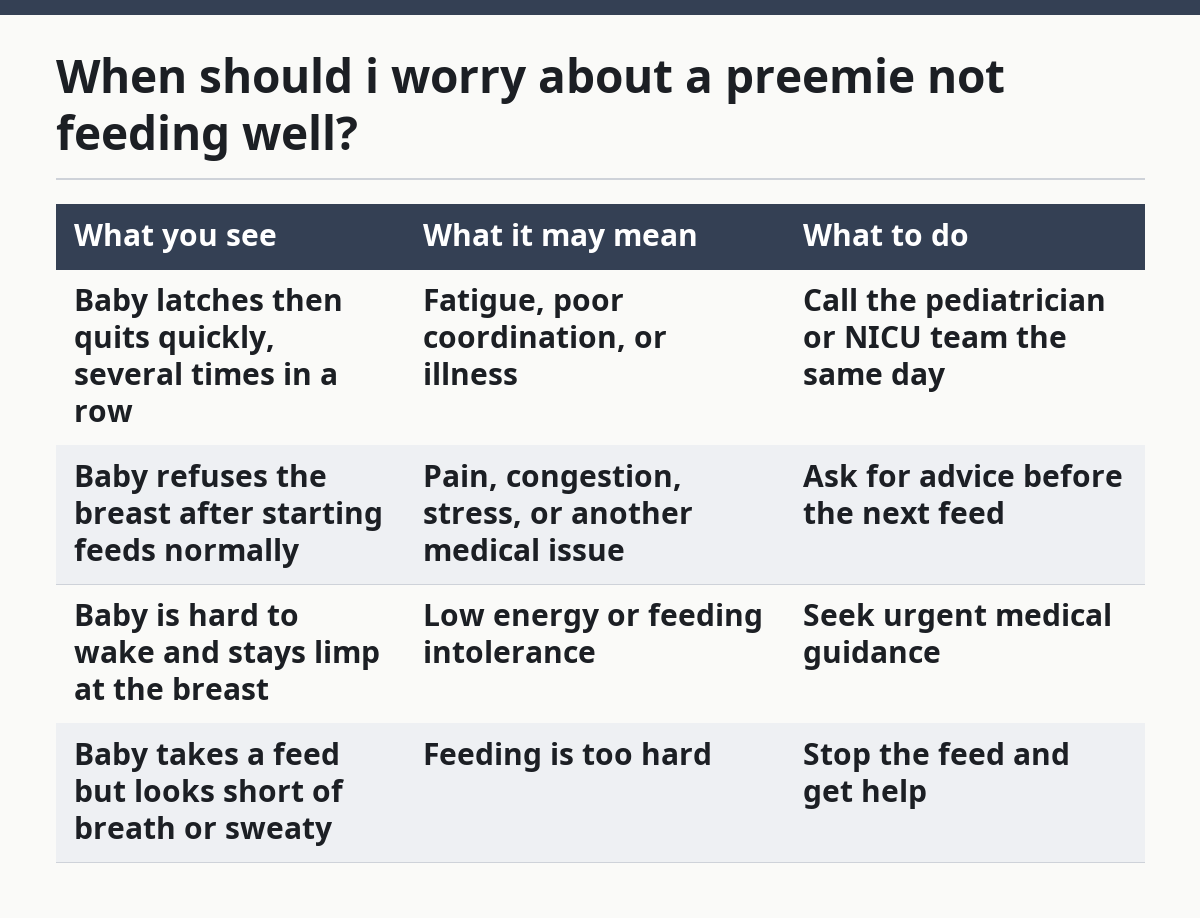
The key trade-off is this: waiting can be reasonable for one difficult feed, but not for a repeated change in behavior. A baby who refuses the breast after a 10-minute struggle may simply be having an off session. A baby who refuses every feed for half a day is giving a different signal.
Do not try to fix repeated refusal by pushing harder at the breast for long stretches. That can tire the baby more and delay the call that should happen. If refusal is new, or if the baby seems colder, weaker, or less responsive than usual, the safest next step is professional guidance.
According to the American Academy of Pediatrics, breathing trouble, blue color, or poor responsiveness in an infant should be treated urgently; if you need a refresher on emergency symptoms, the AAP parent guidance is a useful place to check while you call.
Which breathing problems during feeds are urgent?
Breathing problems during feeds are urgent when the baby pauses, works hard to breathe, turns dusky or blue, or cannot recover quickly after stopping. Any color change around the lips, tongue, or face during breastfeeding deserves fast attention.
Watch for flaring nostrils, ribs pulling in, noisy breathing, coughing fits that repeat during the feed, or a baby who seems to fight for air instead of coordinating suck-swallow-breathe. A premature baby’s feeding muscles and breathing rhythm may not be mature yet, so the problem may show up only at the breast.
If the baby improves right after you stop the feed but then shows the same trouble again when feeding restarts, that still counts as a warning sign. It means the work of feeding may be too much for the baby right now. Do not keep trying for another 20 minutes just to finish the session.
Emergency care is the right move if the baby stops breathing, has blue skin or lips, or becomes floppy. That is not a question for the next clinic slot. It is a same-minute problem.
The CDC’s breastfeeding guidance and preterm care resources both emphasize watching for feeding difficulty and poor intake in vulnerable babies, which is why breathing symptoms during a feed should not be brushed aside.
This is one of the places where a generic “watch and wait” answer goes wrong. A preemie can have small feeding setbacks that are normal, but breathing trouble during the feed is not a normal training issue. It is a safety issue.
How do dehydration signs change the urgency?
Dehydration signs change the urgency because they can mean the baby is taking in too little milk or losing fluid faster than expected. In a premature baby, dehydration signs are reason to call sooner, not later.
Look for a dry mouth, cracked lips, fewer wet diapers, darker urine, unusual sleepiness, or a soft spot that looks sunken. If the baby is also feeding less, those signs matter even more. A preemie does not have much margin for a full day of poor intake.
A common mistake is to assume “the baby was at the breast for 15 minutes, so enough got in.” Time at the breast does not always equal milk transfer, and that is why diaper output and alertness matter too. If the baby had little output and now shows dry mouth or fewer wet diapers, call the pediatrician rather than waiting for the next normal checkup.
Another mistake is to focus on one sign alone. A single dry diaper in a longer stretch may not be enough to panic over, but dry mouth plus weak feeding plus fewer wet diapers is a pattern. Patterns are what move a concern from “watch closely” to “call now.”
If you are unsure, call before dehydration gets worse. That is especially true overnight, when it is easy to talk yourself into waiting 8 or 10 more hours. Babies this small can change quickly.
What about poor weight gain?
Poor weight gain is a reason to call because it can mean the baby is not getting enough milk or is burning too much energy to feed. Premature babies need careful growth checks, and a stalled weight trend should not be brushed off as normal fussiness.
This is not about one scale reading alone. Scale-to-scale trends matter more than one number on one day. If the baby has had several feeds that seem weak, and the next weight check shows little gain, the pediatrician may want to review the feeding plan right away.
What matters most is the pattern at home and at follow-up. A baby who feeds poorly for 1 day and then rebounds is different from a baby whose feeds are weak for a week. The second pattern can point to a swallowing issue, low stamina, illness, or a need to adjust the feeding plan.
Do not wait for a big visible drop before calling. By the time a preemie looks obviously smaller or less active, the problem may already be more advanced. Early weight concerns are one of the reasons follow-up matters so much in premature feeding care.
When do i call the pediatrician, nicu team, or emergency care?
You call the pediatrician or NICU team the same day for repeated poor feeds, ongoing refusal, weak sucking, dehydration signs, or weight concerns. You call emergency care right away for blue color, breathing pauses, limpness, or a baby who cannot be roused enough to feed.
Use this simple rule of thumb: same-day medical advice for feeding patterns, immediate care for breathing and color changes. If the baby is stable but the feeding has clearly changed over 24 hours, a phone call is the right next move. If the baby looks unstable in the moment, skip the phone tree and get emergency help.
Before you call, have 4 details ready: how many feeds were poor, what the baby did at the breast, how many wet diapers you have seen, and whether there was any breathing or color change. That helps the clinician sort urgency faster. If the baby was recently in the NICU, that team may also want to hear about the feeding change.
This page is meant to help you judge urgency, not to replace a medical plan already given for your baby. Some preemies have specific discharge instructions, tube-feeding steps, or weight targets. If those instructions conflict with general advice here, follow the baby’s own care plan and call for clarification.
For a broader feeding overview, the hub page on breastfeeding a premature baby should stay open in another tab while you sort warning signs here.
What feeding problems are urgent in a premature baby?
Urgent feeding problems in a premature baby include breathing trouble, color change, limpness, repeated refusal, and clear dehydration signs. If the baby cannot stay safe while feeding, that is not a latch issue to troubleshoot for a few more minutes. It is a reason to contact the pediatrician, NICU team, or emergency care right away.
When should i worry about a preemie not feeding well?
You should worry when poor feeding is not a one-off event. If the baby refuses several feeds, seems weaker than usual, or shows fewer wet diapers over the same period, call the pediatrician the same day. A premature baby can lose ground faster than a term baby, so repeated trouble matters more than one bad feed.
What are red flags during preemie breastfeeding?
Red flags during preemie breastfeeding are blue or dusky color, pauses in breathing, coughing or choking, hard work to breathe, limpness, and feeding refusal that keeps happening. Dry mouth, fewer wet diapers, and poor weight gain also count as warning signs. If any of these show up together, do not wait for the next scheduled visit.
Drafted with AI; not yet reviewed by a person.