
Last updated: November 26, 2026
Supplementing a Premature Baby at the Breast: When and How is usually done with a supplemental nursing system, or SNS, because it keeps milk or formula coming with the latch instead of replacing it. For many premature babies, that matters because sucking, swallowing, and breathing are not well coordinated until about 34 to 36 weeks of pregnancy, according to the NHS. For related guidance, see our pages on breastfeeding a premature baby and how to express breast milk.
Key takeaways
- Supplementing at the breast keeps the nipple-hunger-suck pattern in place while adding extra milk.
- A supplemental nursing system is a key at-breast option for this, especially when the goal is to protect breastfeeding.
- Expressed breast milk is often the first supplement to consider; formula may also be used when that is the plan.
- Premature babies may need more than milk volume alone, including iron, vitamin D, zinc, or fortified feeds.
- Skin-to-skin time still matters because it supports breastfeeding, weight gain, sleep, stress control, pain relief, and body regulation.
When is supplementation recommended?
Supplementation is recommended when the care team says a premature baby needs more milk than direct breastfeeding alone can reliably provide. The usual reasons are early gestational age, weak milk transfer, low birth weight, poor coordination, or a need for extra nutrients while breastfeeding skills are still forming.

A premature baby often cannot manage the full feeding sequence at the breast right away. The NHS says babies usually do not coordinate sucking, swallowing, and breathing for feeding until about 34 to 36 weeks of pregnancy. That is why a baby can latch well and still tire out before taking enough milk.
This is also the point where a generic “just keep trying” plan can fail. If the baby spends 20 minutes latched and burns energy without getting much milk, the feed may cost more than it gives. Supplementing at the breast helps keep the breast in the picture while reducing that gap.
The supplement can be expressed breast milk or formula, depending on the feeding plan. For some premature babies, the issue is not only milk volume but also minerals and vitamins. Proper iron status at birth supports iron balance in the first 6–9 months of life, and prematurity and low birth weight raise iron deficiency risk, according to a review in PMC.
This is where a lactation consultant can help fit the plan to the baby’s size, latch, and feeding stamina. A premature baby who is stable enough to latch but not yet efficient at transfer is a better candidate for at-breast supplementation than a baby who is too sleepy, too unstable, or too frustrated to stay on the breast.
What is an SNS for a premature baby?
An SNS for a premature baby is a supplemental nursing system that delivers extra milk while the baby stays latched at the breast. It is a small feeding system with a container and tubing so the baby gets supplementation without losing time at the breast.
That matters for two reasons. First, the breast still gives the baby the feel and practice of feeding where breastfeeding is supposed to happen. Second, the baby gets extra milk without a separate bottle session that can change the rhythm of the feed.
The SNS is not the only way to supplement, but it is an important at-breast option worth knowing. A bottle can be easier to set up, but it moves the supplement away from the breast and may reduce the practice time that a premature baby needs. That trade-off is why an SNS is often chosen when the goal is to build breastfeeding, not just to feed.
A practical point: SNS setups vary. Some are simple enough to use with expressed breast milk for a short feed; others are more fiddly and take a few tries before the tubing sits right. That is normal. The drawback is handling, not the concept.
The main reason an SNS makes sense for a premature baby is alignment with the baby’s biology. Skin-to-skin contact for a premature baby helps establish breastfeeding and supports healthier weight gain, sleep, stress, pain, and body regulation, according to the NHS. An SNS works best when it is part of that larger pattern, not a stand-alone fix.
How do you supplement at the breast step by step?
Supplementing at the breast works best when the baby is warm, alert enough to feed, and positioned so the latch can stay stable for the whole feed. The goal is to give extra milk while the breast remains the feeding place.

-
Start with skin-to-skin for a few minutes. Place the baby against bare chest before the feed so the baby can settle and cue for feeding. The NHS links skin-to-skin with breastfeeding support, weight gain, sleep, stress, pain, and body regulation.
-
Prepare the supplement before latching. Use expressed breast milk or formula as directed by the feeding plan, and set up the SNS or other at-breast system so the milk is ready before the baby becomes tired. A premature baby can lose patience quickly if the setup takes too long.
-
Latch the baby first, then place the supplement. Get the baby onto the breast, then position the tubing so milk flows as the baby sucks. This keeps the breast as the main site of feeding and avoids teaching the baby to wait for a bottle nipple instead.
-
Watch for milk flow, not just sucking. The useful sign is that the baby is getting supplement while staying latched with a steadier suck-swallow rhythm. If the baby clamps, slips off, or tires within a short time, the setup may need a different tube position or a smaller flow.
-
End the feed before the baby falls apart. A premature baby that is shutting down, turning away, or becoming frantic has likely crossed the useful limit for that session. It is better to stop on a workable note than to force an exhausted feed.
-
Clean the parts after each use. Any SNS parts that contact milk should be washed and dried carefully. Tiny tubing can trap residue, so the routine matters as much as the feed itself.
Because that routine can feel complicated at first, it helps to keep the setup as simple as possible. This method is not the right fit for every family. A baby who cannot stay latched, a parent who cannot manage the tubing safely, or a plan that requires fast, repeated feeds may do better with a different supplement route for a time. The trade-off is simple: at-breast supplementation protects breastfeeding practice, but it can take more setup and patience.
Which milk should go in the supplement?
The supplement should usually be the milk or feed your care team has chosen for the baby’s current needs. The common options are expressed breast milk and formula, and the best choice depends on growth, tolerance, and nutrient goals.
Expressed breast milk is often the first choice because it keeps the feed human-milk based while the baby learns to breastfeed. It can be especially useful when the main problem is stamina rather than digestion or growth. For babies who need more energy or minerals than unfortified milk can provide, fortified expressed milk may be part of the plan.
That matters because prematurity changes nutrient needs. A review in PMC notes that iron supplementation should be adjusted for birth weight, gestational age, feeding type, catch-up growth needs, and iron status. It also notes that proper iron status at birth supports iron balance in the first 6–9 months of life, and that premature birth and low birth weight raise iron deficiency risk.
Vitamin D also comes into the picture. Neonatal vitamin D levels are about 50–70% of maternal blood levels in both term and preterm births, and because neonatal vitamin D stores depend on the mother and vitamin D half-life is 2–3 weeks, prophylaxis should start in the first few days of life, according to the PMC review.
Zinc and bone minerals can matter too. In preterm infants, blood zinc levels fall in the first months and are lower at 40 weeks post-conception than in term babies. The same review says bone metabolism biomarkers have been suggested for very low birth weight infants by 2–4 weeks after discharge, and it reports that in breastfed premature infants, the incidence is 40%, while with oral calcium and phosphorus supplementation in formula-fed infants, it falls to 16%.
Here is the short version of the trade-off:
| Option | Why it is used | Main drawback |
|---|---|---|
| Expressed breast milk | Keeps the feed human-milk based and supports breastfeeding practice | May still need fortification or other nutrients |
| Fortified expressed milk | Adds nutrients when plain milk is not enough | More steps, more planning |
| Formula | Can meet supplementation needs when breast milk is limited or not enough | Moves the plan farther from exclusive human milk |
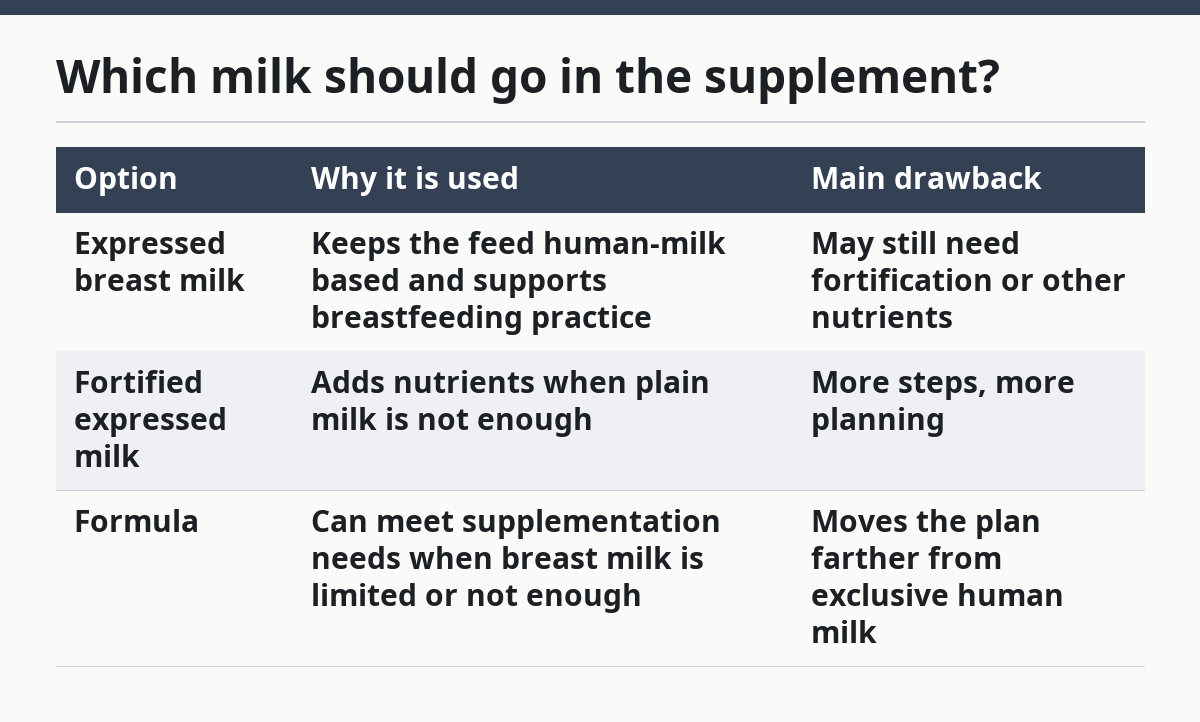
The wrong choice is the one made by habit instead of need. A premature baby may need one supplement plan this week and a different one later, especially as feeding skills improve.
What problems come up with SNS use?
The main problems with SNS use are setup, flow, and baby tolerance. Those problems are real, but they usually mean the method needs adjusting, not that supplementing at the breast has failed.
Tubing position is the most common nuisance. If the tube sits too far from the nipple, the baby may not get enough milk during the latch. If it sits poorly, it can slip, irritate the nipple, or make the feed harder than it needs to be. A small change in placement can fix a lot, but it often takes a few repetitions.
Flow is the next issue. Too little flow can leave the baby working hard for too little reward. Too much flow can overwhelm a baby who is already still learning to coordinate sucking, swallowing, and breathing. That coordination usually does not mature until about 34 to 36 weeks of pregnancy, so a baby who chokes, gulps, or shuts down may simply not be ready for the current setup.
A third issue is parent fatigue. An SNS can be more awkward than a bottle, especially at 2 a.m. when the baby is tiny and the hands are tired. That is the honest drawback of choosing at-breast supplementation: it supports the breast relationship, but it asks more of the adult at the sink and the bedside.
The best fix is usually a stripped-down routine. Keep the parts together, keep the feed order the same, and use the simplest setup that gets milk to the baby. A lactation consultant can help with latch, tube position, and whether the baby needs a different method for a while.
How do skin-to-skin and breastfeeding support fit in?
Skin-to-skin and breastfeeding support fit in because supplementation at the breast works better when the baby still has regular time at the breast and chest. The goal is not only to deliver milk, but to keep feeding cues, latch practice, and calm state control in the same routine.

The NHS says skin-to-skin contact for a premature baby helps establish breastfeeding and supports healthier weight gain, sleep, stress, pain, and body regulation. That makes it more than a comfort measure. For a premature baby, it is part of the feeding plan.
This is especially useful when the baby is too young to take every feed directly from the breast. A baby can do skin-to-skin, then latch with an SNS, then rest, without turning the feed into a series of separate tasks. That reduces handling and keeps the breast in the center of the routine.
It also helps with timing. A baby who is calmer on the chest may show better feeding cues than a baby moved repeatedly between crib, bottle, and breast. That does not guarantee a better latch, but it often gives the feed a better starting point.
The point is not to choose between supplementation and breastfeeding support. For a premature baby, those two usually need to sit together.
What is an sns for a premature baby?
An SNS for a premature baby is a supplemental nursing system that delivers extra milk at the breast while the baby stays latched. It is used when the baby needs supplementation but the goal is still to protect breastfeeding and keep feeding practice at the breast.
Can I breastfeed and supplement for a preemie?
Yes, breastfeeding and supplementation can happen together for a preemie when the feeding plan calls for it. The supplement may be expressed breast milk, fortified milk, or formula, depending on the baby’s needs and the care team’s advice. A lactation consultant can help fit the method to the baby’s latch and stamina.
When do premature babies need supplements?
Premature babies need supplements when direct breastfeeding alone does not meet their feeding or nutrient needs. That can happen because sucking, swallowing, and breathing are still immature, or because iron, vitamin D, zinc, or bone minerals need extra support. The timing and type depend on birth weight, gestational age, feeding type, and follow-up findings.
Sources
- NHS, Breastfeeding your premature baby – NHS (checked 26 Nov 2026)
- pmc.ncbi.nlm.nih.gov, Overview of Important Micronutrients Supplementation in Preterm Infants after Discharge: A (checked 26 Nov 2026)
Drafted with AI; not yet reviewed by a person.