
Last updated: November 19, 2026
Key Takeaways
- Reach out when breastfeeding problems repeat, hurt, or affect feeding, diapers, or alertness.
- A pediatrician should check feeding concerns tied to weight, hydration, jaundice, illness, or unusual sleepiness.
- Strong or ongoing feeding pain, or pain that causes cracks or bleeding, needs prompt attention.
- Lactation consultants, pediatricians, and sometimes your own clinician each handle different breastfeeding problems.
Breastfeeding problems can turn urgent fast when feeding pain, poor weight gain, or fewer wet diapers show up. Quick answer: if a breastfeeding problem lasts 24 hours, or happens 3 times in a row, get help. When to get help for breastfeeding problems is the question here, and the answer is to act early if the pain is strong, your baby feeds poorly, or diapers drop off. The steps below show what you can watch at home and when to call a lactation consultant or pediatrician.
Breastfeeding warning signs that mean you should act now

Picture this: you’ve just finished a feed, and instead of feeling unsure in a normal new-parent way, you feel a sharp pain, your baby seems drained, or the diaper count looks off. Those are breastfeeding warning signs, not something to “wait and see” for days.
The truth is, many breastfeeding hiccups settle with small changes, but some signs mean you should get help the same day. Feeding pain that stays strong through the whole feed, a baby who seems too sleepy to eat well, or a clear drop in wet diapers all deserve attention. If your baby has a fever, trouble waking, or looks dehydrated, that is not a home-fix problem. The NHS advises getting prompt help for feeding concerns, poor feeding, or signs of dehydration. NHS breastfeeding and baby care
Use this quick triage list:
- Call the baby’s pediatrician the same day if your baby feeds poorly across several feeds.
- Contact a lactation consultant if latch trouble or pain keeps repeating.
- Seek urgent care if the baby is hard to wake, breathing oddly, or has no wet diaper for many hours.
- Ask for help if your own pain is getting worse instead of better after a day or two.
A good rule: if you keep telling yourself it will pass, but nothing changes after 24 hours, that is your cue to reach out. Quiet worry is not a plan.
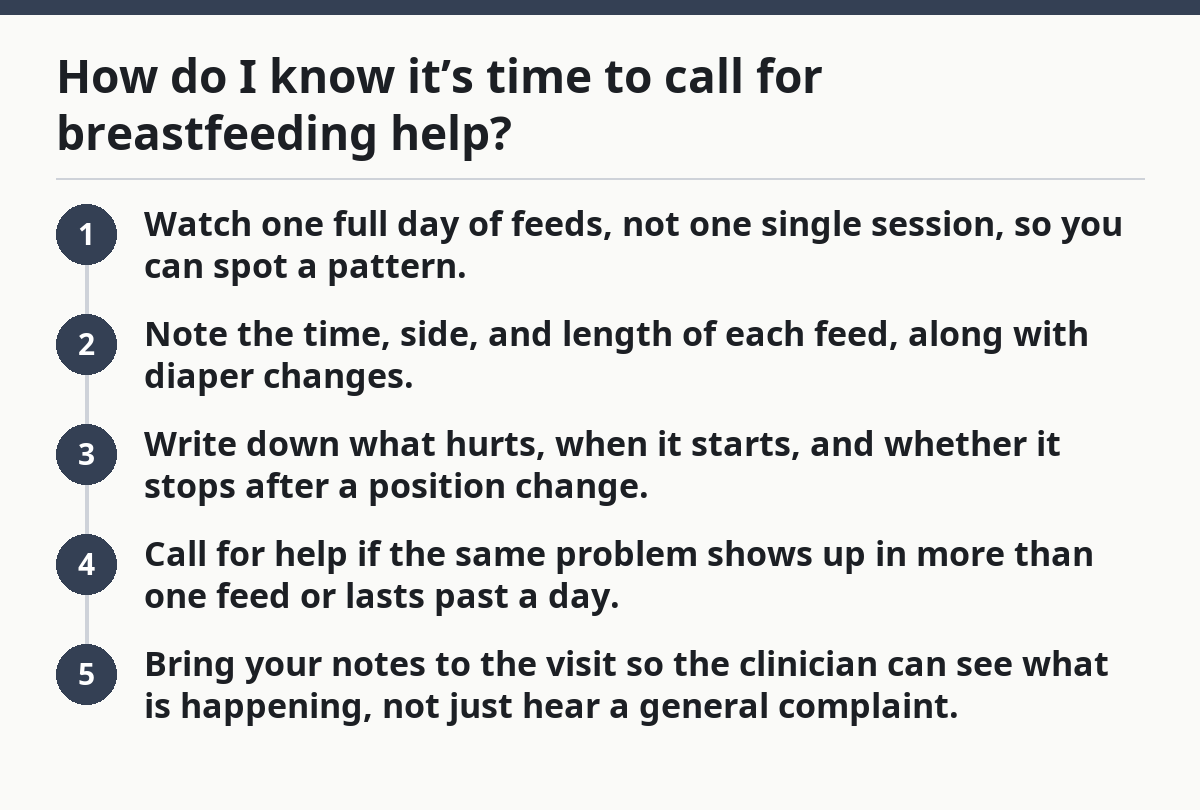
How do I know it’s time to call for breastfeeding help?
You should call for breastfeeding help when the problem is repeated, painful, or affects feeding, diapers, or your baby’s alertness. One bad feed is common; a pattern is the issue.
Picture this: you’re tracking feeds in a notebook or on your phone, and the same problem shows up 3 times in a row. That pattern means the baby is not just having an off moment. It may be a latch issue, milk transfer problem, or something your pediatrician should hear about.
Here’s a simple way to decide:
- Watch one full day of feeds, not one single session, so you can spot a pattern.
- Note the time, side, and length of each feed, along with diaper changes.
- Write down what hurts, when it starts, and whether it stops after a position change.
- Call for help if the same problem shows up in more than one feed or lasts past a day.
- Bring your notes to the visit so the clinician can see what is happening, not just hear a general complaint.
This is the point where a lot of generic advice falls short: “keep trying” is not enough when the same feed keeps ending in pain or frustration. The record helps a lactation consultant or pediatrician see the shape of the problem in minutes, not guess from memory.
What breastfeeding problems need a pediatrician visit?
A pediatrician visit is the right move when the baby’s feeding seems tied to weight, hydration, jaundice, illness, or unusual sleepiness. Breastfeeding troubleshooting is useful, but it does not replace a medical check when the baby’s health could be part of the problem.
Picture this: your baby is nursing, but the diapers are fewer than expected, the baby seems sleepy between feeds, or the weight check at the office has stalled. Weight gain concerns belong with the pediatrician, because they can signal that the baby is not taking in enough milk or has another medical issue. The CDC notes that newborns commonly have about 6 or more wet diapers a day after the first week. The same is true if the baby has a weak suck, a fever, congestion that blocks feeding, or a sudden change in tone or alertness. CDC breastfeeding basics
A pediatrician should also be the first call if:
- Your baby has very few wet diapers for the age and stage your clinician expects.
- Your baby is hard to wake for feeds.
- The baby is vomiting forcefully or repeatedly.
- The skin or eyes look more yellow.
- You are worried about dehydration, not just fussiness.
A lactation consultant can help with mechanics, but the pediatrician checks the baby’s overall status. In many cases, a feeding issue needs both kinds of help. A latch problem can look simple while hiding a weight or hydration problem underneath.
When is feeding pain a red flag?
Feeding pain is a red flag when it is strong, keeps happening, or leaves damage such as cracked nipples, bleeding, or fear of the next feed. Mild tenderness at the start of breastfeeding can happen, but pain that does not ease is not something to brush off.
Picture this: you brace yourself before every feed because you know the same pain will hit again. That pattern usually means the body is trying to tell you something. It may be a latch problem, tongue or mouth issue in the baby, a pumping fit problem, or sore tissue that needs treatment. If you are unsure, consult a professional rather than guessing.
Don’t wait if pain is coming with:
- Bleeding or deep cracks
- Fever or a hard, hot breast
- A lump that stays after feeding
- Pain that gets worse over several feeds
- A baby who pulls off, cries, or sputters at the breast
The cost of waiting is simple: pain can make you dread feeds, skip pumping, or shorten sessions, and that can snowball into more discomfort and less milk removal. Better help early than a week of avoiding feeds because every latch hurts. If pain is severe or paired with fever, call a clinician rather than trying to troubleshoot alone. The American Academy of Family Physicians recommends prompt evaluation for mastitis-type symptoms, especially when fever or breast pain is present. AAFP breastfeeding and mastitis guidance
Who can help with breastfeeding issues?
A lactation consultant, the baby’s pediatrician, and sometimes your own clinician can all help with breastfeeding issues, but they do different jobs. The right helper depends on whether the issue is mechanics, baby health, or your body.
Picture this: you need the right person, not just a sympathetic ear. A lactation consultant is often a strong first stop for latch trouble, positioning, pump fit, nipple pain, and how a feed looks in real time. A pediatrician is the right call for weight concerns, diaper changes, jaundice, sleepiness, illness, or anything that sounds like the baby may not be thriving.
A practical split:
- Lactation consultant: pain with latch, repeated slipping off the breast, pumping questions, feed observations.
- Pediatrician: weight gain, hydration, jaundice, lethargy, fever, weak suck.
- Your own clinician: fever, severe breast pain, possible infection, or symptoms in your body that need treatment.
If you can only make one call, start with the problem that looks most urgent. A baby who is hard to wake goes to the pediatrician first. A baby who feeds but hurts you every time often needs a lactation consultant fast. That choice saves time and gets the right hands on the problem sooner.
What should you do before the appointment?
You should collect a few clear details before the appointment so the visit can solve something, not just start a conversation. A short log from 24 hours is usually enough to show patterns.
Picture this: you walk in with a list instead of a blur in your head. That list helps the clinician see whether the issue is pain, milk transfer, diaper output, or a mix. It also keeps you from forgetting the one detail that might matter most.
Bring this to the visit:
- Feed times and how long each feed lasted.
- Which side you used, if that matters in the pattern.
- Wet and dirty diaper counts for the day.
- Any pain score or description, such as burning, pinching, or deep soreness.
- Recent weight checks, if you have them.
- Photos of nipple damage, if you’re comfortable sharing them.
That prep sounds small, but it changes the visit. Instead of guessing, the clinician can compare the pattern against feeding pain, latch mechanics, and weight concerns. If pumping is part of your routine, bring the pump model or flange size too. A bad fit can mimic breastfeeding trouble.
You do not need a perfect log. Even a messy note in your phone is better than trying to remember three feeds, two naps, and a crying spell from yesterday.
What can you safely wait on, and what should not wait?
You can usually wait a short time for minor soreness, one awkward feed, or a single messy diaper, but you should not wait on worsening pain, fewer wet diapers, or a baby who seems unwell. The line is simple: if the problem is getting worse, get help.
Picture this: you’re hoping it will settle by morning, but the next feed is just as hard and your baby seems less interested than before. That is the moment to stop guessing. A one-off issue can happen after a growth spurt, a long nap, or a rough night. A repeat problem is different.
Do not wait if:
- The baby is hard to wake or too sleepy to eat well
- Wet diapers drop off clearly
- You see signs of dehydration
- Pain is severe or bleeding starts
- You feel feverish, shaky, or unwell
This page belongs to the broader breastfeeding problems and troubleshooting hub, but the rule here is narrower: trust the red flags. The long view is useful; the same-day call is better when something feels off.
FAQ
When should I call for breastfeeding help?
Call for breastfeeding help when the same problem keeps showing up, pain is not easing, or feeding is affecting diapers or weight. If you are going back and forth about whether it is “bad enough,” that usually means it is time to ask. A lactation consultant can help with feeding technique, and a pediatrician should check the baby if weight or hydration is in doubt.
What breastfeeding problems need urgent attention?
Urgent attention is needed for a baby who is hard to wake, has very few wet diapers, has fever, or looks dehydrated. Severe feeding pain with fever, hot breast tissue, or a hard lump also needs prompt care. These are not problems to monitor for several days, because they can worsen quickly.
Who can help with breastfeeding issues?
A lactation consultant helps with latch, positioning, pumping, and feeding technique. A pediatrician helps when the baby has weight gain concerns, poor hydration, jaundice, or illness. If your own body has fever, severe breast pain, or signs of infection, your own clinician should be in the loop too.
Drafted with AI; not yet reviewed by a person.