
Last updated: November 18, 2026
Quick Answer: In most cases, the right latch and positioning fix comes down to one number: start by aiming for a wide gape and a deep latch within the first few seconds of attachment, because the baby should be close enough that you do not have to hold them at arm’s length. Latch, Positioning, and Comfort — The Complete Guide is about making that setup repeatable, not perfect. If nursing hurts, the baby is slipping off, or feeds drag on, the setup is usually the problem—not your body, not your baby, and not your willingness to keep trying.
A good latch puts enough breast tissue in the mouth to create a seal; good positioning helps the baby stay aligned and swallows more milk; comfort tells you the fit is working instead of causing pinching, tugging, or damage. I write about feeding and newborn care for a living, so I’ll keep this practical and plain. According to the Academy of Breastfeeding Medicine, positioning and latch problems are common reasons for breastfeeding difficulty, and getting help early can matter.
Key Takeaways
- A deep latch is the foundation. If the latch is shallow, no position can fully rescue it.
- Positioning is not about one “best” hold. It is about keeping the baby close, aligned, and supported enough to stay on the breast without strain.
- Comfort matters because pain is a warning sign, not a normal test of endurance.
- The right setup usually looks boring: baby’s head and body in one line, nose near the nipple, chin leading, and no need to lean forward.
- If feeds are painful after the first few seconds, the latch likely needs to be reset.
- A long feed is not automatically a good feed. Efficient sucking, swallowing, and relaxed shoulders matter more than time on the clock.
- If weight gain, diaper output, or nipple pain are concerns, a lactation consultant or pediatric clinician should be involved.
What a good latch actually looks like

A good latch is deep, asymmetric, and comfortable once the first suction is established. The lower jaw should take more breast than the upper jaw, the chin should press into the breast, and the nose should stay free enough to breathe without twisting the neck.
The basic signs are visible and practical. The baby’s lips should flare outward, not tuck in. The cheeks should look full, not dimpled. The jaw should move in a slow, rhythmic way, and you should hear swallowing after the initial burst of sucks. Pain may happen for the first second or two as the baby starts, but sharp pain, rubbing, or a lipstick-shaped nipple after the feed usually points to a shallow latch.
A shallow latch is often the problem behind cracked nipples, clicking sounds, frequent slipping off the breast, and feeds that seem endless without much milk transfer. A deep latch usually feels like a tug rather than a pinch. If it hurts the whole time, it is not “just newness.” That is your cue to break suction and try again.
The best single rule is this: bring the baby to the breast, not the breast to the baby. That one change protects your shoulders, keeps the baby close, and makes a deeper latch more likely. A lot of feeding trouble starts when the adult hunches over and the baby has to reach for the nipple instead of meeting it at the right height.
Why positioning changes everything
Positioning wins whenever the baby keeps sliding off, the latch keeps getting shallow, or your back and shoulders are doing too much work. It matters because position controls angle, head support, and how easily the baby can open wide. A baby can only latch well if the body is stable enough to do it.
The most useful idea is alignment. The ear, shoulder, and hip should stay in one line so the neck does not have to twist. The baby should be turned toward the breast, belly to belly, rather than lying flat on the back and reaching across the body. That alignment makes it easier to swallow and less likely to clamp down to stay in place.
Head control matters too. Support the shoulders and upper back, not the back of the head. Pushing on the back of the head can make the baby pull away from the breast or clamp harder. A gentle hold at the shoulders gives the mouth room to open wide, which is what you want before bringing the baby in.
Here is the simplest test: if you have to lean far forward, if the nipple points upward into the baby’s mouth, or if the baby keeps bobbing around before latching, the position is off. Good positioning looks unremarkable. The baby is close, the nose is near the nipple, the chin leads, and your body is supported enough that you are not bracing the feed with your arms.
The best positions for different bodies and situations

The cradle hold works when you and the baby are both relaxed and the latch is already reliable, but it is not always the easiest place to start. Cross-cradle usually gives more control for a new latch because the opposite hand supports the baby’s shoulders and neck, letting the chin lead into the breast. For many people learning to nurse, cross-cradle is the most useful teaching position.
The football hold is often a strong choice after a cesarean birth, with twins, with larger breasts, or when the baby needs extra head support. Because the baby is tucked beside you rather than across your front, there is often less pressure on an incision and more room to see the latch. The trade-off is that some people find it awkward at first and need pillows to avoid shrugging the shoulder.
Side-lying can help during night feeds or when sitting upright is uncomfortable, but it takes attention. The baby still needs to be close and aligned, and the adult still needs a safe, flat sleep environment. If you are too sleepy to stay alert, this position is not the one to use. Comfort is not worth compromising safety.
Laid-back nursing can help a baby use natural reflexes to find the breast, especially in the early weeks. The adult reclines, the baby rests on the chest, and gravity helps keep the body against you. This position can reduce shoulder strain and may help babies who fuss at the breast, but it still depends on a deep latch. A relaxed position is not the same thing as a lazy latch.
The honest side-by-side
Cross-cradle wins for control, football wins for access and incision-friendly support, and laid-back wins for relaxation and baby-led searching. Cradle is fine once feeding is established, but it is usually not the best teaching position if the latch is already shaky.
| Criteria | Cross-cradle | Football hold | Winner for [condition] |
|---|---|---|---|
| Latch control | Very high, because the opposite hand guides the shoulders and neck | High, but setup is less intuitive at first | Cross-cradle for new latch practice |
| Incision comfort after cesarean birth | Can press on the abdomen if pillows are poorly placed | Usually reduces front pressure because the baby is tucked to the side | Football hold after C-section |
| Visibility of the latch | Good, especially in front of a mirror or with help | Very good, because the baby is beside the body | Football hold when you need to see the mouth clearly |
| Shoulder and arm strain | Can be tiring if the baby is held in the air | Can also be tiring without pillows, but keeps the front clearer | Either, if pillows are used well |
| Use with twins | Hard to manage for simultaneous feeds | More practical for tandem positioning | Football hold for twins |
| Best for sleepy night feeds | Less ideal because it requires more active support | Better than cradle, but side-lying may be easier | Side-lying if safety is solid |
| Help for a baby that slips off repeatedly | Often better because you can guide the chin and shoulders | Good, but may be awkward if the baby squirms | Cross-cradle for repeated slipping |
| Suitability for a parent with back pain | Can be hard if the torso leans forward | Often easier if pillows support the arm and baby | Football hold with solid support |
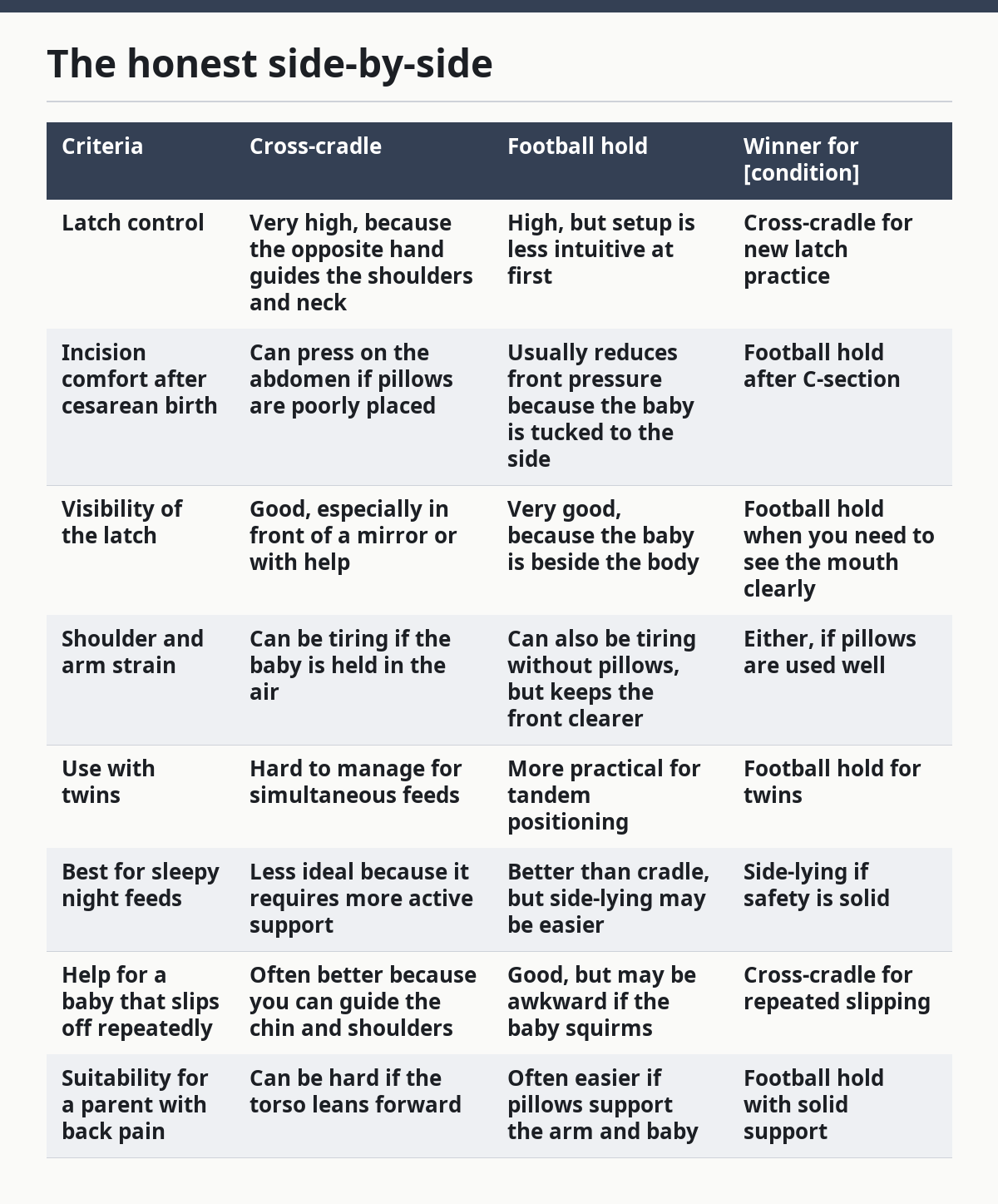
The one thing both positions share is that they fail if the baby is too far away. Distance is the enemy of a good latch. If you need to hold the baby up at arm’s length, the feed is already working against you. The fix is usually pillows, a better chair, or a different angle—not more force.
A generic article would stop here and call one hold “best.” That misses the point. The right hold is the one that solves the actual obstacle in front of you, whether that is a healing incision, a slippery latch, or a feed that leaves your shoulders locked up at the end.
How to get the baby on deeply without fighting the feed
A deep latch starts before the mouth opens. Bring the baby close, line up the nose with the nipple, and wait for a wide gape. The chin should touch first, then the lower jaw should come in with more breast tissue than the upper jaw.
If the baby is chewing on the nipple tip, break suction with a clean finger and try again. Repeated shallow attempts do more damage than one brief reset. It is better to stop and relatch three times than to spend 20 minutes grinding through a painful feed.
The “nose-to-nipple, chin first” cue works because it encourages the baby to tip the head back slightly and open wide. That wide opening matters. A baby that only grabs the nipple cannot compress the milk sinuses well enough and often causes friction at the same time. A baby that takes a deeper mouthful usually feeds with less pain and better transfer.
It also helps to aim the nipple toward the roof of the mouth rather than straight in. That angle encourages a better seal. If the latch feels shallow, try pulling the baby in closer once the mouth is open, not by pushing the nipple deeper after the mouth has already closed. The first move is the important one.
One plain warning: if your nipple comes out flattened, creased, or shaped like a new tube of lipstick, the latch was too shallow. That is not a cosmetic issue. It is evidence that the nipple was compressed against the palate or gums, and it usually predicts more pain at the next feed unless the setup changes.
What comfort really means during a feed
Comfort means the feed is stable, not effortless. You may still feel tugging, especially in the first days, but you should not feel sharp pain, rubbing, or a sense that the nipple is being pinched every time the baby sucks.
The baby’s comfort matters too, and the signs are subtle. A calm body, relaxed hands, rhythmic sucking, and visible swallowing usually tell you the baby is getting milk efficiently. A tense body, frequent slipping, repeated clicking, or frantic re-latching often means the baby is working too hard. That can happen when the position is off, the latch is shallow, or airflow is compromised by poor alignment.
Comfort is also about the rest of the body. Your feet should be supported. Your shoulders should not be shrugged up toward your ears. Your neck should not be craned forward. If the feed leaves you with aching hands or a sore upper back, the position is not really supporting the nursing relationship; it is just moving the strain from the nipple to the spine.
A common mistake is trying to tolerate discomfort because the first few seconds were hard. There is a difference between initial adjustment and ongoing pain. A brief tug at latch-on may be normal. A feed that stays painful is not. The body usually gives enough signal to tell the difference if you stop normalizing pain too early.
If a baby is consistently fussy at the breast, comfort also depends on timing and hunger level. A baby who is very hungry may latch more aggressively and less neatly than one brought to the breast early. That does not mean you have a bad baby or a bad supply. It means the timing can affect the quality of the latch.
When to change course entirely
Change course when the same position keeps producing the same problem after a few careful resets. If cross-cradle still gives you a shallow latch, move to laid-back or football. If football feels awkward and keeps compressing the breast, try cross-cradle with better pillow height. If pain persists across positions, the issue may not be position alone.
This is also the point to look beyond mechanics. A tongue-tie, high palate, nipple anatomy, oversupply, undersupply, engorgement, or a forceful letdown can all change how latch and comfort behave. None of those can be diagnosed from a paragraph, and none should be guessed at casually; if they are suspected, consult a lactation consultant, pediatric clinician, or other trained feeding professional. According to the American Academy of Pediatrics and the Academy of Breastfeeding Medicine, persistent pain or poor milk transfer deserves assessment rather than guesswork.
There are a few red flags that should move the issue out of the “keep trying at home” category: persistent cracked nipples, blood, poor weight gain, fewer wet diapers than expected, repeated choking at the breast, or pain that makes you dread every feed. Those are not signs that you just need more patience.
The same applies if the baby cannot maintain the latch without constant help. That is not a character flaw. It may mean the baby needs more support, a different position, or a medical look at oral function. A good plan is practical and specific, not guilt-based.
The verdict: which setup to choose and why
Choose cross-cradle if you need the most control over a new or shaky latch, especially in the first weeks or after repeated shallow feeds. Choose football hold if you need to protect an incision, manage twins, or see the mouth clearly while keeping the baby off your abdomen. Neither is the right choice if pain stays sharp, the nipple keeps coming out compressed, or the baby cannot stay on the breast without constant relatching.
That is the cleanest answer. Cross-cradle is the teaching position. Football is the access position. Side-lying and laid-back are useful when comfort, fatigue, or body position makes the standard holds harder to sustain.
A generic “pick what feels best” answer is too vague to help. The real decision depends on the problem you are trying to solve. If you need more control, pick cross-cradle. If you need less abdominal pressure or easier visibility, pick football. If you are too exhausted to hold the baby upright, consider side-lying only if the sleep setup is safe and you can stay alert.
When the usual advice flips
The usual advice flips when the body or the feed changes the rules. A laid-back position can beat cross-cradle if a baby fights being held tightly and does better when given time to find the breast. A side-lying feed can beat both upright holds at 2 a.m. when a parent has enough support to stay awake and safe. In those cases, the better choice is the one that lowers tension and improves the latch with less force.
A football hold or a supported laid-back position can also be easier with very large or very sensitive breasts because the tissue can be guided more precisely. The same is true if the baby has a tiny mouth or struggles to gape widely; changing angle and support may matter more than changing your own posture.
The verdict also flips when pain is not about position at all. If the nipples are injured, if latch improves but still hurts badly, or if milk transfer stays poor despite correct alignment, the problem may be oral anatomy, supply, or another feeding issue. At that point, more trial-and-error is not the answer. Getting assessed is.
Finally, if a chair, pillow setup, or feeding surface forces you into a twisted posture, the “best” nursing position on paper is the wrong one in practice. A setup that makes your back hurt for 20 minutes can make feeds harder to repeat. Comfort is not an extra feature; it is part of the feeding system.
What to watch for after the feed
A good feed ends with a softer breast, a relaxed baby, and a nipple that looks normal rather than crushed. You should not need a long recovery just to prepare for the next feed. If every feed leaves the nipple flattened or the breast still feels unsoftened and overfull, the latch or transfer needs attention.
Diaper output and weight gain matter too, though they should be interpreted with a clinician who knows newborn feeding. If the baby seems satisfied at the breast but output is low or weight gain is slow, the feed may not be transferring enough milk. A comfortable latch that does not move milk is not enough. The American Academy of Pediatrics recommends watching growth patterns rather than relying on feed length alone.
Watch for clicking, frequent popping off, or long feeds with little swallowing. Those signs point to a seal problem or poor suction. A baby can stay on the breast for a long time and still not feed well if the latch is shallow. Time alone does not prove effectiveness.
You do not need perfection. You do need repeatable results: less pain, better swallowing, and a setup you can actually use several times a day. That is what makes latch, positioning, and comfort a complete system rather than three separate pieces.
Frequently asked questions
How do I know if the latch is deep enough?
A deep latch usually feels like a strong pull without sharp pain, and the nipple comes out rounded rather than pinched. The baby’s lips should be flanged, the chin should be pressed into the breast, and you should hear swallowing once the sucking settles. If the nipple looks creased or lipstick-shaped, the latch was likely too shallow.
Is one breastfeeding position best for everyone?
No, one position is not best for everyone. Cross-cradle often helps when control is the main issue, and football hold often helps after a cesarean birth or when you need better visibility. The best position is the one that solves the problem in front of you without creating more pain or strain.
Should breastfeeding hurt at first?
A brief tug at latch-on can happen, but ongoing sharp pain should not be ignored. Pain that lasts through the feed usually means the latch is shallow, the baby is not aligned well, or there is another issue that needs assessment. If the pain keeps repeating, it is worth getting help from a lactation consultant or clinician.
Why does my baby keep slipping off the breast?
The baby often slips off because the body is too far from the breast, the latch is shallow, or the head is being held in a way that prevents a wide mouth opening. Bringing the baby closer, lining up ear-shoulder-hip, and letting the chin lead usually help. If the problem keeps happening, oral anatomy or a strong letdown may need a look, and a lactation consultant or pediatric clinician can help assess it.
When should I get professional help?
Get help if the nipples are cracked or bleeding, the pain is persistent, the baby is not gaining well, or feeds stay chaotic despite position changes. Those are not signs to wait and hope. A trained feeding professional can look at latch mechanics, oral function, and milk transfer together instead of treating each symptom alone.
Sources worth checking
The Academy of Breastfeeding Medicine publishes clinical protocols on breastfeeding management and latch-related problems. La Leche League International also has practical guidance on positioning and latch that many parents find useful. The American Academy of Pediatrics also provides guidance on breastfeeding assessment, growth monitoring, and when to seek help. For medical concerns about weight gain, hydration, or persistent pain, a pediatric clinician or lactation consultant should be involved, because internet advice cannot assess the baby in front of you.
Drafted with AI; not yet reviewed by a person.