
Last updated: November 18, 2026
Quick answer: use 3-5 minutes of gentle waking, then breastfeed a sleepy baby while watching for rhythmic sucking and swallowing. A sleepy baby at the breast can miss a full feed. Wake baby enough to latch well, keep baby skin-to-skin, and use a few short arousal steps to keep the feed active. The steps below show what to do, what to skip, and when sleepiness needs a closer look.
Key takeaways
- Start the feed when you see early feeding cues, not after a long nap has turned into deep sleep.
- Use skin-to-skin, an unswaddled baby, and a diaper change to bring baby into a lighter state before latching.
- If baby drifts off, break the cycle with a burp cloth, position change, or brief diaper check rather than just waiting.
- A sleepy feed is not the same as a weak feed; the goal is a baby who sucks, swallows, and stays engaged.
- If sleepiness is constant, hard to interrupt, or paired with other symptoms, get medical advice promptly.
How do I breastfeed a sleepy baby and keep feeds effective?

You breastfeed a sleepy baby by waking baby just enough to feed, then keeping the feed active with touch, position changes, and quick resets. A newborn often needs a little help getting from drowsy to alert; the trick is small arousal steps, not a full wake-up.
Picture this: you have a baby who opens one eye, latches for a minute, then slips back to sleep. You do not need a dramatic reset. You need a tighter routine, a cooler body, and a faster start. That usually means 3-5 minutes of gentle waking before the breast.
-
Unswaddle baby and loosen layers before you start.
Taking away the snug wrap often shifts a baby from deep sleep into light sleep. Keep the room comfortable, but let the arms move free so baby can stir. -
Hold baby skin-to-skin against your chest.
Skin-to-skin helps a sleepy baby organize breathing, rooting, and hand movement. Sit upright, chest bare if possible, and keep the head turned to one side. -
Change the diaper if baby is still hard to wake.
The diaper change adds movement, light, and a small interruption. It is a simple reset, not a punishment. -
Offer the breast as soon as you see cues.
Look for rooting, hand-to-mouth movement, or quick eye opening. Do not wait for crying if baby is already drowsy. -
Bring baby to the breast, not the breast to baby.
Support baby close to you so the head and body stay lined up. A stable position helps baby keep working instead of sliding off and dozing. -
Use a burp cloth nearby.
A burp cloth gives you a quick way to clear milk dribble and keep your hands free for a short reset if baby pauses.
You can repeat these steps during the same feed without making the baby more upset.
What wakes a baby enough to keep a feed going?
The right wake-up tools are simple: skin-to-skin, a diaper change, a cooler layer, and touch at the feet, back, or cheeks. You are trying to move baby from deep sleep to light sleep, not to full alertness for play.
Picture this: you have milk ready, but baby is floppy and slow. Start with the gentlest cue first, then move to the stronger one only if needed. That keeps the feed calm and cuts down on wasted energy.
- Rub the feet or back for a few seconds.
- Sit baby more upright before latching.
- Open the sleeper or blanket so baby is not over-wrapped.
- Switch sides if baby starts to fade on one side.
- Pause for a burp if sucking slows and baby slips into a doze.
A common mistake is to talk louder, bounce more, or keep jiggling a baby for several minutes. That can lead to fussing instead of feeding. A better move is a short, clear reset, then back to the breast.
For a very sleepy newborn, a little light often helps. Keep the room calm, not dark like a nap cave.
Keep the feed active once baby latches

You keep the feed effective by spotting drift early and interrupting it before baby drops into a nap. That means watching for pauses longer than a few sucks, heavy eyelids, and a body that goes loose in your arms.
Picture this: baby latches, sucks a few times, then goes still. Don’t wait for a long spell of silence. Move baby, change the angle, or wake baby with a small touch so the feed stays useful.
-
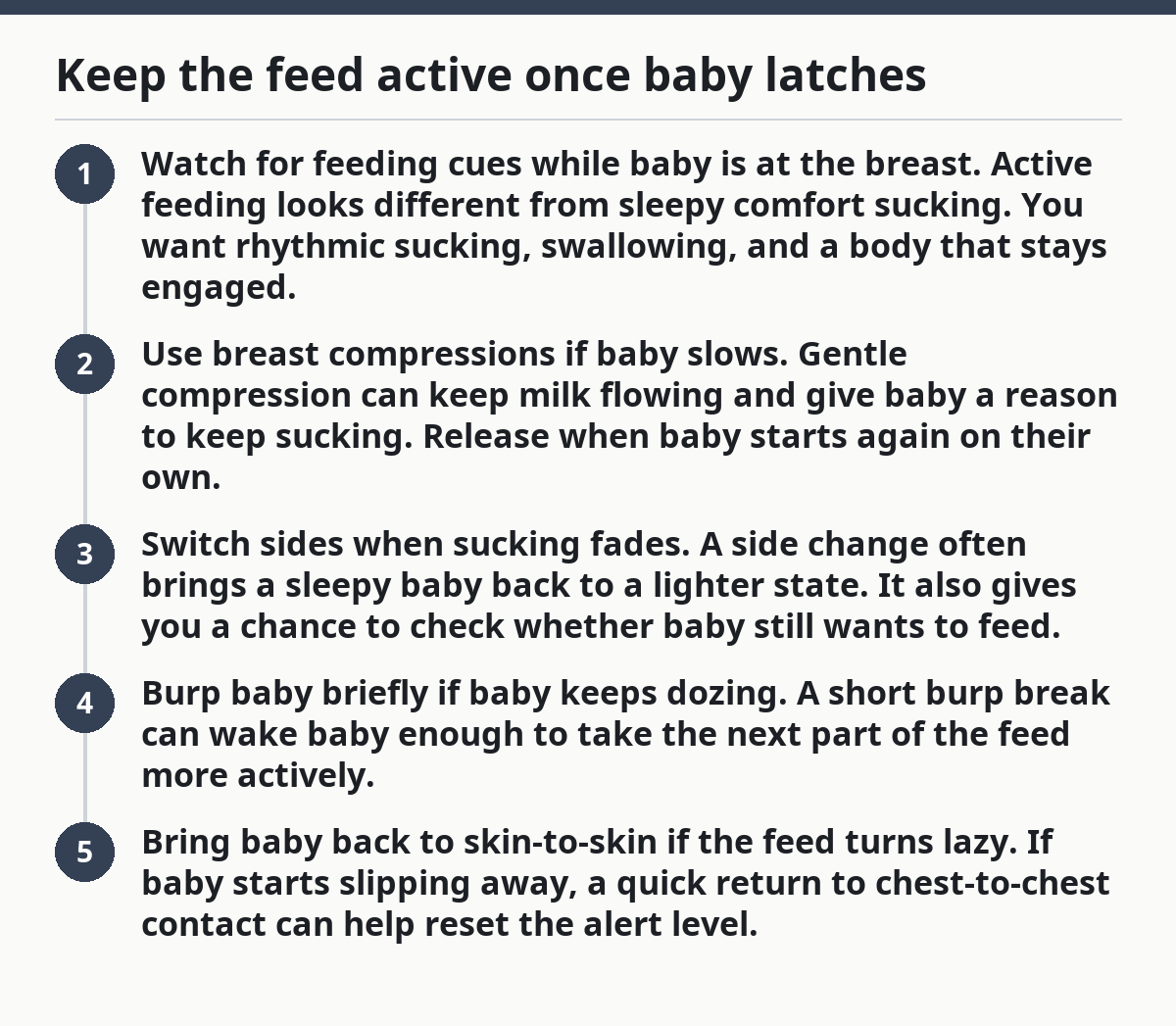
Watch for feeding cues while baby is at the breast.
Active feeding looks different from sleepy comfort sucking. You want rhythmic sucking, swallowing, and a body that stays engaged. -
Use breast compressions if baby slows.
Gentle compression can keep milk flowing and give baby a reason to keep sucking. Release when baby starts again on their own. -
Switch sides when sucking fades.
A side change often brings a sleepy baby back to a lighter state. It also gives you a chance to check whether baby still wants to feed. -
Burp baby briefly if baby keeps dozing.
A short burp break can wake baby enough to take the next part of the feed more actively. -
Bring baby back to skin-to-skin if the feed turns lazy.
If baby starts slipping away, a quick return to chest-to-chest contact can help reset the alert level.
Not every sleepy feed needs to become a long feed. Some babies feed well in short, efficient bursts. The goal is not to stretch every session out; it is to keep each session active enough to do its job.
A feed that is all flutter and no effort often needs a reset. A feed that alternates active sucking with brief rests can still be a good feed.
Signs the sleepy feed is going off track
A sleepy feed is going off track when baby cannot stay roused long enough to suck in a steady way. That is the point where the problem is no longer “drowsy” and starts to look like poor feeding.
Picture this: you’ve tried skin-to-skin, unswaddling, and a diaper change, but baby still dozes almost immediately. That is a different situation from a baby who feeds hard for a few minutes and then settles. The difference matters.
- Baby will not root or open wide after waking.
- Baby latches, then stops almost at once every time.
- Baby seems limp, hard to rouse, or hard to keep awake between attempts.
- Baby feeds poorly on repeated tries across the day.
- Baby has fewer obvious feeding cues than you expect for the time since the last feed.
A common error is to blame every sleepy session on normal newborn behavior. Sometimes that is true. Sometimes it is not. If the baby is unusually hard to wake, refuses several feeds in a row, or seems weaker than usual, contact a pediatric clinician or lactation professional.
The truth is, sleepiness can be normal early on, but it should not keep you from seeing some active feeding. When baby cannot move into that active state after a few reset attempts, stop guessing and get help.
How to fit sleepy feeds into a newborn day
You fit sleepy feeds into the day by feeding on cues, keeping the setup simple, and avoiding long waits between attempts. A newborn may need repeated short feeds, not one giant session.
Picture this: your day is full of naps, diaper changes, and short windows when baby seems awake. That is normal. The job is to catch those windows early and use the same routine each time so the body learns what comes next.
- Keep a burp cloth at arm’s reach at every feed.
- Start with skin-to-skin if baby seems drowsy.
- Use a diaper change as your first reset when needed.
- Feed before baby becomes deeply asleep from a long nap.
- Use the same chair, pillow setup, and lighting when possible.
A predictable setup helps because sleepy babies do better with fewer extra steps. If you spend five minutes arranging blankets and pillows, baby may drift deeper before the feed even starts. A simple chair, a solid armrest, and a ready burp cloth work better than a perfect setup you cannot repeat.
Do not keep prodding a baby for a long time if baby is too sleepy to eat. Make a few waking attempts, try the feed, and if baby still cannot stay with it, look at the bigger picture rather than forcing it.
What not to do with a sleepy baby at the breast
Do not keep trying the same sleepy latch over and over without a reset. That usually wastes time and leaves both of you frustrated.
Picture this: baby keeps slipping off, eyes closed, body loose. It is tempting to stay in the same position and hope for a better latch by sheer persistence. That is usually a dead end.
- Don’t leave baby tightly swaddled during the attempt.
- Don’t wait for crying if baby is already showing early feeding cues.
- Don’t keep the room overly warm if baby is too drowsy to wake.
- Don’t force a long session when baby is barely awake.
- Don’t confuse comfort sucking with a full feed if baby is drifting off fast.
One honest limitation: a sleepy baby who needs frequent waking is not a topic to manage by habit alone. If the pattern is new, extreme, or paired with poor tone or very weak wakefulness, get medical guidance. The guidance should be prompt.
Why is my baby too sleepy to breastfeed?
A baby may be sleepy for ordinary reasons, like a long nap, a warm room, or newborn sleep patterns. The answer is sometimes simple and temporary. If the sleepiness is unusual, hard to interrupt, or happens at many feeds in a row, it deserves attention from a pediatric clinician or lactation professional.
A sleepy feed can also follow a hard day, a growth spurt, or a long stretch between feeds. The key is whether baby can wake with skin-to-skin, a diaper change, and a few minutes of gentle arousal. If those steps don’t help, don’t keep pushing alone.
How do I wake a baby to feed?
You wake a baby to feed by using light, touch, and position changes before offering the breast. Start with skin-to-skin, then unswaddle, then try a diaper change if baby is still hard to rouse. The goal is to reach a light-alert state, not a fully awake, playful state.
If baby still won’t engage, pause and try again after a short break. A calm, repeated routine works better than lots of stimulation at once.
When is sleepiness during feeds a concern?
Sleepiness during feeds is a concern when baby is hard to wake, cannot stay active at the breast, or feeds poorly over and over. The first sentence matters: repeated hard-to-wake feeds are not something to brush off.
If baby seems unusually limp, uninterested, or very difficult to rouse, call a pediatric clinician promptly. If the pattern is mild and baby wakes with simple steps, it may just be normal newborn sleepiness, but persistent changes still deserve a closer look.
More help from trusted breastfeeding resources
The CDC explains that newborn feeding often happens 8 to 12 times in 24 hours, and that cue-based feeding matters for milk intake and supply. La Leche League International also notes that sleepy newborns may need waking help at the breast, especially in the early days.
Drafted with AI; not yet reviewed by a person.