
Last updated: November 19, 2026
Key Takeaways
- A repeatable night feeding routine can reduce wakefulness; if you have concerns, check with a lactation consultant or pediatrician.
- Keep the steps short and familiar, with low light, less talking, and minimal movement.
- A low-light setup works best when it limits both brightness and unnecessary motion.
- Side-lying feeding can reduce movement at night, but it is not right for every parent or baby.
Night nursing can feel like a trap: you want to feed the baby fast, keep the lights low, and get back to sleep without feeling wired. How to nurse in the middle of the night without fully waking up comes down to a simple night feeding routine with a dim night light, everything within arm’s reach, and a position that lets you stay half-asleep. The steps below show how to set it up, what to do with a sleepy baby, and where people usually lose sleep.
Set up a night feeding routine before you need it

Because 2 a.m. is not the time to improvise, set up a night feeding routine before the first cry. A routine like this can help your body treat each wake-up as familiar, but if sleep disruption is severe or persistent, check with a lactation consultant or pediatrician.
Start with the bed or chair you already use most nights. Put a night light, water, burp cloth, phone charger, and pillow support where your hand can reach them without turning on a ceiling light. A dim lamp is better than a bright overhead light because bright light tells your brain it’s morning. The goal is not perfect organization. It’s fewer decisions.
If you need to stand up, rummage, or scroll for instructions, you’re already more awake than you want to be. Keep the diaper, wipes, and spare shirt in the same place every night so you can move on instinct. A 2022 NIH review noted that light exposure at night can delay sleep timing and reduce sleep quality, which is why the setup matters.
Use this setup checklist:
- Place a low, warm night light near the bed.
- Keep one pillow or nursing pillow ready for pillow support.
- Set out a burp cloth, water, and diapers before sleep.
- Keep a small basket for wipes, nipple cream, and a spare onesie.
- Leave the room as dark as you can while still seeing baby’s face.
A good setup should make the whole feed feel boring. That is the point.
How do I nurse in the middle of the night without fully waking up?
You do it by moving through the same short steps every time, with as little light, talking, and shifting as possible. A repeatable night feeding routine can help reduce how alert you feel after each wake-up, and if you are struggling to stay asleep between feeds, a lactation consultant or pediatrician may help.
Use this sequence:
- Keep the light low and stay in the same spot.
- Bring baby to the breast before you sit up too much.
- Use pillow support so your arms and shoulders stay loose.
- Latch baby while your movements are slow and small.
- Keep the feed quiet and brief unless baby clearly wants more.
- Resettle baby in the same place, then lie back down right away.
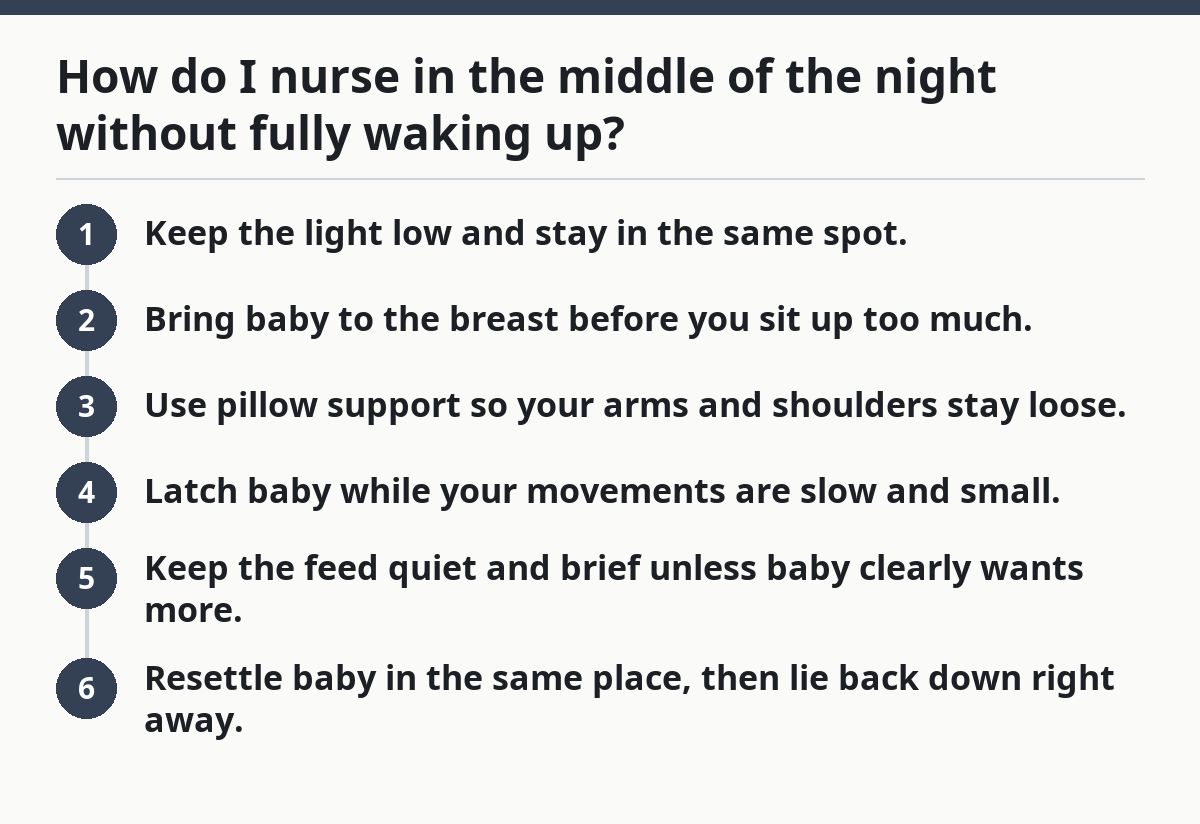
The first two steps matter most. If you sit up fully, turn on a bright lamp, or start talking, your brain gets the message that it’s time to be alert. That makes the return to sleep harder than the feed itself.
A sleepy baby often latches best when you keep the room calm and your hands steady. Don’t chase a perfect latch with frantic motion. Bring baby close, wait for a wide mouth, and let the mouth open on its own if you can.
If the baby dozes off fast, that may be enough. If sucking turns shallow or baby keeps slipping off, adjust once or twice, then pause. Repeated fiddling usually wakes both of you more than a firm, quiet reset.
The safest low-light feeding setup

A low-light setup works best when it reduces movement as much as it reduces brightness. The night light should let you see baby’s face and your hand position without forcing your eyes wide open.
Keep the bed clear of loose blankets, pillows, and clutter near baby’s face. If you feed in bed, make the surface as simple as possible before you start. A lamp with a soft bulb or a small plug-in light beats a phone flashlight, which is too harsh and keeps your eyes awake.
The simplest setup is often the safest because it removes extra steps. No balancing a phone in your mouth. No reaching across the bed for a hidden wipe.
Use these safety habits:
- Keep the mattress area around baby free of loose bedding.
- Use one dim light, not a bright overhead light.
- Stay in a position that keeps baby’s nose and mouth visible.
- Put away anything that could fall onto baby while you nod off.
- If you feel too sleepy to stay alert, reset the feed in a safer, more upright spot.
A lot of parents try to make the room dark enough to stay sleepy and then can’t see what baby is doing. That backfires. You want just enough light to keep the latch and airway in view.
For more day-to-day setup ideas, the breastfeeding routines and day-to-day management hub covers the bigger picture. The CDC and NIH both recommend keeping sleep spaces clear and lowering unnecessary night stimulation.
Side-lying feeding: when it helps and when it doesn’t
Side-lying feeding can help at night because it lets you stay more relaxed and move less, but it is not the right choice for every parent or every baby. It works best when you can keep your body settled and still see baby clearly.
That can matter when you’re already in bed, baby is close, and the feed needs to happen without a full sit-up. A side-lying position can make that possible, especially when your shoulders, hips, and knees are already stacked in a comfortable line. It is also the easiest way to avoid the stop-start pattern that wakes you up completely.
The downside is simple. If baby is hard to position, if you’re too drowsy to monitor the latch, or if bedding keeps shifting, side-lying can become awkward fast. That is not a reason to force it. It’s a reason to switch.
Try this if side-lying seems worth using:
- Keep baby on a flat, clear surface beside you.
- Turn your body toward baby, not away.
- Use one pillow for pillow support if it helps your upper body stay steady.
- Keep the light dim but enough to check the latch.
- Stay alert enough to notice if baby’s face gets covered or the latch slips.
A side-lying feed should feel calm, not like you’re wrestling with blankets. If it takes more effort than sitting up for a minute, it may not be the better night choice.
How to handle sleepy latches and short feeds
A sleepy latch is usually the reason a night feed drags on or falls apart. The fix is not more force. It’s cleaner positioning, less pressure, and a faster reset when baby starts drifting off.
That matters when baby is hungry enough to root, but sleepy enough to slack off after a few sucks. It is common at night, and it usually means you need to help the latch happen with less fuss, not more.
Watch for these common problems:
- Baby latches only at the tip and slips off quickly.
- Sucking feels weak after the first minute.
- Baby keeps turning the head away after a few tries.
- You find yourself adjusting the latch over and over.
What to do instead:
- Bring baby in close before the mouth closes.
- Wait for a bigger open mouth.
- Reposition once, not ten times.
- If baby is content and swallowing, let the feed stay short.
- If baby is frustrated, pause for a few seconds and try again.
Short feeds are not always a problem. Some babies eat efficiently at night and settle fast. The issue is a feed that keeps starting and stopping until both of you are fully awake. That’s the version to avoid.
One useful rule: if your fixes are getting more complicated than the feed itself, stop and reset the whole setup. A second minute spent calmly relatching often beats ten minutes of half-awake struggle.
Should I change diapers during every night feed?
No, you do not need to change diapers during every night feed, especially if the diaper is only wet and baby is settling well. A diaper change is worth the wake-up only when it is likely to improve comfort or prevent a bigger mess.
If baby wakes, feeds, and drifts off again, changing the diaper every time can turn a 10-minute feed into a full wake cycle. That extra movement often costs you more sleep than the diaper saves.
A quick decision rule helps:
- Change if there is poop.
- Change if the diaper is very full or leaking.
- Skip the change if it is only a light wet diaper and baby is calm.
- Change before the feed if baby usually wakes fully after eating.
- Keep wipes and a clean diaper ready so the swap takes little time.
The trade-off is simple. A diaper change can wake baby more, but skipping one can leave a wet diaper on longer. Many parents land in the middle: check quickly, change only when needed, and keep the whole process quiet.
If you do change diapers at night, do it like a repair, not a play break. No bright lamp. No extra talking. No long pause before the feed restarts.
What usually wakes you up too much — and how to avoid it
The biggest sleep thieves are bright light, too much handling, and trying to solve every small issue in the middle of the night. A good night feeding routine cuts those three things down.
Most fixes are small. You do not need a new chair or a perfect schedule. You need fewer decisions after midnight.
Common mistakes and what they cost:
- Turning on a bright light: you wake fully and may not fall back asleep fast.
- Leaving supplies in another room: you end up walking, searching, and thinking.
- Over-adjusting the latch: baby gets fussier and you get more alert.
- Changing every diaper: the feed turns into a long awake stretch.
- Talking or checking your phone: your brain may start treating the feed like daytime, so keep both out of the routine.
Do this instead:
- Use one dim night light.
- Keep supplies in one basket within reach.
- Make one latch adjustment, then pause.
- Save non-urgent checks for morning.
- Keep the room quiet enough that your body stays sleepy.
Not every feed needs to be improved. Some just need to be repeated the same way. That is often what keeps you least awake.
How do I stay safe while feeding at night?
You stay safe by keeping the feeding space simple, visible, and predictable, and by avoiding anything that makes you too drowsy to monitor baby. If you feel overly sleepy, the safer move is to reset the setup rather than pushing through.
That is the moment to pay attention, not the moment to improvise. A clear surface, a dim light, and a steady position are doing more for safety than any clever trick.
Use a quick safety check:
- Can you see baby’s face?
- Is the airway clear?
- Is the bedding away from baby’s nose and mouth?
- Are you alert enough to notice slipping or a bad latch?
- Can you reach everything without twisting?
If the answer to any of those is no, change the setup. Sit up more, move to a safer spot, or pause until you feel more present. Night feeding should be sleepy, not foggy.
For feeding positions and day-to-day routines beyond the middle of the night, the breastfeeding routines and day-to-day management hub is the right next stop.
How can I breastfeed at night more easily?
You can make night breastfeeding easier by keeping the same setup every night. Use a dim night light, keep water and a burp cloth within reach, and choose one position that feels steady enough to repeat without thinking.
A sleepy baby usually does better with fewer changes, not more. If you spend less time searching, shifting, and relatching, the feed tends to end faster and with less wakefulness for both of you.
Should I change diapers during every night feed?
No, you usually do not need to change a diaper at every night feed. Change for poop, leaks, or a very full diaper, and skip the change when it’s only wet and baby is settling well.
That small decision can save a lot of sleep. A diaper change adds light, movement, and stimulation, which can turn a short feed into a longer awake stretch.
How do I stay safe while feeding at night?
You stay safe by keeping baby visible, the bedding simple, and your own alertness honest. Use one low light, keep loose blankets away from baby’s face, and reset the feed if you feel too sleepy to monitor the latch.
If your eyes are closing or you can’t track baby’s position, stop and change the setup. Safety beats speed in the middle of the night.
Drafted with AI; not yet reviewed by a person.