Last updated: November 19, 2026
Quick answer: use 1 full wash of every milk-contact part, then sanitize only if your pump instructions allow it. How to clean a breast pump after illness depends on the parts involved, but the basic reset is simple: wash, rinse, dry, and then sanitize the pieces the manufacturer says are safe to sanitize. For a stomach bug, respiratory illness, or thrush concern, that usually means cleaning the milk-contact parts first and replacing anything that stayed wet, grew mold, or looks damaged.
Key takeaways
- Wash every milk-contact part with soap and hot water before you think about sanitizing.
- Treat tubing differently from bottles, valves, flanges, and membranes; if you are unsure, check the manual or ask a clinician.
- A sanitizer step helps after illness, but it does not fix cracked, cloudy, or moldy parts.
- Wet tubing is a problem spot; if it cannot dry fully, replacement is usually the cleaner choice.
- If your pump manual says a part is single-use or not washable, do not improvise with it.
How do I clean a breast pump after being sick?
How to clean a breast pump after illness starts with the parts that touched milk, then moves to sanitizing those parts if your pump instructions allow it. That means taking apart the flanges, valves, membranes, bottles, and connectors, washing them with hot soapy water, rinsing well, and letting them dry completely before reuse. The CDC’s breast pump cleaning guidance and the FDA’s pump instructions both stress following the manufacturer’s directions for your exact model.
- Gather supplies: a clean basin or sink, dish soap, a clean brush, and a drying rack. Keep a fresh towel nearby so parts do not sit on a used dishcloth.
- Take apart the pump parts that touched milk before washing. Separate bottles, valves, membranes, flanges, and any connectors so soap reaches every surface.
- Wash each part in hot, soapy water, then scrub the corners and small openings where milk can hide. The goal is to remove residue, not just rinse the outside.
- Rinse each part under clean running water until the soap is gone. Soap film can leave taste and residue behind, which is especially annoying after a few days of illness.
- Sanitize the parts that can be sanitized by your pump maker’s directions. Use the method listed for your specific model, because not every breast pump part can handle the same heat.
- Air-dry all parts on a clean rack until they are fully dry. Put them back together only when every piece is dry to the touch.
Because the CDC recommends washing pump parts that contact milk after each use and sanitizing them when extra protection is needed, this is a reliable baseline for how to clean a breast pump after illness. The FDA also reminds users to follow the manufacturer’s cleaning instructions for the exact pump model.
Should I sanitize after a stomach bug?
Yes, sanitizing after a stomach bug is a smart extra step because vomit and diarrhea bugs spread easily by hand contact and contaminated surfaces. If the pump parts touched milk during the illness, wash them first, then sanitize the parts that your manufacturer says can be sanitized. The CDC and FDA both point users back to clean hands, careful washing, and model-specific instructions.
This is the point where generic advice goes wrong for how to clean a breast pump after illness. People often wipe the outside of the pump and call it done, but the milk path is the part that matters most. The bottles, valves, membranes, and flanges are the pieces that need the most attention because milk can collect in seams and corners.
Do not soak parts for hours unless the pump instructions say to. Long soaking does not replace scrubbing, and it can warp some plastics or weaken small silicone parts. If a valve or membrane no longer sits flat after washing, replace it instead of trying to force a seal.
A clean restart after a stomach bug is about breaking the cycle of wet surfaces, not chasing perfection. If the parts were stored closed up while still damp, inspect them closely before you put the pump back into regular use.
How do I clean pump parts after a respiratory illness?
How to clean a breast pump after illness is usually the same after a respiratory illness, but pay extra attention to hand hygiene and dry storage. A cold, flu, or other respiratory infection does not usually change the wash steps; it changes how careful you need to be about coughing, sneezing, and touching the parts.
Use soap and hot water on the milk-contact parts first, then sanitize if your model allows it. Clean your hands before you start, and again if you touch your face, phone, or tissues during the process. That matters because the pump parts are only one route for germs; hands are the other.
Tubing needs special judgment here. If the tube stayed dry and never had milk or condensation inside, it may only need a wipe on the outside, depending on the pump manual and the manufacturer’s directions. If it has moisture, cloudiness, or any sign of residue inside, replacement is usually safer than trying to scrub the inside clean.
This is not the moment to reuse a questionable part because it “looks fine.” A tube with trapped moisture can be hard to dry fully, and that makes it a poor place to keep after an illness.
What should I do about pump tubing?
You should inspect pump tubing for moisture, cloudiness, residue, and cracks before you reuse it after illness. Tubing is different from bottles and valves because milk usually should not enter it, so the main problem is trapped moisture or contamination from a spill.
If the tubing is completely dry and the outside is clean, check the pump manual before washing it. Many pumps treat tubing as a part that should not be submerged or scrubbed the same way as bottles and valves, but that depends on the model and the manufacturer’s directions. If your pump had visible milk in the tube, or if liquid reached the inside during illness, replacement is often the practical answer.
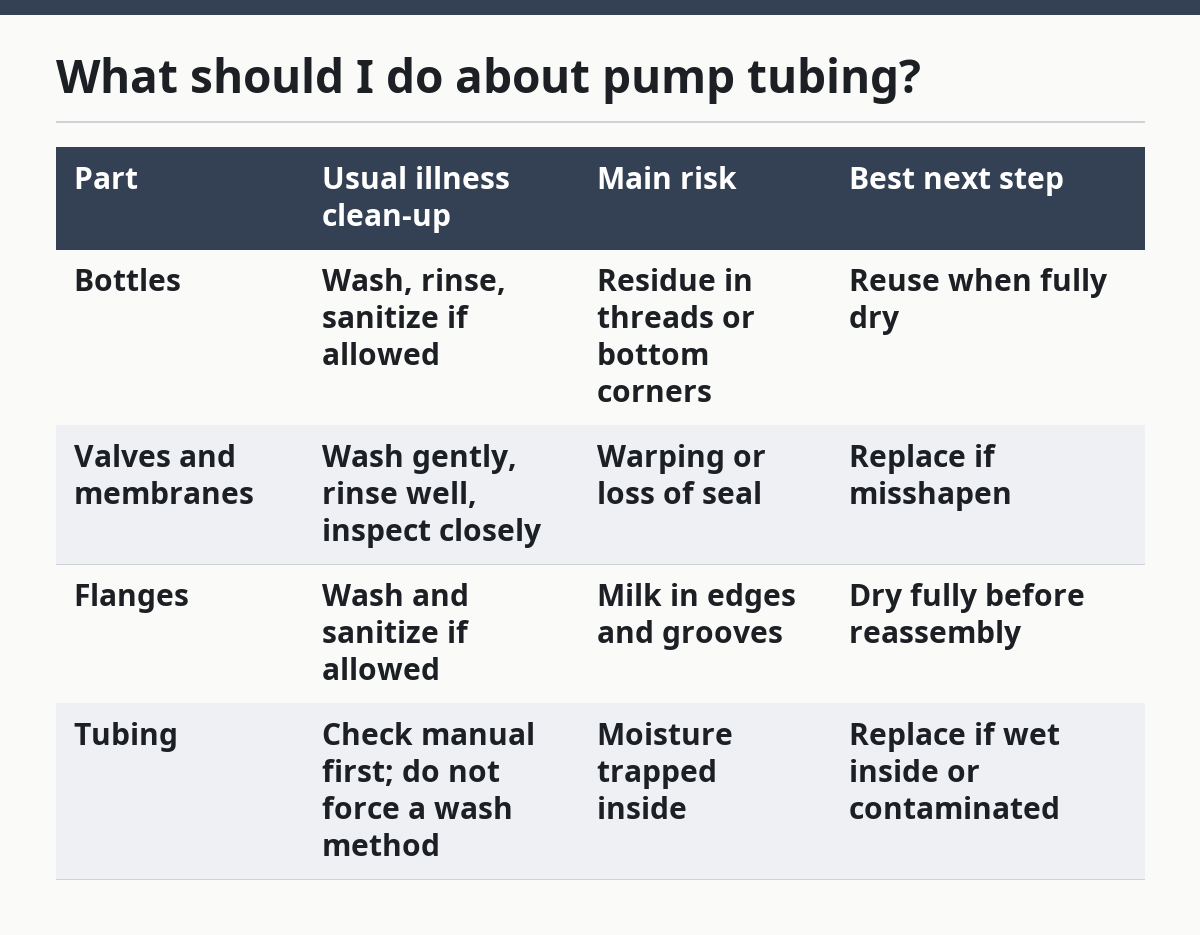
Use this quick comparison:
| Part | Usual illness clean-up | Main risk | Best next step |
|---|---|---|---|
| Bottles | Wash, rinse, sanitize if allowed | Residue in threads or bottom corners | Reuse when fully dry |
| Valves and membranes | Wash gently, rinse well, inspect closely | Warping or loss of seal | Replace if misshapen |
| Flanges | Wash and sanitize if allowed | Milk in edges and grooves | Dry fully before reassembly |
| Tubing | Check manual first; do not force a wash method | Moisture trapped inside | Replace if wet inside or contaminated |
A tube that smells stale, looks cloudy, or keeps moisture after drying is a bad candidate for reuse. Replacing tubing is not wasteful if it saves you from guessing.
Can I reuse parts safely after illness?
You can reuse breast pump parts safely after illness if they are washed, fully dried, and still in good shape. The key is not the illness label alone; it is whether the part is actually clean, intact, and fit for the next pumping session.
Look for three things before reuse: no visible residue, no lingering odor, and no damage to the seal or shape. A valve that looks stretched, a membrane with a curl, or a bottle with cracked threads can make the pump harder to use and harder to keep clean. That is especially true for parts that work by suction.
Do not mix old and new care routines in the same session. If you washed one set of parts in the sink and then dropped them onto a dirty counter, start over. If a part went through illness care and still feels damp in a seam, give it more drying time before you put it back together.
This section is not for every pumping problem. If the issue is not illness but repeated pain, poor milk flow, or a baby who will not latch, that belongs on a different page. Here, the rule is simple: clean well, dry completely, and replace parts that no longer fit the job.
What about thrush concerns?
Thorough cleaning matters more after thrush concerns because yeast can linger on damp surfaces and in small creases. If you suspect thrush, wash the milk-contact pump parts carefully, sanitize them if your pump instructions allow it, and pay close attention to anything that stays moist for long periods.
Thrush worries often make people overdo one step and skip another. Boiling a part that should not be boiled can damage it, while only rinsing a part leaves milk film behind. Stick to the manufacturer’s instructions for each part, and let the part dry fully before storage or reuse.
You also need to be strict about what gets replaced. If tubing or a valve shows cloudiness, odor, or residue after cleaning, replacement is the cleaner move. A pump part that looks old but still works is not the same as one that is clean enough after a yeast concern.
If the pump has several small pieces, lay them out separately while they dry so nothing traps moisture under another part. A crowded drying rack works against you here.
When should I replace a part instead of cleaning it?
Replace a breast pump part instead of cleaning it when the part is cracked, warped, cloudy, moldy, or still damp inside where you cannot reach. Cleaning helps with residue; it does not fix damaged plastic or silicone.
That is especially true for valves, membranes, and tubing. These parts are small, easy to miss, and often cheap enough to replace compared with the trouble of a poor seal or hidden contamination. A damaged valve can also reduce suction, which turns the whole pump session into a drag.
Do not keep reusing a part just because it survived one illness. If it smells stale after washing, if milk has dried inside a seam, or if the manufacturer says the part is disposable or single-use, stop there. A part should be replaced when it no longer leaves no doubt about what is in the milk path.
For broader milk-handling questions, the hub on breastfeeding storage and milk handling covers the next layer of routine care.
Do I need to sanitize pump parts after every illness?
Not always, but sanitizing is a good extra step after stomach bugs, thrush concerns, or any illness that leaves you unsure about contamination. Wash first, then sanitize only the parts your pump maker says can handle that method. If a part cannot be sanitized without damage, replace it instead of improvising.
Can I use the same pump after I recover?
Yes, if the pump parts are clean, dry, and undamaged, you can use the same pump after you recover. The pump itself usually does not need a full reset unless milk or moisture reached parts that were not meant to get wet. Check the manual before you reassemble anything.
What if my baby was sick too?
If your baby was sick too, keep the cleaning routine focused on the milk-contact parts and on hand hygiene. Wash, sanitize if allowed, and inspect all parts before reuse. If the illness changed how often you pumped or how the milk was handled, be strict about drying and part replacement.
Drafted with AI; not yet reviewed by a person.