Last updated: November 19, 2026
Quick Answer: A baby can have a normal 3- to 5-minute feed if the latch is deep, swallowing is steady, and feeds happen often enough. If you are learning how to breastfeed a baby with short feeding sessions, focus on milk transfer, not the clock. The steps below help you tell a fast, effective feed from one that needs help.
Key Takeaways
- Brief feeds can reflect efficiency, distraction, or poor milk transfer.
- Watch latch, swallowing, and body tension; those three signs matter more than minutes.
- The goal is a better feed, not a longer struggle.
- Short feeds are working when baby latches deeply, swallows steadily, and leaves calm, not frantic.
What short feeding sessions can mean
Short feeding sessions can mean your baby is efficient, distracted, or not moving milk well. A 3-minute feed at the breast is not the same as a 3-minute snack from a shallow latch. The difference shows up in how your baby sucks, swallows, and settles after the feed.
Picture this: you sit down for a feed, your baby latches, and then pops off before you expected. That can feel rushed, but the clock alone tells you very little. What matters is effective milk transfer, not the length of time on the breast.
A few things can shorten a feed without making it a problem:
- A strong latch with steady swallowing
- A baby who feeds often and takes in enough milk over the day
- A baby who is older and faster at the breast than a newborn
- A baby who stops because the first breast already gave enough milk
The hard part is that a short session can also happen when baby is slipping on and off the nipple, getting sleepy at the breast, or stopping before the breast is well drained. That’s why the rest of the guide focuses on what to do next, not on guessing from time alone.
Start by watching the feed, not the clock
Start by watching the latch, swallowing, and body tension, because those three things tell you more than minutes on a timer. A feeding log helps here, even if you keep it simple with the time, side, and what you saw.
Picture this: you’re at the couch with a notebook or phone, and you want a quick way to judge the feed without spiraling. A plain log works best. You’re looking for a pattern, not a perfect score. The simple version is enough for 2 or 3 feeds.
Use this simple log for a few feeds in a row:
- Write the time — note when the feed starts and ends.
- Name the side — left, right, or both.
- Record swallowing — note whether you hear or see steady swallows.
- Note the unlatch — baby came off calmly, fell asleep, or got fussy.
- Add one sentence — “relaxed,” “fidgety,” or “kept relatching.”
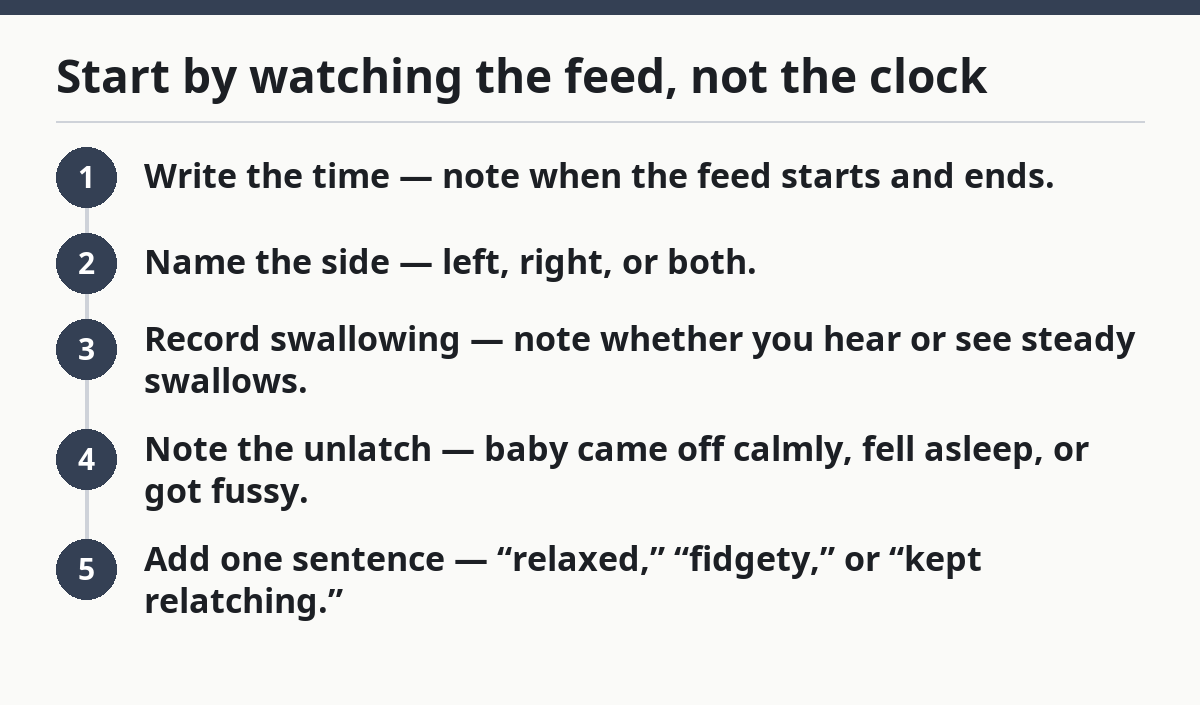
A useful log does not need a long chart. Even 2 or 3 feeds can show whether your baby is feeding briefly but well, or briefly and poorly. If every short feed ends with constant relatching and little swallowing, that points to a latch or transfer issue. If the latch looks deep and swallowing is steady, the short session may simply be enough for that moment. For more on feeding patterns, see the guide to breastfeeding basics and baby feeding cues.
On the flip side, don’t use the log to chase a target minute count. A 10-minute feed with no swallowing can be less useful than a 5-minute feed with strong, rhythmic milk transfer.
How to breastfeed a baby with short feeding sessions
How to breastfeed a baby with short feeding sessions is to make each latch count, offer both breasts, and keep the baby feeding often enough that the short feeds add up. The goal is a better feed, not a longer battle.
Picture this: your baby takes the breast, feeds for a few minutes, and then quits. You want a repeatable sequence that does not turn into a struggle. This is where the practical work starts.
- Settle the baby — hold your baby skin-to-skin or in a calm position until the body softens.
- Offer the breast — bring baby to the breast, nose level with the nipple, so the mouth opens wide.
- Check the latch — look for a deep latch, not just a nip at the tip.
- Watch the swallows — listen for small, regular swallows after the first fast sucks.
- Switch sides — offer the second breast when sucking slows or baby unlatches.
- Repeat once — if the second side is brief, offer the first side again.
- End cleanly — stop when baby looks relaxed, not when you force a longer session.
That last step matters. Forcing a baby to stay on the breast can turn a short but decent feed into a fussy one. A better move is to let the baby come off, then offer the second side if the first side was short or the sucking was weak.
The best part of this approach is that many babies do better with a short burst, a side switch, and another short burst. That pattern can be very normal, especially after the first letdown. What you want is not marathon nursing. You want effective milk transfer from one breast, then the other if needed.
How do I know if short feeds are effective?
You know short feeds are effective when your baby latches deeply, swallows in a steady rhythm, and comes off the breast calm rather than frantic. That is the real test, not the clock.
Picture this: your baby feeds for 4 minutes, unlatches, and looks loose in the arms instead of angry. That can be a good sign. A baby who is transferring milk well often slows down at the end, relaxes the hands, and lets go without a fight.
Use these signs during the feed:
- Deep latch — the mouth covers more than the nipple tip.
- Rhythmic swallows — sucking patterns change when milk starts flowing.
- Relaxed body — hands open, face soft, shoulders loose.
- Easy release — baby lets go or comes off without repeated relatching.
- Willing to feed again — baby may take the other side or feed again later at a normal interval.
A short feed is less convincing when you see lip smacking, pinching pain, frequent clicking, or a baby who comes off hungry and stays upset. That often means the latch is shallow or the feed is stopping before milk transfer is done.
One detail matters here: not every short feed needs both breasts. Some babies take a full feed from one side and are done. Others need a second breast every time. The feed tells you which pattern you have.
Common mistakes that make feeds shorter
Common mistakes make short feeds look normal while they quietly reduce milk transfer. The fix is usually small — better positioning, a cleaner latch, or a side switch at the right time.
Picture this: you assume baby is done because the latch looked fine at first, but the feed keeps ending in a weak, fast suck pattern. That often means the setup, not the baby, is the problem. Tiny changes can make a real difference.
Mistakes that shorten or weaken feeds:
- Pulling baby away too soon — this can cut off a feed before the second letdown.
- Letting baby stay shallow — a shallow latch often leads to quick fatigue and poor transfer.
- Ignoring one-sided patterns — if baby often quits after one side, the second breast may still be needed.
- Waiting too long between feeds — a very hungry baby may latch poorly and quit fast.
- Chasing the clock — a long session with poor swallowing is not a win.
What to do instead:
- Reposition baby if the latch feels pinchy or unstable.
- Offer the second breast when the first side slows.
- Use a feeding log for 2 or 3 days to spot the same pattern.
- Keep feeds frequent enough that baby is not frantic at the breast.
A plain truth is that short sessions are not the only issue. A short session with good swallowing can be fine; a longer session with little transfer can still be a problem. The goal is not duration. The goal is a feed that actually moves breast milk.
When short breastfeeding sessions are a problem
Short breastfeeding sessions are a problem when the pattern comes with poor latch, weak swallowing, or a baby that seems unsettled after most feeds. That is the point where a feeding log and a professional lactation check make sense.
Picture this: the sessions are brief every time, and the baby never seems satisfied. That is different from an occasional quick feed. A pattern matters more than a single day.
Watch for these red flags:
- Baby latches, then slips off repeatedly.
- You hear little or no swallowing.
- Feeding ends with frustration, arching, or constant relatching.
- One breast is always ignored and not offered again.
- Short sessions happen at nearly every feed, not just a few.
This is also where a broader view matters. A short feed by itself does not tell the whole story, and this page is not the place to judge daily weight gain or overall intake feed by feed. That is covered elsewhere in the hub on breastfeeding and baby behavior at the breast.
If you’re seeing a pattern that worries you, bring your feeding log to a lactation professional. A log with times, sides, and notes about swallowing gives far more useful detail than “baby feeds too fast.” It turns a vague complaint into something the helper can work with.
One more honest limit: if short feeds are paired with pain, persistent clicking, or a latch that never feels stable, home tweaks may not be enough. That is not a failure. It just means the problem needs a closer look.
Small changes that often make a short feed better
Small changes often make a short feed better because they improve latch quality and let baby stay on the breast long enough to get the milk available there. You do not need a full routine overhaul.
Picture this: you’re halfway through a feed and baby keeps popping off. Instead of starting over from scratch, try one clean adjustment at a time. That keeps the feed calmer and gives you a clear signal about what helped.
Try these changes:
- Change position — cradle, cross-cradle, or laid-back can each change how deeply baby latches.
- Offer the second side earlier — some babies do better with a switch before they get tired.
- Keep baby close — chest-to-chest contact can steady the latch.
- Pause less — long interruptions can break the feeding rhythm.
- Use the same setup — a stable cushion, chair, or pillow can reduce strain during the feed.
The main trade-off is patience. If you change five things at once, you won’t know which one worked. Change one thing, then watch the next feed. That is the cleanest way to learn what helps your baby move milk well.
A short feed that improves after one change is useful information. A short feed that stays messy no matter what you try is a stronger clue that the latch or transfer needs outside help. That’s the line. For more support, see how to tell if baby is getting enough milk.
Is it normal for a baby to nurse for only a few minutes?
Yes, it can be normal for a baby to nurse for only a few minutes if the latch is deep and swallowing is steady. A fast, effective feed is not the same as a skipped feed.
The real question is what happens during those minutes. If baby comes off calm and seems to feed well again later, short sessions may simply be your baby’s pattern. If the feed is short and sloppy every time, that is a different story.
How do I know if short feeds are effective?
Short feeds are effective when you see good latch quality, regular swallowing, and a relaxed baby at the end. Those signs matter more than the timer.
A feeding log helps you spot the pattern over several feeds. If the same short feed ends with calm release and normal spacing before the next feed, that supports the idea that the feed is doing its job. If the same pattern comes with relatching and frustration, it points to a problem.
When are short breastfeeding sessions a problem?
Short breastfeeding sessions are a problem when they happen often and come with weak swallowing, poor latch, or a baby who stays upset after feeds. That pattern needs a closer look.
If you keep seeing the same brief, unfinished feed, bring notes to a lactation professional. The details in your log — side, time, and what you heard at the breast — are the pieces that help sort out whether the issue is latch, transfer, or feeding rhythm.
References
- La Leche League International. Breastfeeding basics: https://llli.org/breastfeeding-info/
- NHS. Breastfeeding and bottle feeding: https://www.nhs.uk/conditions/baby/breastfeeding-and-bottle-feeding/breastfeeding/
Drafted with AI; not yet reviewed by a person.