
Last updated: November 19, 2026
The right setup depends on your goal: direct breastfeeding, pumping for milk removal, or expressing milk when your baby cannot feed well yet. For a premature baby, the safest path is usually the simplest workable one, because the point is to protect milk supply, move milk out often enough, and avoid gear that makes the process harder than it already is.
I write this guide for a parent who needs a clear plan, not a shopping list that goes in circles. It focuses on what each tool does, what it does not do, and when a lactation consultant or pediatric clinician should weigh in, especially for a premature or medically fragile baby.
Key takeaways
- The best equipment is the one that helps milk move out regularly without adding avoidable stress.
- Hand expression, manual pumping, and electric pumping solve different problems.
- For a premature baby, feeding plans often depend on the baby’s strength, latch, and milk-transfer ability, not just on the parent’s supply.
- Donor human milk is the backup WHO points to when a mother’s own milk is not available for preterm or low-birth-weight infants.
- A setup that works on day 2 may be the wrong setup at week 3; recheck it often.
What equipment do you actually need?

You usually need less gear than first-time parents expect, but the few items you choose matter a lot. A basic setup often includes a pump or hand-expression plan, clean milk-collection containers, and whatever helps you stay consistent for 6 months or longer if that is your goal.
The most important “equipment” is not a brand name. It is a way to remove milk often enough to protect supply, since fewer than half of infants under 6 months old are exclusively breastfed, contrary to WHO recommendations. That gap exists for many reasons, but one common issue is that families get equipment before they get a plan.
For a premature baby, the first question is not “What is the fanciest pump?” It is “How will milk be removed if the baby cannot nurse effectively right away?” If the baby is in a hospital setting, the team may suggest pumping or hand expression until direct breastfeeding is realistic. If the mother’s own milk is unavailable, WHO recommends donor human milk for preterm or low-birth-weight infants.
A useful way to think about equipment is by function:
- Milk removal: hand expression, manual pump, electric pump
- Milk collection: bottles or collection containers
- Milk storage: containers used for refrigerating or freezing milk
- Comfort and fit: flanges or other parts that match the body well enough to avoid pain and poor milk flow
If the setup causes pain, repeated leaks, or long sessions with little output, the problem may be the fit or the method, not the parent’s body. A lactation professional can help check technique and fit before the parent blames supply.
Hand expression: when is it the best first step?
Hand expression is often the best first step when the goal is small-volume colostrum collection, quick relief, or milk removal in the first days. It needs no machine, no motor, and no power source, which makes it useful in the hospital, at home, and anywhere a baby’s feeding plan changes fast.
This method fits especially well when the baby is premature and the parent is just starting to produce milk. The first milk can come in small amounts, so a pump that looks impressive may still collect less than careful hand expression. A generic article often misses this and pushes equipment before teaching the skill.
Hand expression can also be useful when pain makes pumping hard. If suction hurts, the parent may tense up, and that can make milk removal harder. Hand expression gives more control over pressure and pace, though it takes practice and patience. The downside is obvious: it can feel awkward at first, and many parents need instruction before it becomes efficient.
This method is not the best choice for every situation. It is usually not the easiest path when large-volume milk removal is needed repeatedly over many weeks. If a parent has to express milk often to match a premature baby’s feeding schedule, a pump may save time and effort. Even then, hand expression can still be a useful backup when the pump is unavailable or milk flow is slow.
For a parent who is overwhelmed, hand expression is worth learning even if a pump will be used later. It is the one technique that never depends on a charging cord, replacement parts, or a specific flange size.
Manual pump or electric pump: which one should you choose?

An electric pump wins for frequent milk removal, while a manual pump wins for short sessions, travel, and backup use. The choice depends on how often milk needs to be removed, how much time the parent has, and whether the baby is able to nurse directly yet.
The biggest practical difference is repetition. A manual pump asks the parent to do the work with the hand, which can be fine for occasional use but tiring when sessions stack up. An electric pump does the repetitive part for you, which matters when the goal is to protect supply for a baby who is not feeding well yet.
That said, a pump is not automatically the right answer just because it is powered. A pump that is painful, badly fitted, or hard to clean can become a burden. For a premature baby’s feeding plan, the best pump is the one the parent can use consistently without dread.
Here is the straight comparison:
| Criteria | Hand expression | Pumping | Winner for condition |
|---|---|---|---|
| Setup time | No parts to assemble | Needs parts and preparation | Hand expression for quick use |
| Best use case | Small early milk volumes | Repeated milk removal | Pumping for ongoing routine |
| Portability | Extremely high | Lower, especially with electric units | Hand expression for travel |
| Learning curve | Technique takes practice | Technique and fit both matter | Neither is easy at first |
| Comfort control | Very direct | Depends on suction and fit | Hand expression if pain is an issue |
| Time burden | Can be slow | Usually easier for frequent sessions | Pumping for regular use |
| Backup value | Strong backup method | Strong when equipment works | Hand expression if power fails |
| Matching a premature baby’s needs | Good early and for tiny volumes | Better when milk removal must be repeated | Pumping if sessions are frequent |
| Dependency | No device needed | Depends on parts, cleaning, and power | Hand expression when simplicity matters |
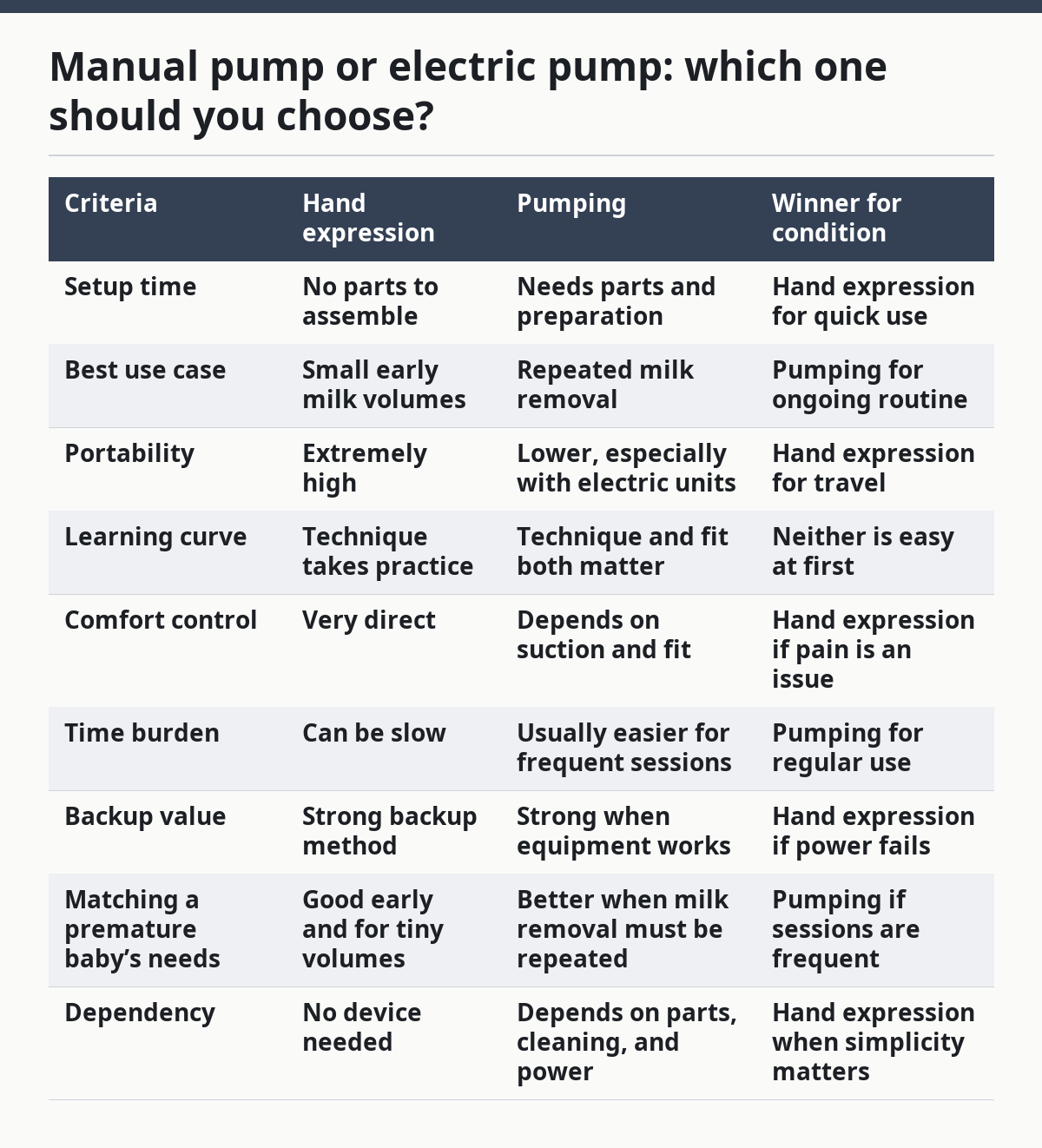
The honest call is simple: choose a pump if milk needs to be removed often enough that hand expression alone would be too slow or exhausting. Choose hand expression if the milk volume is tiny, the parent is in pain, or the equipment itself is a barrier. Skip both as a “must-buy now” if the baby is already nursing well and a professional says direct breastfeeding is enough.
A generic article would stop here and say “both are useful.” That is true but not useful. The real question is which method matches the parent’s day. A parent caring for a premature baby may need the easiest method for the first week and a more efficient method later.
How do you know if the setup fits your body?
The setup fits your body if milk flows without avoidable pain, pinching, or long sessions that produce very little. Fit matters because a pump is not one-size-fits-all, and a poor fit can make a technically good machine perform badly.
This is where many beginners get tripped up. They blame supply when the real problem is a mismatch between the body and the equipment. If pumping feels sharp, rubs the nipple, or leaves the breast still uncomfortable after a session, the setup likely needs review.
A good fit is not only about comfort. It affects whether milk is removed effectively, which matters when the parent is trying to maintain supply for a premature baby. If milk is not removed well, the body may get the wrong signal about how much milk is needed.
Common warning signs that the setup is wrong include these:
- Pain during suction that does not settle after a short adjustment
- Nipples rubbing against the tunnel
- Milk output that seems far lower than expected after several sessions
- Sessions that go long without an effective sense of relief
- Swelling, redness, or a sense that the equipment is pulling too hard
The fix is often boring but effective: recheck the fit, the position, and the technique. A parent does not need to “tough it out.” A consult with a lactation specialist can be worth more than a new accessory, especially when the baby was born early and the feeding plan already has enough variables.
One more practical point: the best fit can change over time. A setup that works in the early days may not be right once milk supply changes or a baby starts taking more at the breast. Reassessing every 1 to 2 weeks is sensible in a changing feeding plan, even though the exact timing should be adjusted with professional guidance.
What should a premature baby change about the plan?
A premature baby usually shifts the plan toward milk protection, small steps, and close follow-up. The goal is not just feeding; it is helping the baby get human milk safely while the parent keeps supply going.
This matters because a premature baby may not have the strength, coordination, or stamina for direct breastfeeding at first. In that setting, the parent may need to express milk and feed it another way until the baby can handle the breast better. If mother’s own milk is unavailable, WHO recommends donor human milk for preterm or low-birth-weight infants.
The plan may include more than one method across the same day. A parent may hand express early milk, pump later for larger volumes, and work on latching when the baby is ready. That is not inconsistency; it is a realistic response to a changing medical situation.
The biggest mistake is treating the first method as permanent. A baby born early may move from tube feeding or bottle support to breastfeeds over time. The equipment choice should be flexible enough to match that transition. A rigid setup can make a hard period harder.
This is also the section where the numbers matter. About 1 in 3 infants, or 30%, are exclusively breastfed by 6 months old, according to the CDC, and fewer than half of infants under 6 months old are exclusively breastfed, according to WHO’s recommendations. Those figures do not tell one family what to do, but they do show how hard this can be even in ordinary situations. With a premature baby, the plan often needs more support, not less.
The practical takeaway is plain: for a premature baby, the right equipment is the one that helps milk get expressed safely and often enough, while leaving room to shift toward direct breastfeeding when the baby can manage it.
How do pumping and direct breastfeeding work together?
Pumping and direct breastfeeding work best as partners, not rivals. The parent may need pumping when the baby cannot transfer milk well, then direct breastfeeding later when the latch and stamina improve.
This hybrid approach is common when a baby starts life in a hospital or needs extra support. Pumping helps keep milk moving even when the baby is not ready to feed at the breast. Direct breastfeeding then becomes the practice ground for the baby and a more natural feeding option as the baby grows stronger.
A generic guide often turns this into a loyalty test: breast or bottle, pump or nurse. Real life is messier. The same baby can need expressed milk today and direct nursing later the same month. The equipment should make that transition easier, not trap the parent in one method.
There is also a supply reason to keep both options open. If a parent waits too long between milk removals, supply can dip. If the baby nurses poorly but the parent assumes nursing “should be enough,” the gap may widen. Pumping gives a backup route to protect milk removal while the baby learns.
Direct breastfeeding is not automatically the better method if it leads to exhaustion, pain, or poor transfer. Pumping is not automatically the better method if it steals too much time or makes the parent miserable. For a premature baby, the winning plan is usually the one that keeps milk coming while reducing pressure on the parent.
A clear sign that the mix is working is simple: the baby gets milk, the parent’s breasts are relieved after sessions, and the plan changes as the baby’s feeding improves. If those pieces are not happening, the setup needs a review.
What are the most common mistakes with milk expression?
The most common mistake is waiting too long to make a plan, then trying to fix supply after the fact. Milk removal works best when it is regular and deliberate, especially if a premature baby is not yet feeding effectively at the breast.
Another common mistake is buying equipment before understanding the feeding problem. A parent may order a machine when the real need is technique, fit, or support with hand expression. A beautiful pump cannot solve a bad schedule or poor positioning.
A third mistake is assuming that more force equals more milk. Too much suction, too much pressure, or too much time can make pumping painful and less sustainable. That is a bad trade when the parent needs to do this many times, not once.
A fourth mistake is ignoring the backup plan. If the pump stops working, parts are missing, or the baby suddenly needs a different feeding route, the parent should already know the fallback. Hand expression is the simplest backup. For medically fragile babies, the clinical team may also discuss donor human milk if mother’s own milk is not available.
The last mistake is treating every feeding setback as personal failure. The numbers tell a broader story: the share of babies who start breastfeeding rose from 70% in 2000 to 86% in 2023, according to the CDC, but only about 1 in 3 infants are exclusively breastfed as recommended until 6 months old, according to the CDC. Many families start well and still run into trouble later. A setback is a systems problem more often than a character problem.
The fix is to simplify. Use the least complicated method that gets milk out well, check fit and technique, and revisit the plan when the baby’s feeding changes.
What should you choose right now?
Choose electric pumping if milk must be removed often, the baby is not latching well yet, and repeated sessions are part of the plan. Choose hand expression if the milk volume is small, the parent needs portability, or pain makes pumping a poor fit. Neither if the baby is feeding well at the breast and a professional says extra equipment is not needed.
That is the cleanest recommendation I can give. It depends on the baby’s condition, but the dependency is specific: choose the method that matches the baby’s feeding ability and the parent’s ability to repeat the task every day.
If the baby is premature, the balance usually tilts toward whatever helps keep milk moving with the least friction. For many families, that means learning hand expression and using a pump when regular milk removal becomes the central job. For other families, especially when breastfeeding is already going well, more equipment only adds noise.
The wrong choice is the one that looks impressive but cannot be maintained. A parent who stops using a device after a few difficult days ends up worse off than a parent who starts with a simple method and stays consistent.
When should you get professional help?
You should get professional help if pumping is painful, the baby cannot latch or transfer milk well, or there is doubt about whether the feeding plan is enough for a premature baby. A lactation consultant, pediatric clinician, or hospital team can help with fit, technique, and timing.
This is not a sign that the parent is doing something wrong. Breastfeeding and expressing milk are skills, and the stakes are higher when the baby was born early. A small fix in fit or timing can save days of frustration.
Professional help also matters if the baby’s feeding route changes. A premature baby may move from expressed milk to direct breastfeeding gradually, and that shift can change how much equipment is needed. If mother’s own milk is unavailable, the team may discuss donor human milk, which WHO recommends for preterm or low-birth-weight infants.
A parent should not wait for a crisis. If a session is painful, output stays poor, or the baby seems to work too hard to feed, the plan needs review. That is especially true in the first weeks, when habits are forming and supply is still being established.
FAQ
Is hand expression enough on its own?
Hand expression can be enough in some situations, especially for small early milk volumes or as a backup method. It is often less useful when repeated milk removal is needed many times a day, which is common when caring for a premature baby. In that case, a pump may be easier to sustain.
Should I buy a pump before the baby is born?
A pump can be useful to have ready, but the real need is a plan, not a purchase. If the baby is premature or there is uncertainty about feeding, ask the clinical team what method makes sense first. Equipment should match the baby’s needs, not the other way around.
What if pumping hurts?
Pain usually means something needs adjustment, not that the parent has failed. Check fit, suction, and technique, and get help if the discomfort keeps happening. A painful setup is hard to maintain and can make milk removal less effective.
Can I switch between breast and pump?
Yes, and many families do. A premature baby may need expressed milk now and direct breastfeeding later, so switching methods is often part of the plan. The best setup is the one that supports milk removal while the baby’s feeding skills develop.
What if my milk is not available?
If mother’s own milk is unavailable, WHO recommends donor human milk for preterm or low-birth-weight infants. That decision should be made with the baby’s medical team, since the baby’s condition and feeding route matter.
Sources
- CDC, About Breastfeeding – Breastfeeding – CDC (checked 19 Nov 2026)
- WHO, Breastfeeding (checked 19 Nov 2026)
Drafted with AI; not yet reviewed by a person.