
Last updated: November 28, 2026
A pumping plan for a premature baby in the NICU should start with a simple schedule, a reliable pump setup, and a way to track each session. The goal is to build a routine you can repeat every 2 to 3 hours, then adjust with the NICU team as your baby’s needs change.
Key takeaways
- Start with a repeatable day-and-night rhythm instead of waiting for the “perfect” schedule.
- Put your pump, parts, and milk storage containers in one ready-to-grab spot so each session takes less effort.
- Plan for the NICU’s rules on bedside pumping, labeling, and storage before the first session.
- Track output session by session, not by guesswork, so you can see what is actually happening.
- A lactation consultant can help if the plan feels too hard to keep up with, especially after a missed session or a shift change.
What should a pumping plan include?
A pumping plan should include when you pump, where you pump, what you use, and how you label and move milk. For a NICU parent, that usually means a 24-hour rhythm, a breast pump, clean parts, milk storage containers, and a note of each session.
The plan does not need to be fancy. It needs to work on a Tuesday at 3 a.m. and again when you are tired, upset, or rushing back to the hospital. A plan that looks neat on paper but breaks down after one night is not a good plan.
Start by writing down four pieces:
- Your target pump times across 24 hours
- Your main pump location: home, NICU bedside, or both
- Your milk collection workflow, from pump to container
- Your tracking method, such as a notebook, phone note, or chart
If the NICU has a lactation consultant, ask how their unit handles timing, labels, and bedside access. NICU rules vary, and one hospital may allow a pump cart at the bedside while another may require you to use a family room. The plan should fit the unit, not fight it.
A useful plan also has one backup. If your 6 p.m. session gets missed because of a doctor update or ride home, you need to know which later session can absorb the gap. That matters more than a perfect clock.
How do I build the schedule?
You build the schedule by anchoring it to your day, then fitting in a 24-hour rhythm that you can actually repeat. For many NICU parents, that means aiming for pumping every 2 to 3 hours, including at least one overnight session, unless the NICU team gives different instructions.
Start with the times you already know you can protect. Maybe that is 6 a.m., 9 a.m., noon, 3 p.m., 6 p.m., 9 p.m., and 2 a.m. The exact clock times matter less than the spacing and the fact that they are realistic.
Here is a simple way to set it up:
- Pick your anchor times for the day, such as morning, afternoon, evening, and one night session. This turns the plan into a routine instead of a guess.
- Add sessions between those anchors until you have a steady 2- to 3-hour pattern. This gives your body frequent signals and keeps the day from drifting.
- Decide which session is your hardest one and protect it first. For many parents, that is the overnight session, because it gets dropped when sleep wins.
- Pair each session with a trigger, like a phone alarm, a feeding update from the NICU, or a meal break. Triggers reduce the number of decisions you have to make.
- Keep one backup slot of about 30 to 60 minutes in the day. That gives you room for transport delays, rounds, or a nap.
A lactation consultant can help you shape the timing if your baby was born very early, if you had surgery, or if your pump sessions are painful. This is not the place to guess wildly or copy a schedule that worked for someone else.
Where should you pump in the NICU?
You should pump wherever you can do it cleanly, comfortably, and often enough to stick with the plan. The right spot is the one that fits the NICU’s rules, your body, and your day.
| Pumping location | Best for | Trade-off | What to check first |
|---|---|---|---|
| NICU bedside | Staying close to your baby | Space can be tight | Ask about privacy, outlets, and chair height |
| Family room | A quiet, private session | You may miss part of a NICU update | Check whether the room is reserved or shared |
| Home | Longer sessions and less stress | Harder to coordinate with NICU visits | Make sure your pump, parts, and containers are packed |
| Car or transit stop | Keeping the rhythm during long travel days | Not ideal for comfort or cleanup | Plan for privacy and a safe place to sit |
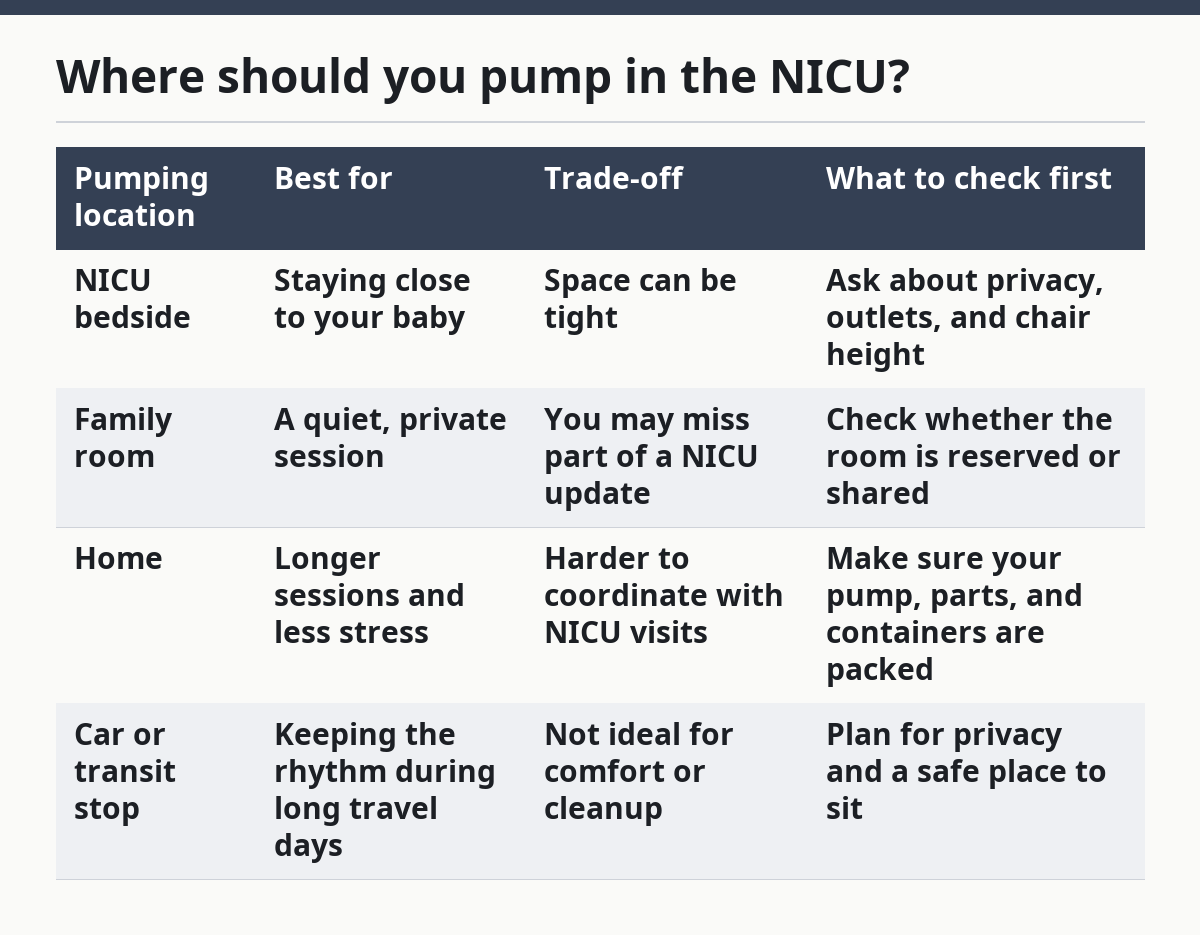
A bedside plan is useful when the unit allows it, because it keeps the routine tied to your baby’s care. A home plan can be easier to repeat when you are exhausted. Many families end up using both.
Before your first NICU session, check the practical details:
- Is there an outlet within 1 to 2 meters?
- Is there a table for pump parts and milk containers?
- Does the unit need any label format?
- Can a support person carry clean parts or milk to and from the room?
This is where a good plan saves time. If you arrive with the wrong adapter, no clean bottle, or nowhere to set the pump, the session gets shorter or gets skipped. A 10-minute setup problem can cost a whole pumping window.
How do I set up the milk collection workflow?
You set up the milk collection workflow by making each step easy to repeat in the same order every time. That means pump, collect, label, chill or hand off, and record the session before you leave the area.
Keep the workflow as short as possible:
- Wash or sanitize your hands, then place the pump parts within reach.
- Assemble the pump and place the flanges so you are not reaching across the table mid-session.
- Pump into the container that fits your setup, or into the pump kit if that is how your system works.
- Move milk into clean milk storage containers right away if that is how your NICU handles collection.
- Label each container with the baby’s name, date, and time exactly as the unit asks.
- Hand off the milk or store it the way the NICU told you to, then note the session in your tracker.
The “right” container is the one your NICU accepts, not the fanciest one on the shelf. Some parents do better with small containers for the first days because smaller volumes are easier to label and move without spilling. That can feel discouraging if the bottle looks nearly empty, but it is still useful milk.
Make the workflow easier by keeping a small pump kit ready:
- 2 sets of pump parts if you can manage the turnover
- 2 to 4 clean milk storage containers for a day
- A permanent marker or label system
- A zip bag or clean bin for used parts
If the unit has rules for transport, follow those instead of improvising. NICU milk handling is one place where details matter, because a missed label or mixed-up container creates work for the nurses and stress for you.
For general breastfeeding guidance, the CDC breastfeeding pages and Academy of Breastfeeding Medicine protocols are useful references, but your NICU team’s rules come first when your baby is in the hospital.
How should I track output and adjust the plan?
You should track output in a way that shows patterns over 3 to 7 days, not just one session at a time. The simplest method is a note with the time, total output, and anything unusual, such as a missed session, a painful flange fit, or a longer gap overnight.
A basic tracker can be a notebook page or a phone note with three columns:
- Time
- Amount pumped
- Notes
You do not need a complex chart. You need enough data to answer questions like, “Did I skip two sessions after midnight?” or “Does output drop when I pump only 10 minutes instead of my usual time?” If you cannot see the pattern, you cannot fix it.
This is also where honesty matters. Some sessions will be small, some may be dry, and some may vary for reasons you cannot control. A low-output day does not always mean the plan failed. It may mean the timing slipped, the pump fit was off, or stress and sleep got in the way.
Adjust one variable at a time if possible. If you change the time, the location, and the pump parts all at once, you will not know what helped. Keep the change small for at least a few sessions before judging it.
A lactation consultant can help if you are unsure how to read the pattern. That is especially useful when the plan is being built around a NICU schedule, which can change day by day.
What mistakes make the plan fall apart?
The biggest mistakes are skipping the overnight session, waiting too long to start, and making the setup harder than it needs to be. Each one costs time, and in a NICU week, time is usually the thing you have the least of.
One common mistake is building a plan around the best day instead of the hardest day. If the schedule only works when you are rested and calm, it will fail the first time rounds run late. A better plan survives the 2 a.m. version of your life.
Another mistake is keeping pump parts in different rooms. That adds a few extra minutes to every session, and those minutes build into missed pumps over a week. Put the pump, flanges, bottles, charger, and labels in one place.
A third mistake is guessing about NICU rules. If you bring milk in the wrong container, or show up without the right label, staff may need to rework the handoff. That is not a moral failure; it is a systems problem that a better checklist fixes.
Who this plan is not for: a parent who has been told by the NICU or lactation team to use a different schedule because of a medical issue, a surgical recovery limit, or a different feeding plan. In that case, the unit’s instructions override any general guide.
How do I keep the plan workable for a long NICU stay?
You keep the plan workable by treating it like a routine you will repeat for weeks, not a one-day sprint. That means building around 24 hours, protecting one overnight slot, and keeping your pump setup simple enough to reset in a few minutes.
Think in blocks of 3:
- 3 main pumping zones in the day: morning, afternoon, night
- 3 places the pump may live: bedside, home, or travel bag
- 3 things to check before leaving: parts, labels, and containers
That kind of structure helps when your brain is tired. It also makes it easier for a partner, friend, or family member to help without asking a dozen questions.
If the plan becomes too heavy, shrink the friction before you shrink the frequency. Move supplies closer to the pump. Use a single bag for clean parts. Keep a written checklist by the chair. Those changes do not sound dramatic, but they can make the difference between a plan that lasts 2 days and one that lasts 2 weeks.
The most useful pumping plan is not the most ambitious one. It is the one you can keep doing while your baby stays in the NICU.
How often should I pump for a premature baby?
A common starting point is every 2 to 3 hours across the day and night, unless the NICU team gives you a different plan. That rhythm helps create a steady routine and keeps long gaps from building up. If the schedule is hard to maintain, a lactation consultant can help you make it more realistic.
Should I pump at night for NICU milk supply?
Yes, night pumping is usually part of a NICU pumping plan because long overnight gaps can throw off the rhythm. A single overnight session is often the hardest one to keep, which is why it should be protected early in the plan. If night pumping is not possible, ask the NICU team how to adjust the schedule safely.
What if I miss a pumping session?
If you miss a session, restart at the next planned time and get back to the 24-hour rhythm as soon as you can. One missed pump is a setback, not a failure. Write it down in your tracker, then look for the reason it happened so the same gap is less likely next time.
Drafted with AI; not yet reviewed by a person.