
Last updated: November 26, 2026
Quick answer: to increase milk supply for a premature baby, start milk removal as early as possible, use hand expression plus a breast pump, and keep doing it across the full 24 hours. This article on How to Increase Milk Supply for a Premature Baby focuses on steady milk removal, because a premature baby may not nurse effectively yet. A lactation consultant can help you fine-tune the plan if supply stays low.
Key takeaways
- Early and frequent milk removal matters more than waiting for the “right” time.
- Hand expression is especially useful right after birth and when only small drops of colostrum are coming.
- A breast pump helps protect supply when a preterm baby cannot latch or tires too fast to feed well.
- A simple routine done across the full day usually works better than one long session.
- If milk stays low, the issue may be timing, technique, flange fit, stress, or a medical factor that needs a clinician’s eye.
How do I start building supply right after birth?
Start milk removal as soon as you can, then repeat it across the day so your body gets the message to produce more milk for a premature baby. In the first days, colostrum is often thick and comes in tiny amounts, so the job is to collect what you can and keep stimulation steady.
-
Begin with hand expression in the first hours. Use clean hands and a sterile cup or syringe if the hospital provides one, because colostrum often sticks to pump parts and is easy to lose. Even a few drops count as early stimulation. The CDC recommends early and frequent milk expression for mothers of hospitalized infants.
-
Use a breast pump within the first day if you can. A hospital-grade electric pump is often the most efficient choice when baby is in the NICU or not latching yet. The point is not a huge volume on day 1; it is regular milk removal. The Academy of Breastfeeding Medicine also emphasizes early, frequent milk removal for establishing supply.
-
Pump often across 24 hours. A premature baby usually cannot empty the breast well, so the breast pump has to do the work for now. Aim for short, repeated sessions rather than one or two long ones, because the breast responds to repeated signals.
-
Pair pumping with breast massage. Gentle massage before and during pumping can help milk flow and may help you get more from each session. Keep pressure light; painful squeezing can make the session harder to tolerate and may not help output.
-
Track output without panicking over tiny amounts. Colostrum volume is small at first, especially after a preterm birth. The useful question is whether milk removal is happening on a steady schedule, not whether the first collection looks impressive.
The real mistake here is waiting for the milk to “come in” before starting. A baby born early may be ready to feed later than your breasts are ready to respond, and that gap can work against supply if you sit still for too long.
What pumping routine helps a NICU parent most?
A steady pumping routine helps a NICU parent most when it fits real life, because supply usually drops when sessions get skipped, rushed, or spaced too far apart. The best plan is the one you can repeat across days, including nights, while your baby is still too small or too sleepy to nurse well.
| Option | What it looks like | Best for | Trade-off |
|---|---|---|---|
| Hand expression | Short bursts by hand, often right after birth | Colostrum and the earliest days | Slower and more tiring than a pump |
| Breast pump | Electric pump sessions at set times | Ongoing supply building | Needs parts, space, and time |
| Both together | Hand expression first, then pump | Premature babies and low early output | More work, but often the strongest option |
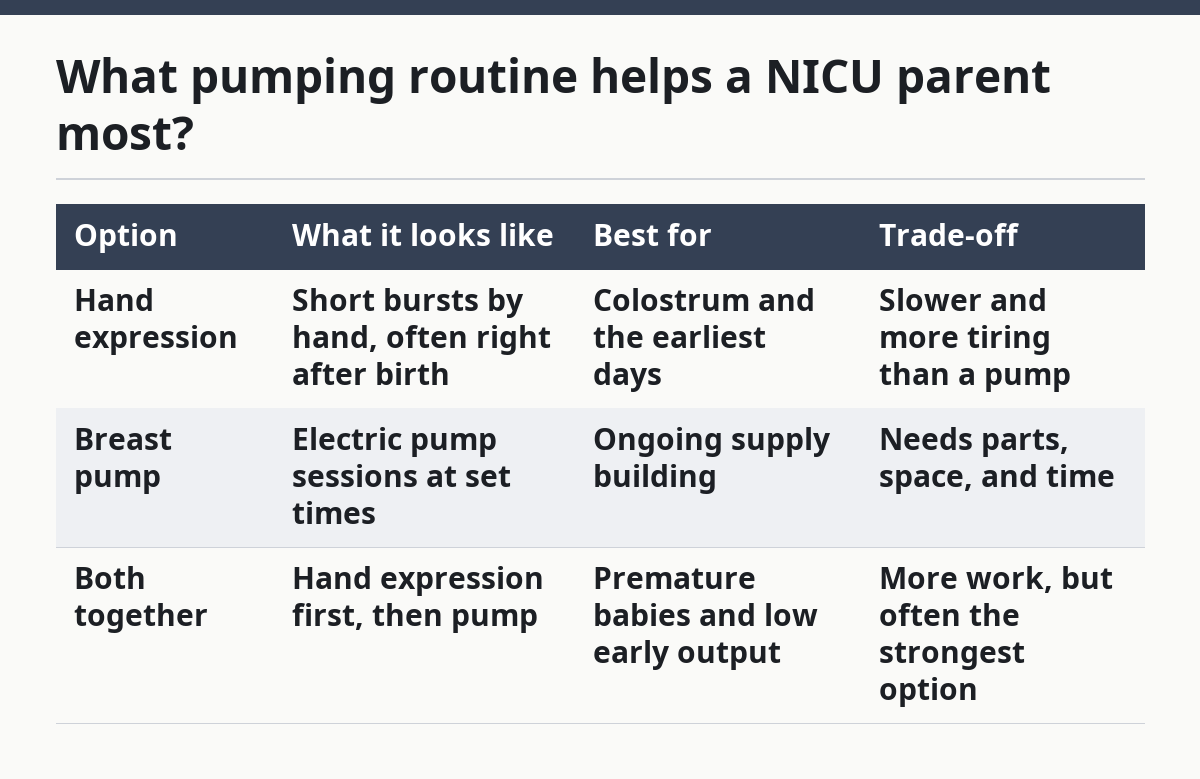
Use the breast pump as the main tool and hand expression as the backup that adds extra stimulation. That pairing matters when the baby cannot nurse directly, because the breast needs the same repeated signal it would get from a term infant feeding well.
A common mistake is treating pumping like a single event, so it helps to check with a lactation consultant if the routine feels ineffective. A NICU parent often needs a schedule that survives bad sleep, hospital hours, travel, and the emotional drain of a preterm birth. A lactation consultant can help adjust flange size, suction comfort, and session timing if the routine feels ineffective.
One practical standard is to choose a pump session length that is long enough to trigger letdown without making your nipples sore or numb. If a session leaves you in pain, the setup is wrong, not your body. That is often a flange fit issue, a suction issue, or both.
Should I use hand expression, a breast pump, or both?
Use both if you can, because each tool helps in a different way. Hand expression works well for colostrum and the earliest drops, while a breast pump is better for regular milk removal when the baby cannot nurse yet or cannot stay at the breast long enough.

Hand expression can be the better first step in the first 1 to 3 days after birth, especially when the amount is tiny. A breast pump then carries the larger job of keeping milk moving across the full day. That combination is often the most practical answer for premature babies.
The trade-off is effort. Hand expression takes practice and can feel slow. A pump takes setup time, cleaning, and the right flange fit. If one method hurts, drains you, or gives no milk despite repeated tries, the problem may be technique rather than supply alone.
How do I protect supply when my baby cannot nurse?
Protect supply by acting like your baby is still feeding, even if the baby is in an incubator or not ready to latch. Milk production depends on removal, so the breasts need regular emptying or near-emptying even when the baby is too small, sleepy, or medically fragile to do the work.

The first priority is consistency across the whole day. If sessions cluster too close together and then stop for many hours, the body gets mixed signals. That pattern is common after a preterm birth, when the day gets broken up by NICU visits, stress, and sleep that comes in fragments.
The second priority is making each session count. Use the pump parts that match your body size, keep the suction comfortable, and bring a clean container so collected milk does not get lost in tubing or bottle corners. Small improvements add up over several days.
The third priority is reducing friction. Store pump parts in the right place, keep a spare set if that is possible, and ask the NICU team how milk is labeled, refrigerated, and transported. A smooth routine matters because missed sessions are often caused by logistics, not motivation.
This is also where a lactation consultant earns their keep. If milk volume stays low after a preterm birth, the issue may be an incomplete latch history, delayed start, poor flange fit, or a medical problem that needs review. That is worth a professional check rather than guesswork.
What mistakes lower milk supply after a preterm birth?
Skipping milk removal for long stretches lowers supply after a preterm birth, and so does relying on a weak latch when the baby is not yet strong enough to feed well. The body responds to repeated milk removal, not to wishful thinking, so gaps show up in the output.
Another mistake is using a pump with the wrong fit. A flange that is too large or too small can make pumping painful, slow, or ineffective. That is a fit problem, not a moral failure, and it usually needs a size check rather than more force.
A third mistake is stopping hand expression too soon. Early colostrum can be hard to collect with a pump alone, so dropping hand expression may cost you valuable milk and stimulation in the first days. The breast pump is not always enough on its own at the start, so it helps to review technique with a lactation consultant if output stays low.
A fourth mistake is calling the supply “low” after one unhelpful session. Premature birth changes the feeding timeline, and early output is often uneven. The better question is whether there is a repeatable pattern over several days and whether the routine is being done often enough.
| Mistake | What it costs | Better move |
|---|---|---|
| Long gaps between sessions | Less stimulation | Short, repeated milk removal across 24 hours |
| Wrong pump fit | Pain and poor output | Recheck flange size and suction comfort |
| Pumping without hand expression early on | Missed colostrum | Add hand expression in the first days |
| Judging supply from one session | False alarm or false reassurance | Look for patterns over several days |
When should I ask for help?
Ask for help if milk stays very low despite regular pumping, if pumping hurts, or if you cannot keep a routine because the NICU schedule is overwhelming. A lactation consultant can spot problems that are easy to miss, including fit, timing, and technique.
It is also wise to ask for help if your baby was born very early and direct breastfeeding is still off the table after the first stretch of recovery. The goal is to protect supply now so the baby has milk available later, when feeding skills improve.
If you are unsure whether the problem is supply, removal, or something medical, do not guess for long. A preterm feeding plan can change fast, and the sooner the routine is reviewed, the easier it usually is to correct course.
This page fits into the larger guide to breastfeeding a premature baby, where the next step is often matching supply work to the baby’s feeding readiness. Here, the job is simpler: keep milk moving until the baby can take over more of the work.
What if pumping feels like it is not working?
Pumping may feel like it is not working even when it is helping, because early output after a preterm birth is often small and uneven. The breast pump is still giving the breast a signal, and that signal matters even when the bottle does not look full.
If the output stays low, check the parts of the routine you can control: timing, flange fit, comfort, and whether hand expression is being used alongside the pump. Those details often explain more than “low supply” as a label.
A lactation consultant is the right person to ask when the routine is in place but the result is not improving. That is especially true in the NICU setting, where stress, long travel days, and short sleep can break the pattern in ways you may not notice.
How can I build supply for a preemie?
Build supply for a preemie by removing milk early, often, and with both tools if possible. Start with hand expression after birth, then use a breast pump on a steady schedule across 24 hours so your body keeps getting the signal to make more milk.
How often should I pump for a premature baby?
Pump often enough that the breast is emptied or nearly emptied across the day, not just once or twice. In practical terms, that means short, repeated sessions spread through the full 24-hour cycle, since a premature baby may not nurse well yet and cannot be counted on to empty the breast.
What if my milk supply is low after a preterm birth?
Low supply after a preterm birth deserves a closer look, not just more pressure. The issue may be timing, pump fit, comfort, or a medical factor, and a lactation consultant can help sort that out. A routine review is often more useful than simply trying harder.
Drafted with AI; not yet reviewed by a person.