
Last updated: November 28, 2026
Quick answer: in the first 24 hours after delivery, colostrum often comes in tiny amounts, and even a few drops can be worth collecting for a premature baby. If a baby is in the nicu or not ready to coordinate sucking, swallowing, and breathing, the goal is to get that milk out early, handle it cleanly, and offer it in a tiny-volume way the baby can manage.
Key takeaways
- Colostrum is the first milk, and it is worth saving even when only a few drops come out.
- For many premature babies, direct breastfeeding is not the first step because the suck-swallow-breathe pattern is still developing.
- Hand expression is often the most practical way to collect the first drops, especially early after birth.
- Tiny amounts can still matter, so the job is to collect, store, and deliver the milk carefully.
- If you are unsure about timing, storage, or the right feeding method, the nicu team should show the plan before you start.
What makes colostrum different for a premature baby?
Colostrum for a premature baby is the first milk, and it matters because it is the earliest milk the body makes while the baby is still learning to feed. The body begins producing colostrum between 12 and 18 weeks of pregnancy, and according to Cleveland Clinic, colostrum can be expressed by about week 37 of pregnancy.
That timing matters because many premature babies are not ready for full oral feeding yet. According to the NHS, babies usually do not coordinate sucking, swallowing, and breathing until about 34 to 36 weeks of pregnancy. That means a baby may be too early to nurse well, even when they are ready for milk in another form.
This is why the first drops are not “too little to count.” Colostrum is the milk that arrives first, and it can be a good early milk to start with when the baby cannot manage a full feed at the breast. The job is not to produce a large bottle right away. The job is to save what comes, even if it is a few drops at a time.
The same early milk also changes quickly. According to Cleveland Clinic, colostrum changes to transitional milk around this time, then to mature milk after about 14 days. That means the first days after birth are a short window, and the milk you collect in that window is especially valuable.
How soon should I start expressing colostrum?
Start as soon as your care team says it is safe, because early expression helps you catch the first milk while production is still starting. According to Cleveland Clinic, the body begins producing colostrum between 12 and 18 weeks of pregnancy, and by the time pregnancy reaches 37 weeks it is usually OK to squeeze out colostrum.
For a premature baby, the practical point is this: do not wait until the baby is ready to latch. If the baby is in the nicu or too early for direct breastfeeding, the first milk still needs to be collected and saved. That gives the baby a chance to receive breast milk even before oral feeding is steady.
A simple order of operations helps:
- Wash your hands and set out a clean container. Use a sterile or clean container the nicu team approves, because the first drops are small and easy to lose on cloth or skin.
- Use hand expression first. Place your fingers around the breast and apply gentle pressure in a rhythm, because the first milk often comes in drops rather than a stream.
- Collect each drop as it appears. Aim the drop into the container or onto a spoon or syringe if your unit uses that method, because a tiny amount can still be useful.
- Keep each session short and calm. A few minutes is enough at the start, since colostrum may come in very small amounts and forceful squeezing is not the goal.
- Label and pass the milk to the nicu staff right away. The baby’s team can tell you how the milk should be stored and when it can be given.
The main mistake is waiting for “enough” milk before starting. That costs time, and early time matters most with colostrum. Another mistake is using a heavy squeeze or a rushed approach, which can make hand expression less effective and more uncomfortable. Gentle, repeated expression usually works better than trying to force a flow.
For a step-by-step refresher, the La Leche League hand expression guide is a practical starting point, and Medela’s expression guide explains the same basics in a different format.
How do I give tiny amounts in the nicu?
Tiny amounts are usually given by the method the nicu team chooses, often with a syringe or another small-volume tool, because premature babies may not be ready for a full bottle or direct nursing. The point is to deliver the milk safely in a way the baby can handle.
Here is the basic comparison of common first-step approaches:
| Method | Why it may fit early colostrum | Main drawback |
|---|---|---|
| Hand expression into a small container | Works well when milk comes in drops and there is no pump setup | Can feel slow at first |
| Syringe or small-volume feed tool | Matches the tiny amount often available in the first days | Needs careful handling and staff guidance |
| Direct breastfeeding | Best when the baby can coordinate sucking, swallowing, and breathing | Many premature babies are not ready yet |
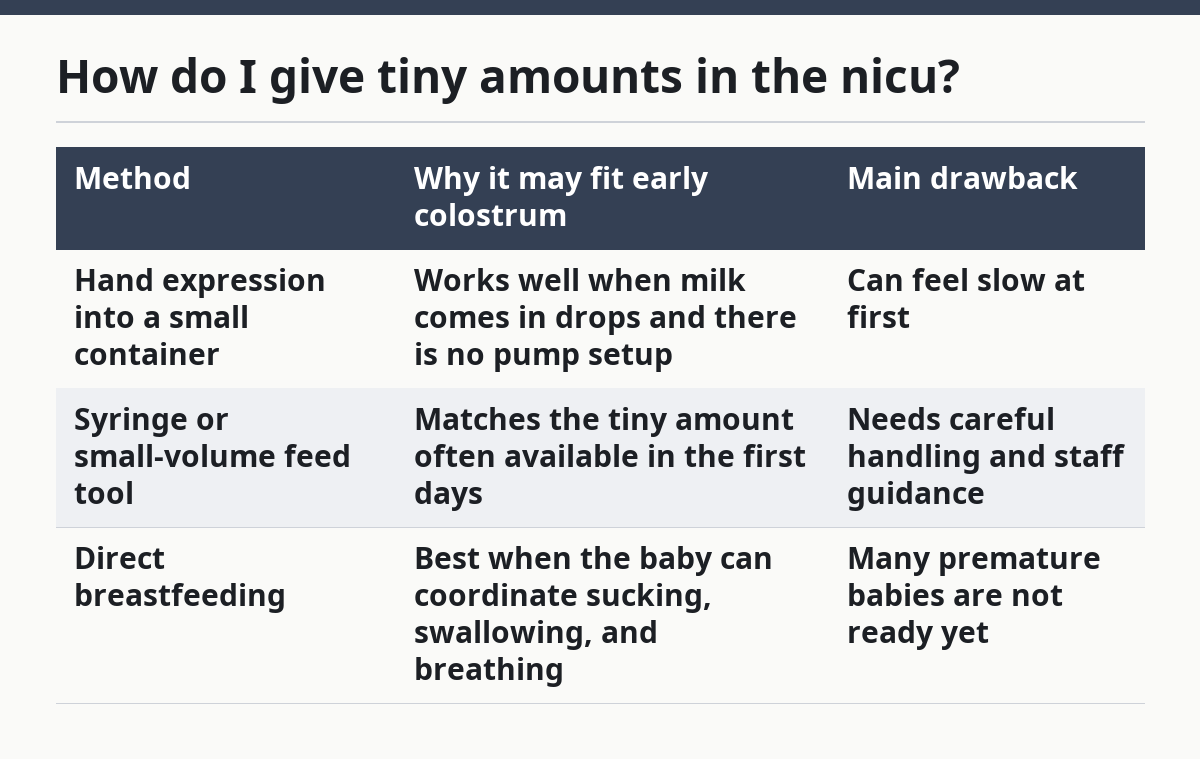
The right choice depends on the baby’s readiness and the nicu plan. A premature baby who cannot coordinate sucking, swallowing, and breathing may need milk offered another way first. That is not a failure. It is a sign the baby needs a feeding route that fits their stage.
The safest mindset is to treat colostrum like a careful feed, not a volume goal. If you collect only a few drops, that still counts. A feed that is too large or too fast is not better just because it looks more impressive. What matters is that the baby receives breast milk in a form the baby can manage.
If the team gives you a syringe, keep the milk clean, move slowly, and follow the unit’s instructions for placement and timing. Do not guess at a faster method at home unless the nicu team has shown you the exact steps. Tiny feeds leave little room for error, so simple is better than improvised.
What does early milk handling in the nicu look like?
Early milk handling in the nicu is about clean collection, careful storage, and clear labeling, because the milk volume is small and easy to mix up. The exact process depends on the unit, but the basics stay the same: keep the container clean, identify the milk clearly, and get it to the staff without delay.
A practical nicu milk routine usually includes these steps:
- Put the milk in a clean container the team accepts.
- Mark the time and date if the unit asks for it.
- Keep the container closed until staff takes it.
- Follow the nicu’s instructions for transport and storage.
- Tell staff if the milk was expressed recently or frozen.
This matters because the milk is often too small to replace if it spills or is mislabeled. A few drops may be the entire session’s output. That makes the handling step as important as the expression step.
This is also where many generic articles leave out the real work. They talk about milk supply in broad terms, but the nicu problem is physical: the milk may be tiny, the container may be small, and the transfer may happen across a fast-moving unit. Clean hands, a closed container, and staff direction reduce the chance of waste.
One more limitation belongs here: this page is not the place for latch training, breastfeeding frequency, or checking whether the baby is getting enough milk. Those are different questions. This page is for the first milk and the first handoff.
For storage basics, CDC guidance on breast milk storage is a reliable reference, and NHS guidance on expressing and storing breast milk is helpful if you need a second source.
What should I expect from the first 24 hours?
Expect very little volume at first, because according to Cleveland Clinic, most people produce about a tablespoon to an ounce of colostrum in the first 24 hours after delivery. That amount may still sound small, but it fits the normal pattern of early milk.
The first days often feel slow because the milk changes before your eyes. Colostrum is thick, concentrated, and limited. Then it changes to transitional milk, and after about 14 days it becomes mature milk, according to Cleveland Clinic. That change is useful to know because it keeps you from judging the first day against later days.
It also helps to know what “enough” can look like in the early period. According to Cleveland Clinic, a baby is getting colostrum if they are maintaining weight and wetting diapers. That does not answer every feeding question, but it gives a concrete sign that milk is being taken in.
This is not the stage for big expectations. It is the stage for repeated collection, careful storage, and patience with small output. If the first sessions yield only drops, that does not mean you are doing it wrong. It usually means the milk is in the exact early phase it is supposed to be in.
What if I am not getting much?
Not getting much at first is common, and it does not mean the colostrum is not there. Early milk may come in drops, not ounces, and hand expression can still be a practical way to collect it while the baby is premature.
The first trade-off is patience versus pressure. If you push hard, you may end up with sore breasts and little gain. If you use a calm, repeated hand-expression pattern, you may collect a small amount without extra strain. That is usually the better fit for the early days.
A second trade-off is time versus perfection. Waiting for a pump setup or a perfect container can cost the first drops. A clean, simple setup is often better than delaying the session while trying to make it ideal.
This approach is not for a parent who has been told to follow a different plan by the nicu team. It is also not a substitute for care if there are pain, bleeding, or other breastfeeding concerns. Those need direct medical guidance. For a premature baby, though, the main goal is steady access to the first milk, not a perfect-looking session.
If you are building the bigger feeding plan, the breastfeeding a premature baby hub page can help with the next steps after these first drops.
How do I fit colostrum into the bigger feeding plan?
Colostrum fits into the bigger plan as the first milk goal, not the whole plan, because a premature baby may need several stages before direct breastfeeding works well. That stage-by-stage approach is normal when the baby is still learning to feed.
Think of the sequence this way: collect the first milk, give it in the form the baby can manage, then move toward more direct feeding only when the baby is ready. The NHS notes that premature babies often need time before they can coordinate sucking, swallowing, and breathing, and that is why the first plan often starts away from the breast.
This is also where skin-to-skin contact may fit if the care team allows it. According to the NHS, for premature babies, skin-to-skin contact reduces stress and pain, supports weight gain, helps breastfeeding, sleep, and body regulation. That does not replace colostrum, but it can support the feeding journey around it.
The honest bottom line is that colostrum for a premature baby is most useful when it is saved early, handled cleanly, and offered in a way the premature baby can tolerate. It is not the place for guesswork. It is the place for small actions done well.
For the larger picture, see the related guides on breastfeeding a premature baby, pumping breast milk for NICU babies, and storing breast milk safely.
How much colostrum does a premature baby need?
A premature baby usually needs only tiny amounts at first, because the first feeds are often limited by the baby’s readiness, not by adult-sized feeding goals. The exact amount should come from the nicu team, since the baby’s size, condition, and feeding route all matter.
Can expressed colostrum be given by syringe?
Yes, expressed colostrum can be given by syringe when the nicu team uses that method. A syringe is often a good match for tiny volumes because it handles small drops without wasting much milk, but the staff should show you how they want it done.
How soon should I express colostrum after birth?
Start as soon as your care team says it is safe, because early milk is easiest to collect while it is still the first colostrum phase. According to Cleveland Clinic, the body begins producing colostrum between 12 and 18 weeks of pregnancy, and by 37 weeks it is usually OK to squeeze it out.
Sources
- NHS, Breastfeeding your premature baby – NHS (checked 28 Nov 2026)
- Cleveland Clinic, Colostrum: What Is It, Benefits & What To Expect (checked 28 Nov 2026)
Drafted with AI; not yet reviewed by a person.