
Last updated: November 26, 2026
The clearest signs are wet diapers, steady weight gain, and your premature baby acting satisfied after feeds. For a preemie, diaper counts matter, but weight checks matter even more because standard newborn rules can miss feeding problems.
Key takeaways
- A preemie’s milk intake is judged by a mix of diaper output, weight trend, and feeding behavior, not by one sign alone.
- From day 5 onward, at least 6 heavy wet nappies every 24 hours is a key marker according to NHS guidance.
- In the first 48 hours, only 2 or 3 wet nappies can still be normal, so early counts need context.
- Weight that stalls or drops after the early newborn period is a reason to check in with a pediatrician.
- A baby who seems calm after feeds can still need follow-up if diapers or weight do not match.
How do I check milk intake day by day?
You check milk intake day by day by watching wet nappies, stool changes, feeding behavior, and weight together. A premature baby can look sleepy and still be underfed, so one sign on its own is not enough.
Start with the diaper log. According to NHS guidance, in the first 48 hours a baby is likely to have only 2 or 3 wet nappies. From day 5 onward, the target is at least 6 heavy wet nappies every 24 hours. That shift matters more than a single good day.
Then look at weight, because weight trend is the clearest long view. Babies normally lose some birth weight in the first 3 to 4 days, then gain weight steadily after that, according to NHS guidance. Frimley HealthierTogether says most babies lose some weight in the first two weeks, but failing to gain weight, static weight, or losing weight can be a concern.
A simple way to think about it is this: diapers show today, weight shows the week, and both together show the pattern. If the diaper count looks fine but weight stalls, that needs a closer look. If weight is fine but wet nappies are low, that also deserves attention.
A premature baby is not the same as a full-term baby, and that is why standard newborn rules can mislead. The term “enough milk” is not about one perfect feed. It is about a steady pattern over several days, especially after the first week.
What wet nappies should I count?
Wet nappies should become more frequent as the days pass, and from day 5 onward you should be looking for at least 6 heavy wet nappies every 24 hours. That is the easiest home check to track.
In the first 48 hours, only 2 or 3 wet nappies can still be typical. That early pattern can feel low, but it is not automatically a problem on its own. The key is whether output rises after that first stretch.
Use the diaper itself, not just the number of changes, as the clue. A heavy wet nappy is more useful than a barely damp one. If you are changing frequently but each nappy is light, the total intake may still be too low.
A log helps here because memory gets messy during night feeds. Write down the time and whether the nappy felt light or heavy. You do not need a perfect chart; you need a pattern over 24 hours. If the count drops compared with earlier days, that can be a concern.
One common mistake is assuming that frequent changes always mean enough milk. They do not. A baby can have a few small wets that do not add up to the expected daily output. Another mistake is waiting for the diaper count to “catch up” on its own. If the number stays low past day 5, it is time to ask for help.
What stool pattern matters?
Stool pattern matters because it gives another clue that milk is moving through the baby’s system. It does not replace wet nappies or weight checks, but it helps fill in the picture.

A preemie’s stool pattern can change fast in the early days, so the main point is trend, not one diaper. If stools are becoming less frequent while wet nappies are also low, that can point to poor intake. If stools are changing but weight is still flat, that also matters.
This is where many generic newborn articles go wrong. They talk as if one type of diaper is enough to judge feeding, but that is too simple for a premature baby. A preemie may feed in smaller amounts, tire faster, and show a weaker pattern in the first days. That is why a single “looks fine” moment is not enough.
Keep your attention on the whole day, not one feed. If there are several feeds with no clear wet nappy later, the total picture weakens. If the baby has wet nappies and is also gaining weight steadily after the first two weeks, that is more reassuring than behavior alone.
The trade-off here is patience versus delay. It helps to watch patterns for 24 hours, but it is not smart to wait many days if the diaper pattern is poor and weight is not moving. That is when the check-in matters more than more observing.
Does weight gain matter more than diapers?
Yes, weight gain matters more than diapers for a premature baby because weight shows whether the milk intake is adding up over time. Diapers can look acceptable for a day while intake is still not enough.

Frimley HealthierTogether says babies should gain weight steadily after the first two weeks, and losing some birth weight in the first two weeks is normal. NHS guidance also says babies normally lose some birth weight in the first 3 to 4 days, then gain weight steadily after that. Those two ideas work together: early loss can be normal, but the curve should turn upward.
If weight is static or falling after the early newborn period, that is a concern. That is true even when the baby seems settled after feeds. A baby can fall asleep at the breast or bottle and still not take enough milk.
This is why weight checks are not a backup plan. They are part of the main plan. A pediatrician may want to see the trend over several checks, not just one weigh-in. For a premature baby, that trend tells more than a one-day snapshot.
Here is the blunt version: if the diaper count is borderline and the weight is flat, do not wait for a better mood or longer sleep stretch. Those are not reliable fixes. The safer move is a feeding review.
What does a satisfied preemie look like?
A satisfied preemie often looks settled after feeds, but that alone does not prove enough milk. Content behavior helps, yet it can be misleading if the baby is too sleepy or too weak to feed well.
What you want to see is a pattern that matches the intake signs. A baby who feeds, then has the right wet nappies, then shows steady weight gain gives a much better picture than behavior alone. If the baby seems sleepy all the time and the diaper output is low, that is not a reassuring sign.
Do not use sleep as proof of fullness. Frimley HealthierTogether says that in the early weeks, babies may sleep for less than 3 hours, and this is normal. That means sleep length is not a clean marker either way. A baby can sleep a lot and still need a feeding review.
A practical mistake is treating a calm baby as a “good feeder” without checking the numbers. Calm can mean content, but it can also mean tired. The safer habit is to pair the behavior with the diaper log and the weight trend.
This is also why this page is not for parents who want a quick yes-or-no answer from one symptom. For a premature baby, that shortcut can miss a real feeding problem. The better question is whether the full pattern supports enough milk over time.
When should I call the pediatrician?
You should call the pediatrician when wet nappies stay low, weight stops moving up, or your baby’s feeding pattern changes in a worrying way. Those are the red flags that matter most for a premature baby.
A few examples stand out. If the baby is past day 5 and still not reaching the expected wet nappy pattern, that needs review. If the baby has stopped gaining weight, is losing weight beyond the early newborn period, or seems too sleepy to feed well, that also needs attention. Frimley HealthierTogether calls static weight or weight loss a concern.
Do not wait for every sign to become obvious. A low diaper count and a flat weight trend are enough reason to ask. This is especially true if you are trying to guess whether the baby is getting enough milk without professional follow-up. That guess is not reliable enough for a preemie.
A quick call is better than a long wait if you are unsure. Bring the diaper log and the weight dates if you have them. That makes the conversation shorter and more useful, because the pediatrician can judge the trend instead of guessing from memory.
If you want the broader feeding picture, this article sits under the main guide to breastfeeding a premature baby, which is where the wider questions about preemie feeding belong.
What is the fastest way to judge milk intake?
The fastest way to judge milk intake is to compare wet nappies, weight, and feeding behavior against the day the baby is on. That gives you a real-world check instead of a guess.
| What you see | What it can mean | What to do next |
|---|---|---|
| 2 or 3 wet nappies in the first 48 hours | Can still be typical | Keep tracking over the next days |
| At least 6 heavy wet nappies every 24 hours from day 5 onward | More reassuring | Keep watching the trend |
| Weight loss in the first 3 to 4 days | Can be normal | Recheck the next weights |
| Static weight or weight loss after the early period | Can be concerning | Call the pediatrician |
| Baby seems sleepy after feeds | Not enough on its own | Pair it with diapers and weight |
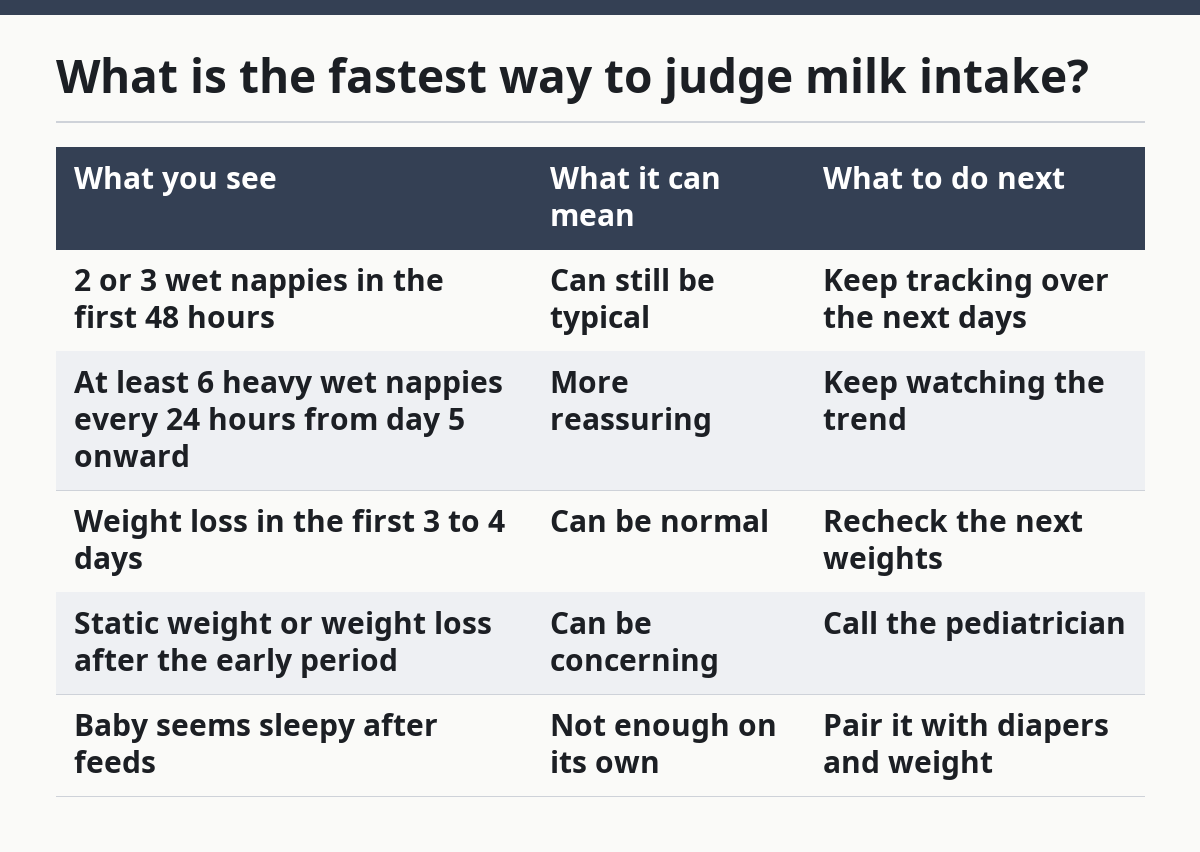
The table is useful because it shows what to watch without turning one clue into the whole story. That matters for premature babies, where feeding can be uneven from day to day.
Do not overread a single good day. One heavier nappy or one settled feed does not cancel a poor week. The question is whether the pattern is moving in the right direction.
How many wet diapers should a premature baby have?
From day 5 onward, a premature baby should have at least 6 heavy wet nappies every 24 hours according to NHS guidance. In the first 48 hours, only 2 or 3 wet nappies can still be typical. The point is to watch the shift over time, not one isolated day.
What are signs my preemie is getting enough milk?
The strongest signs are steady weight gain, the right wet nappy pattern, and a feeding pattern that looks stable across the day. A premature baby who is past the first days and is having at least 6 heavy wet nappies every 24 hours is on a better track. Weight that starts rising after the early drop is another good sign.
When should i call the pediatrician about feeding?
Call the pediatrician if wet nappies stay low, weight stops rising, or your baby is losing weight after the early newborn period. Frimley HealthierTogether says failing to gain weight, static weight, or losing weight can be a concern. If you are unsure, bring the diaper log and ask for a feeding review.
Sources
- nhs.uk, Breastfeeding: is my baby getting enough milk? – NHS (checked 26 Nov 2026)
- frimley-healthiertogether.nhs.uk, Is my baby getting enough breast milk? :: Frimley HealthierTogether (checked 26 Nov 2026)
Drafted with AI; not yet reviewed by a person.