Last updated: November 19, 2026
Quick Answer: In 3 steps, you can usually make pumping more comfortable: start with the lowest suction, center the nipple in the flange, and stop before rubbing or pinching begins. If you are learning how to use a breast pump without pain, the main goal is to adjust fit, suction, and session length before the nipple gets sore. Pain that is sharp, lasting, or causes cracked skin should be assessed by a lactation professional or clinician.
Key takeaways
- Pain usually comes from too much suction, a poor flange match, or pumping too long.
- A normal pumping session should feel like pulling, not stabbing, rubbing, or burning.
- Small changes matter: a softer setting, a better flange position, or a shorter session can change comfort fast.
- Nipple cream can help with surface soreness, but it does not fix a bad fit.
- Pain that does not fade when settings change should be treated as a warning sign, not something to push through; CDC breastfeeding guidance and NHS expressing breast milk advice both support adjusting technique when pumping is painful.
How do I start a breast pump session without pain?
Start a breast pump session by using the lowest comfortable suction and building up only if the milk starts flowing easily. A gentle start matters because the first minute is when the nipple and areola are most likely to feel stretched or pinched.
Use this simple order:
- Set the pump to the lowest stimulation or expression setting available. The goal is a light pull, not a strong yank.
- Place the flange so the nipple sits in the center of the tunnel, with little side rubbing. If the nipple brushes the sides right away, stop and adjust before turning the suction up.
- Turn the suction up slowly only until milk starts moving well. If a setting feels “effective” but hurts within a few pulls, that setting is too high for this session.
- Watch the nipple movement for the first few minutes. The nipple should move in and out without the skin at the base being dragged hard into the tunnel.
- End the session if pain builds instead of fading after a short start-up period. A pump session should not get more painful as the minutes pass.
A practical rule helps here: comfort comes first, and milk flow comes second. A breast pump that works well at a moderate setting is better than one cranked high enough to make the nipple swell or blanch. If the pump has more than one mode, use the gentler mode first and only switch once the milk is flowing.
This is also where nipple cream can help, but only as support. A thin layer may reduce dry friction on already tender skin, yet cream will not make a harsh suction setting feel right. If the pump hurts in the same spot every time, the problem is usually mechanical. For basic pump setup and comfort, the CDC and NHS both advise checking fit and technique rather than pushing through pain.
What flange fit symptoms should I watch for?
Therefore, flange fit symptoms show up as rubbing, pinching, white rings, swelling, or skin that gets pulled too far into the tunnel. Those signs matter because a flange that is off by even a little can make a short session painful.
The most useful clues are plain and visible:
- Rubbing on the sides of the tunnel: the nipple is likely not centered well, or the tunnel shape is not giving enough room.
- Pain at the base of the nipple: the opening may be too tight, or the suction may be too strong for the current session.
- Blanching or whitening after pumping: the tissue may be getting compressed too hard.
- Areola pulled deeply into the tunnel: the pump may be grabbing too much surrounding skin.
- Redness that lasts after the session: friction or pressure is too high.
A common mistake is to ignore these signs because milk is still coming out. Milk output is not the same as comfort. A session that “works” but leaves the nipple tender is often setting up more pain later in the day.
If the flange seems wrong, do not just add more suction to compensate. That usually makes the rubbing worse and can turn a small problem into cracked skin. Adjust the pump first, then the flange position, then the session length. If none of that helps, the fit itself may need a separate check on another page.
For readers who want the broader equipment picture, the hub on breastfeeding equipment and pumping basics covers the larger setup around the breast pump and related supplies.
How long should a pumping session be?
Therefore, a pumping session should be short enough that the nipple still feels normal at the end, not scraped or swollen. The right length depends on comfort more than on a fixed clock, because the goal is to remove milk without creating friction injury.
A session that runs too long often causes pain in a predictable order. First comes mild warmth, then tenderness, then rubbing, then a sharper sting when the skin gets tired. That is the point to stop, even if the pump was set correctly at the start.
A few practical signs say the session has gone long enough:
- The nipple starts to look puffy or stretched.
- The suction feels stronger than it did at the start, even though the setting has not changed.
- Milk slows down and the pump begins to feel like empty pulling.
- The skin at the nipple base starts to ache instead of moving comfortably.
Shorter, more frequent sessions are often easier on the skin than one long session that leaves it sore. That trade-off matters for anyone already dealing with tender tissue, including a parent who is pumping often and cannot afford a raw nipple at the next session.
The usual mistake is to keep going after milk flow slows just to “get the last drops.” Those last minutes are often where pain begins. Stopping while the skin still feels okay is better than forcing a longer session and paying for it afterward.
Why does suction comfort matter so much?
Because suction comfort matters, the pump should move milk, not bruise tissue. Too much suction can make the nipple swell, turn pale, or feel sore for hours, while too little suction may be annoying but still gentler on the skin.
The right level is the one that feels strong enough to trigger flow without creating a pinch. That is not the same as the highest setting the pump can reach. A higher number on the dial is not a sign of better pumping if it makes the nipple hurt.
Here is a simple comparison of what different settings usually do:
| Pump setting | What it may feel like | What it costs | What to do instead |
|---|---|---|---|
| Low suction | Light tugging, easier to tolerate | May feel slower at first | Start here and build only if needed |
| Moderate suction | Firm pull with some movement | Can be comfortable or too strong | Stay here if milk flows and the nipple stays calm |
| High suction | Strong pulling, more risk of soreness | Can cause swelling, blanching, or pinching | Lower it if pain starts, even if milk is still flowing |
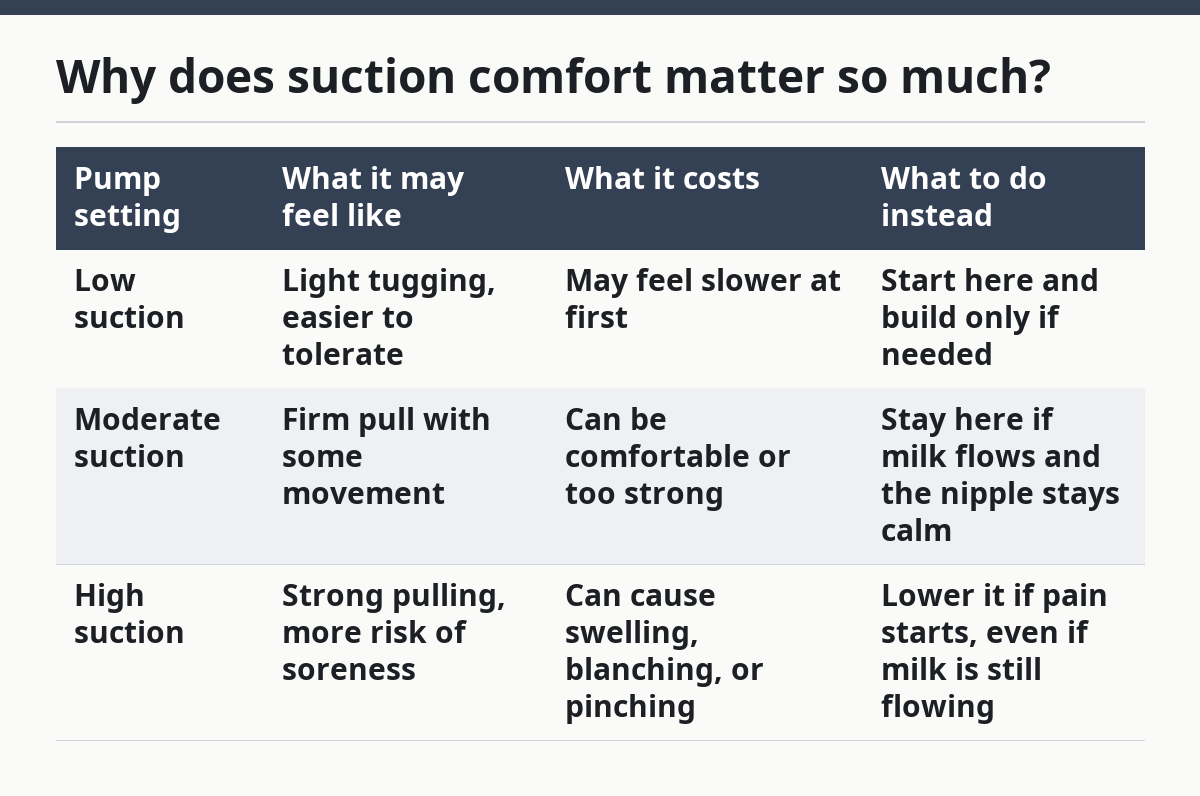
A lot of people assume pain means the pump is “working harder.” That is a bad bargain. A pump that hurts may be creating damage faster than it is helping milk removal. Comfort should be treated as part of the job, not as a bonus; the CDC and NHS both emphasize comfort-focused troubleshooting when pumping is painful.
If a higher setting seems necessary every time just to get milk moving, the fit or position may be off. That is a clue to slow down, re-center the nipple, and check whether the flange tunnel is the real problem.
What should I do if pumping still hurts?
If pumping still hurts, stop the session and change one thing at a time: suction, position, or session length. Pain that stays the same after a small adjustment is a sign that the problem is not just temporary sensitivity.
A good reset looks like this:
- Lower the suction to the gentlest level again.
- Re-seat the flange so the nipple is centered and not scraping the sides.
- Shorten the session and see whether the pain fades before the end.
- Use nipple cream if the skin feels dry or raw on the surface.
- Pause pumping if the pain becomes sharp, the nipple looks damaged, or the tenderness is getting worse with each session.
This is the point where a reader needs an honest line: some pain should not be pushed through. A pump that causes repeated injury is not something to “get used to.” It is wrong for sessions that leave the nipple cracked, bleeding, or more painful each time.
Breast pump pain is also not the same as the early learning curve of breastfeeding itself. If the pain is tied specifically to the pump, focus on the equipment and settings first. If pain continues despite gentler settings and better positioning, that is the moment to ask a lactation professional or clinician for help.
For background on breastfeeding and pumping equipment, the CDC’s breastfeeding resources and the NHS guidance on expressing breast milk are useful starting points: CDC breastfeeding recommendations and NHS expressing breast milk pages are both established public health references.
How do I make pumping more comfortable?
If you want to make pumping more comfortable, reduce friction, shorten the session, and treat the nipple like skin that can get irritated. Small changes, especially on a day when the tissue is already tender, often do more than a bigger suction setting ever will.
A few comfort fixes are practical right away:
- Use nipple cream on dry or sore skin before or after pumping, as directed by the product label.
- Start at a lower setting and wait for milk to begin moving before increasing suction.
- Keep the nipple centered so it is not rubbing one side of the flange tunnel.
- Stop before the skin gets tired, even if the pump still feels productive.
- Watch for warning signs like blanching, swelling, or soreness that lingers after the session.
This is also where honest limits matter. Nipple cream can soothe skin, but it cannot fix a flange that is pinching or a pump setting that is too aggressive. If comfort only improves for a minute and then pain returns, the session setup is still wrong. For persistent pain, the CDC and NHS both point readers toward technique changes and professional support rather than continued discomfort.
A reader who wants a simple rule can use this one: mild pressure is acceptable, pain that makes you brace is not. If pumping feels tolerable at the start and then gets worse, the session should end sooner next time, not later. That is often the difference between a manageable routine and a sore, frustrating one.
Why does pumping hurt?
Because pumping hurts when the suction is too strong, the flange rubs the nipple, or the session goes on long enough to irritate the skin. It can also hurt when the nipple is pulled too far into the tunnel or when the pump is started too fast. A comfortable session should feel like a steady pull, not a sharp pinch.
Should pumping ever hurt?
No, pumping should not hurt in a way that feels sharp, burning, or steadily worse. Mild pressure can happen at the start, but pain that keeps building is a sign that something needs to change. If the pain lasts after the pump is off or leaves visible redness, the setup needs attention.
How do I make pumping more comfortable?
Therefore, make pumping more comfortable by lowering the suction, centering the nipple in the flange, and stopping before the nipple gets sore. Nipple cream can help if the skin is dry or irritated, but it will not solve a bad fit. If comfort does not improve after a few small changes, the problem needs a closer look.
Drafted with AI; not yet reviewed by a person.