
Last updated: November 28, 2026
Quick answer: the safest approach is to follow the hospital’s feeding plan exactly, keep a written log, and use your pediatrician and lactation consultant as your back-up team. If you are looking for a practical guide to how to breastfeed a premature baby at home after NICU discharge, home care usually means careful scheduling, close observation, and quick follow-up rather than trying to improvise. For general breastfeeding support, the CDC breastfeeding guidance and the American Academy of Pediatrics are good starting points.
Key takeaways
- A home feeding routine after NICU discharge should be written down, not guessed.
- The first 24 hours at home are about routine, records, and small adjustments, not dramatic changes.
- A feeding log is more useful than memory when a premature baby seems sleepy or the day feels chaotic.
- You still need follow-up support after discharge, especially from a pediatrician and lactation consultant.
- This is not the time to “wait and see” if the plan is confusing or the baby is feeding very differently from the NICU routine.
What changes after NICU discharge?
What changes after NICU discharge is that the monitoring moves from trained staff to you, and the feeding plan becomes a home routine you must keep steady. In the NICU, weights, intake notes, and staff checks happen around the clock. At home, you are the one keeping the record, watching behavior, and carrying the plan forward until the next follow-up.
That shift is why the home feeding routine after NICU discharge should be treated like a handoff, not a fresh start. The NICU team may send home instructions about breastfeeds, supplements, pumping, or a combination of all three. Those instructions matter more than a generic breastfeeding article because premature babies are not all ready for the same pace.
A lot of generic guidance gets this wrong by speaking as if every newborn starts from the same place. A premature baby may tire faster, need more rest between feeds, or have a more fragile rhythm at the breast. That does not mean breastfeeding has failed. It means the home plan has to fit the baby you actually have.
Keep the written discharge plan in one place on day one. If the paper uses terms you do not understand, list the exact words and ask the pediatrician or lactation consultant to translate them at the first follow-up. A 10-minute call can save days of confusion.
How do I set up the first day at home?
How do I set up the first day at home? Start with a simple, repeatable setup: the feeding plan, a clean place to sit, a notebook or app for the log, and the phone numbers for the pediatrician and lactation consultant within reach. The goal is not a perfect day; the goal is a predictable one.
Use a chair with arm support and a firm pillow so your shoulders do not take all the load. Keep water, burp cloths, and the discharge instructions in the same spot every time. If pumping is part of the plan, set that up before the first full day passes so you are not scrambling later.
Here is the core procedure for the first 24 hours at home:
- Put the NICU discharge instructions on the counter or nightstand before the first feeding. This keeps the plan visible when you are tired.
- Write the first feed time, side used, and any supplement or pumped milk given. A simple log works better than memory at 2 a.m.
- Feed in the same quiet spot for the first few sessions. A calmer setting helps you notice the baby’s cues and your own posture.
- Stop and record what happened after each feed, even if it was short. That note becomes useful at the next check-in.
- If the plan includes both breast and bottle, keep the order the same unless the NICU team told you otherwise. Consistency reduces guesswork.
- Save one place for follow-up numbers and appointment times. A sticky note is fine if that is what you will actually use.
Because the first day can feel overwhelming, do not redesign the plan because a neighbor or relative has a strong opinion. Premature babies often do best when the home feeding routine after NICU discharge follows the discharge plan closely, at least until the first pediatric review. A 24-hour log gives you something concrete to discuss instead of vague worries.
How do I keep a feeding log that actually helps?
A feeding log helps when it is short, consistent, and easy to fill out after every feed. The best log is the one you can keep using on an exhausted day, not the one that looks impressive for 12 hours and then falls apart.
Write down the time, which breast was offered first, how long the feed took, and whether the baby needed extra milk or a pump session. If the NICU team used specific terms, copy them exactly. If you change the format every day, the log becomes hard to read and useless at follow-up.
A paper notebook is fine. So is a notes app. A printed chart works if you like checkboxes, and those checkboxes can help on a day when you are counting feeds rather than writing long notes. The tool matters less than the habit.
| Log item | What to write | Why it matters |
|---|---|---|
| Time | 7:10 p.m. | Shows spacing and patterns |
| Side | Left first | Helps you keep the plan balanced |
| Length | Short or long feed | Shows stamina over time |
| Extra milk | Yes or no | Tracks the full plan |
| Behavior | Sleepy, alert, fussy | Gives context for follow-up |
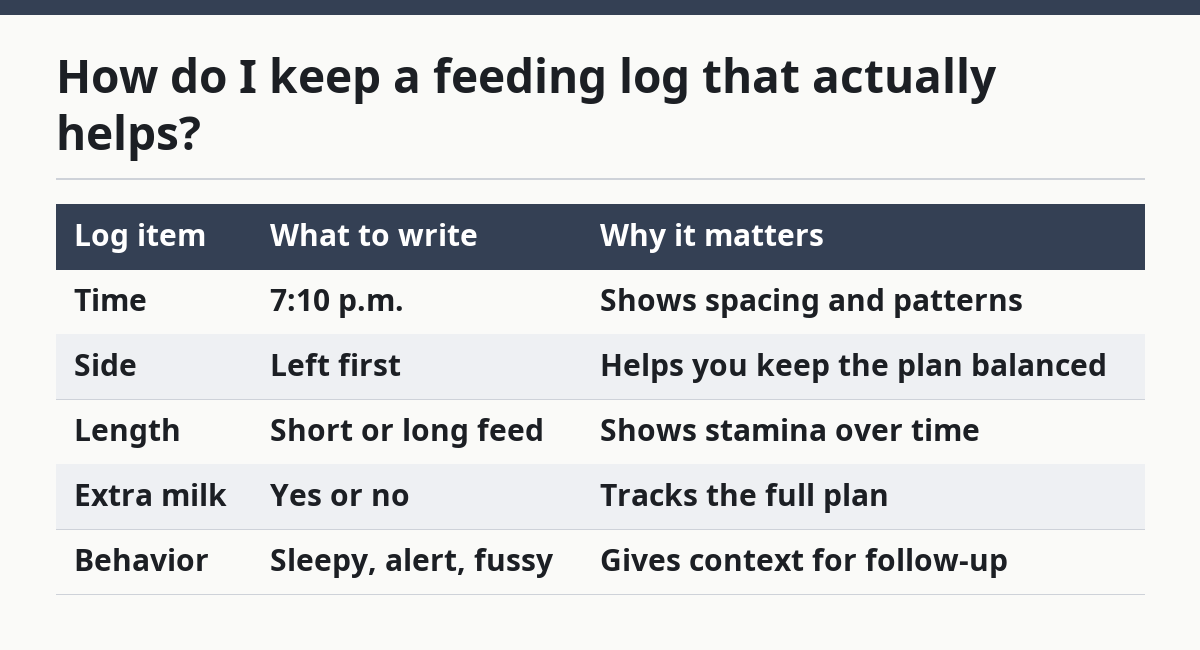
A feeding log is especially useful when the baby seems to change from one day to the next. Premature babies can have short, uneven feeds at home because they are still building stamina. A record makes those swings easier to describe to a pediatrician or lactation consultant.
The main mistake is trying to remember everything. Memory blurs fast when feeds happen through the night. A log turns a blurry week into a timeline you can use.
What support should I still use after discharge?
You should still use follow-up support after discharge from both the pediatrician and the lactation consultant, because the NICU plan often needs small home adjustments. Discharge does not mean the feeding job is finished; it means the setting has changed.
Schedule the follow-up appointment exactly as instructed in the discharge papers. Bring the feeding log, not just your questions. The log lets the clinician see patterns over several days instead of a single difficult feed, including whether the routine changed across 3, 4, or 5 feeds rather than one isolated moment.
A lactation consultant can help with latch, positioning, pumping questions, and ways to make the home routine less physically punishing. A pediatrician can look at the big picture and decide whether the feeding plan needs to change. Those roles are different, and both matter after NICU discharge.
This is one place where a generic article often leaves parents on their own too soon. It may say “ask for help,” but not say what kind of help. In this situation, the right help is specific: feeding technique from the lactation consultant, overall growth and health review from the pediatrician, and the discharge plan as the baseline. For more background, the CDC breastfeeding guidance covers breastfeeding support, and the AAP offers parent-facing infant feeding material.
One practical rule: if a change is about the breast, latch, or pumping setup, start with the lactation consultant. If the change is about the overall feeding plan, the baby’s health picture, or whether the routine should shift, start with the pediatrician. If you are unsure, call the number on the discharge papers and ask who should handle it.
For broader background on breastfeeding support, the CDC breastfeeding guidance is a solid place to start, and the American Academy of Pediatrics also has parent-facing material on infant feeding.
What mistakes slow down progress?
The most common mistakes are changing too much at once, skipping the log, and treating one rough feed like proof that the whole plan has failed. Those mistakes cost time and make it harder to see what the baby is actually doing. If you are unsure whether a change is safe, check with the pediatrician or lactation consultant before you make it.
A big change on day two can backfire. If you move the schedule, the position, and the supplement plan all at once, you lose the ability to tell what helped or hurt. Change one thing at a time unless the pediatrician or lactation consultant tells you otherwise.
Another mistake is trying to do everything from memory. That sounds manageable until you are tired and the baby has fed three times overnight. Without a log, it becomes easy to miss a pattern that matters.
A third mistake is assuming a feed that looks short or messy means the baby is doing worse. Premature babies often have uneven stamina at home. The right response is usually to record it, stay with the plan, and bring the details to follow-up rather than improvising a new routine in the moment.
Here is a simple comparison of what to do instead:
| Common mistake | What it costs | Better move |
|---|---|---|
| Changing several parts of the plan at once | No clear way to tell what worked | Adjust one piece only |
| Skipping the log | Poor follow-up information | Write feeds down every time |
| Rewriting the routine after one hard feed | Extra stress and confusion | Keep the discharge plan as the baseline |
| Waiting to ask for help until the pattern is obvious | Delayed support | Call early if the plan is hard to follow |
When is home breastfeeding not enough on its own?
Home breastfeeding is not enough on its own when the discharge plan includes extra milk, pumping, or a specific feeding order that you cannot follow consistently. That is not failure; it is the plan the NICU gave you for this stage.
The main warning sign in a practical sense is not a single difficult feed. It is a pattern of feeds that you cannot keep track of, cannot complete as instructed, or cannot describe clearly to the pediatrician or lactation consultant. If the log is full of blanks because the day felt unmanageable, that is a support problem as much as a feeding problem.
This is also the place to be honest about who this guide is not for. It is not for a parent who is looking for a one-size-fits-all feeding schedule, because premature babies leave the NICU with different needs. It is not for anyone trying to ignore the discharge plan and follow internet advice instead.
The home feeding routine after NICU discharge works best when it stays close to the hospital plan until follow-up says otherwise. That approach is slower than people want, but it gives the baby a steadier path and gives you cleaner information to bring back to the care team.
If you want the larger picture behind this stage, the hub page on breastfeeding a premature baby is the right place to start before you branch into more specific questions.
What changes after nicu discharge?
The biggest change after NICU discharge is that you become the person keeping the feeding plan on track at home. The hospital tools are gone, so your notebook, your schedule, and your follow-up appointments matter more than ever. That is why a clear home feeding routine after NICU discharge is so useful.
How often should i breastfeed at home?
You should follow the NICU discharge plan and not guess at a new schedule. If the paper instructions are unclear, use them as written until you can check with the pediatrician or lactation consultant. A premature baby often needs a plan that is different from a term newborn’s routine.
Who should i call if feeding goes poorly at home?
Call the pediatrician or lactation consultant listed in the discharge paperwork. If you are unsure which one should answer, start with the number given for follow-up support and explain exactly what changed. Bring the feeding log details so the person on the phone can hear the pattern, not just the worry.
Drafted with AI; not yet reviewed by a person.