Last updated: November 28, 2026
A premature baby may be ready for full breastfeeding when breathing, sucking, and swallowing work together, the baby stays awake long enough to feed, and rooting shows real interest in the breast. Those signs matter more than age alone, because readiness depends on coordination and stamina, not just the calendar.
Key takeaways
- Readiness shows up in a cluster: steady breathing, alert periods, rooting, and a suck-swallow-breathe pattern that does not fall apart.
- A baby who starts strong but tires fast may be near readiness, but not fully there yet.
- Crying, limpness, color changes, or repeated stopping are warning signs that the feed is too much right now.
- A NICU team can help judge readiness using bedside cues, not just weight or gestational age.
- Full breastfeeding is not the same as a long try at the breast; the baby has to stay organized through the whole feed.
What signs matter most?
The most useful signs are coordinated sucking, swallowing, and breathing, along with enough alertness to keep working at the breast. A premature baby who is ready for fuller breastfeeding usually comes to the breast awake, roots or opens the mouth, latches with less struggle, and keeps a steady rhythm without long pauses or stress.
That rhythm matters because premature babies often have immature suck-swallow-breathe coordination. If the feed looks smooth for a few minutes and then breaks down, that can mean the baby is close but still building the control needed for full breastfeeding.
The signs to watch are practical, not vague:
- The baby wakes for feeds without a long battle.
- The mouth turns toward the breast or nipple.
- Sucking starts and does not look frantic.
- Breathing stays even enough that the baby can keep feeding.
- The baby does not fade out after a very short try.
This is different from “looks hungry.” Hunger cues can show interest, but readiness for full breastfeeding means the baby can manage the work of the feed. A baby may want to nurse before the body can handle a full session.
If the NICU team is already tracking feeding skills, use their language. Terms like state control, endurance, and suck-swallow-breathe coordination are not just chart words; they point to the exact skills that matter here. For general guidance on premature infant feeding readiness, the CDC and the American Academy of Pediatrics both have public breastfeeding resources that discuss the special needs of preterm babies.
How does suck-swallow-breathe coordination show readiness?
Suck-swallow-breathe coordination shows readiness when the baby can keep the three actions in a workable pattern without frequent stopping or distress. A mature feed is not just “suck harder”; it is a timed rhythm that lets the baby take milk and still breathe safely.
A premature baby who is close to ready often shows:
- several sucks in a row
- a swallow that fits into the rhythm
- short pauses that look planned, not panicked
- no obvious gasp, cough, or long breath-holding
The opposite pattern is easy to spot too. If the baby sucks a few times, loses rhythm, pulls off, or looks worked up, the coordination may still be too immature for full breastfeeding. That does not mean breastfeeding is off the table. It means the baby may need more time, shorter attempts, or more support from the NICU team.
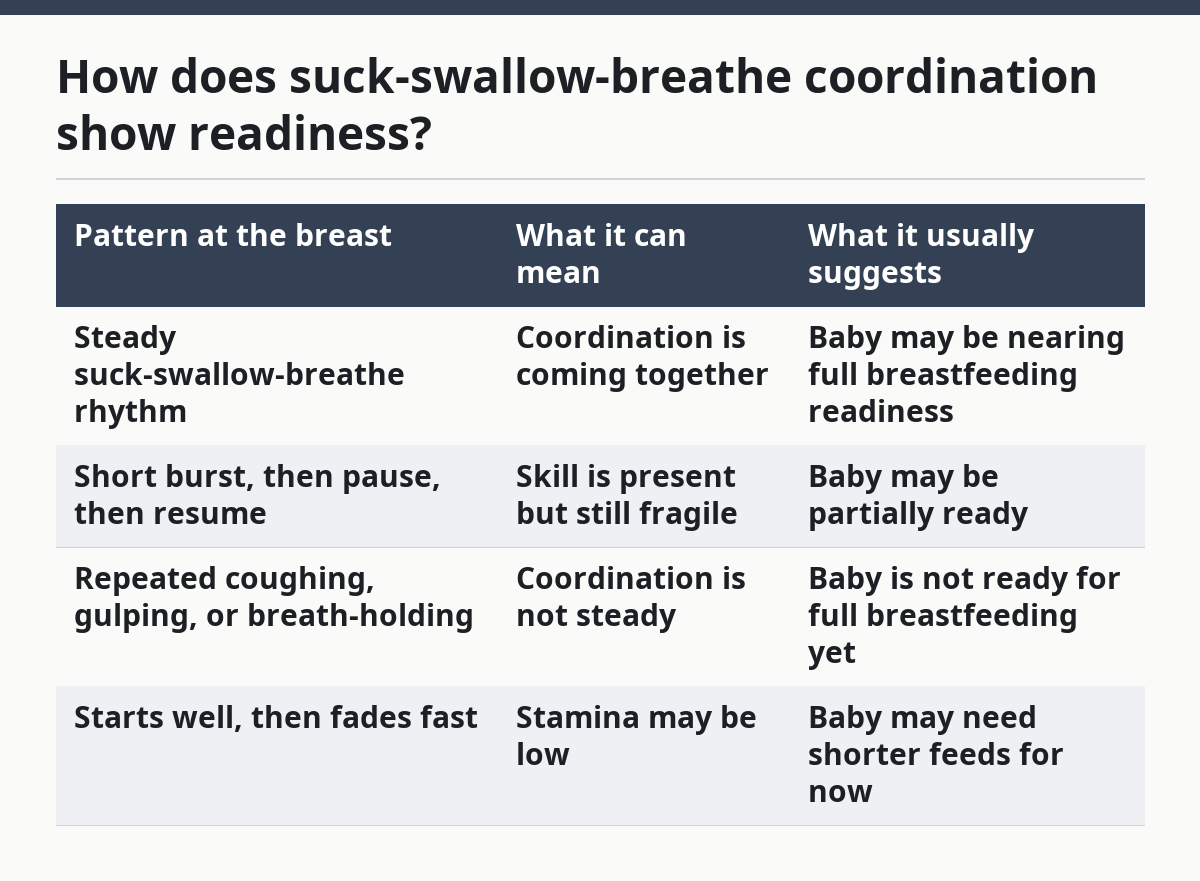
Here is a simple comparison of what the breastfeed may look like:
| Pattern at the breast | What it can mean | What it usually suggests |
|---|---|---|
| Steady suck-swallow-breathe rhythm | Coordination is coming together | Baby may be nearing full breastfeeding readiness |
| Short burst, then pause, then resume | Skill is present but still fragile | Baby may be partially ready |
| Repeated coughing, gulping, or breath-holding | Coordination is not steady | Baby is not ready for full breastfeeding yet |
| Starts well, then fades fast | Stamina may be low | Baby may need shorter feeds for now |
A feed that looks “busy” is not always a good feed. Smooth, organized work matters more than speed.
Does alertness and rooting matter?
Alertness and rooting matter because a baby cannot feed well if the brain state is wrong for learning and stamina. A premature baby who is ready for full breastfeeding usually has quiet alert periods, turns toward the breast, and opens the mouth when the cheek or lip is touched.
Rooting is one of the clearest bedside clues. The baby may turn the head, open wide, or make repeated searching movements toward the breast. That shows interest, but it also shows the nervous system is organized enough to start the feed.
State control is the other half of the picture. A baby who swings from sleepy to frantic, or who cannot stay calm long enough to latch, may not be ready yet. In a NICU setting, this often shows up as a baby who needs too much help staying organized before the feed even starts.
The difference between “awake enough to try” and “ready for full breastfeeding” can be small. A baby may root once, latch, and then fall asleep after a few minutes. That still counts as useful information. It says the baby is practicing, but may not yet have enough state control for the whole feeding job.
A useful rule is simple: rooting opens the door, but alert, stable behavior has to carry the baby through the feed. Without that, the breast may be a short practice session rather than the main feeding method.
How long should a feed hold together?
A feed should hold together long enough that the baby keeps working without falling apart. There is no single clock time that proves readiness, but a baby who can stay organized through the feeding window is giving a stronger signal than a baby who starts well and then shuts down quickly.
This is where feeding stamina comes in. Premature babies often have enough interest for the first part of a feed, then tire before they finish the work. That is not failure. It is a common sign that the muscles and nervous system are still building endurance.
A fuller breastfeeding pattern usually looks like this:
- The baby wakes in a usable state, not just in a half-asleep fuss.
- The baby roots or opens the mouth when brought to the breast.
- The latch starts with limited struggle.
- The baby keeps a steady suck-swallow-breathe rhythm for more than a brief burst.
- The baby stays engaged until the feed naturally winds down, not because the baby is overwhelmed.
- The baby can recover after the feed without obvious stress.
That last point matters. A feed is not only about what happens at the breast. It also matters how the baby looks after: settled, not wiped out, not visibly stressed, not fighting to recover. If a baby needs a long time to regroup after a short feed, the body may not be ready for full oral work yet.
Readiness is a pattern across several feeds, not a one-time lucky session. One good latch does not mean the baby is done building skills.
What should I watch during a practice feed?
You should watch the baby’s rhythm, color, energy, and ability to keep feeding without signs of strain. A good practice feed gives clear clues, and those clues are often easier to spot than milk volume.
Use this step-by-step check during a breastfeeding attempt:
- Start with the baby in a calm, alert state, usually during a routine feeding window, and look for rooting or mouth opening.
- Bring the baby to the breast and watch for a latch that does not need repeated re-positioning.
- Listen and look for a suck-swallow-breathe pattern that stays organized for several minutes, not just a few strong sucks.
- Notice whether the baby keeps the same level of effort or begins to fade, gulp, cough, or pull off.
- Pause and check the baby’s overall state at the end of the feed: calm, drowsy, or stressed.
- Share those concrete observations with the NICU team so the next feed can match the baby’s current skill level.
This method is useful because it focuses on what the baby actually does, not on guesswork. It also keeps the NICU team in the loop, which matters when feeding skills are changing from day to day.
If a baby shows strong interest but cannot hold the pattern together, that is useful data. It usually means the baby is practicing, not yet finished. A short, well-timed attempt can be better than forcing a long feed that drains the baby.
What signs mean full breastfeeding is not ready yet?
Full breastfeeding is not ready yet if the baby cannot stay organized, tire shows up quickly, or feeding triggers stress. A premature baby may need more time when the feed looks messy from the start or falls apart before a useful rhythm develops.
The clearest signs that the baby is not ready include:
- repeated inability to latch without a lot of help
- poor alertness at the breast
- fast fatigue after a short attempt
- coughing, gulping, or breath-holding
- obvious color change or distress
- losing interest before the feed can settle
This is the section where honesty matters most. A baby who is not ready is not “failing.” Prematurity changes how much work the body can manage at one time. Pushing for full breastfeeding too soon can waste energy and make the next feed harder.
That is also why this page is not the place to judge milk intake, feeding frequency, or tube-to-breast transition plans. Those are separate questions. The job here is readiness, and readiness is about skill, not volume.
A premature baby may also be wrong for full breastfeeding if the room, timing, or handling creates too much chaos. A calm bedside, a rested baby, and a coordinated NICU plan can change the feed more than another minute of effort can.
What should the NICU team help decide?
The NICU team should help decide whether the signs add up to readiness or just a promising start. That matters because readiness is a clinical judgment built from repeated observation, not a single strong feed.
A good team will look at:
- suck-swallow-breathe coordination
- state control before and during the feed
- feeding stamina over time
- rooting and alertness
- how well the baby recovers after the attempt
That judgment is more useful than any one marker alone. A baby can have a nice latch and still tire too fast. Another baby can look sleepy at first and then feed well once settled. The pattern across several feeds tells the real story.
This is also where honest limits belong. If the baby is still in a very unstable phase, full breastfeeding may be the wrong goal for now. The safer goal is a feed plan that matches current skills, then revisits readiness as those skills improve.
The CDC has a public breastfeeding page for premature infants, and the American Academy of Pediatrics also addresses breastfeeding support for preterm babies. Those sources are useful because they treat prematurity as a special case, not a smaller version of term feeding.
FAQ
How do i know if my preemie is ready to nurse?
Your preemie is likely ready to nurse when rooting, alertness, and suck-swallow-breathe control show up together. A baby who wakes well, opens the mouth, latches with less struggle, and keeps a steady rhythm is giving a stronger sign than a baby who tires or falls apart quickly.
What milestones matter before full breastfeeding?
The main milestones are stable alertness, organized sucking and swallowing, and enough stamina to keep feeding without stress. Weight alone does not tell the full story, and age alone does not either. The feed has to look coordinated from start to finish.
Can a premature baby breastfeed before discharge?
Yes, a premature baby can sometimes breastfeed before discharge if the feeding pattern is organized and the NICU team thinks the baby is ready. The important part is not just starting at the breast, but staying coordinated and recovering well after the feed.
Drafted with AI; not yet reviewed by a person.