Last updated: November 28, 2026
Quick answer: how to breastfeed a premature baby after a bottle or tube feed works best when you treat the breast as the next step, not a reset: calm the baby, do skin-to-skin for a short stretch, then offer the breast when the baby is drowsy but not deeply asleep. A premature baby may still need bottle feeds or tube feeds first, especially before about 34 to 36 weeks’ gestation, so the goal is steady practice, not a perfect latch every time.
Key takeaways
- A preemie often feeds best after a short calm-down period, not right in the middle of crying.
- Skin-to-skin before nursing can settle the baby and make the breast feel familiar.
- If the baby is tired, check with your neonatal team or lactation consultant and keep the session short if they advise it.
- Babies born earlier than 34 weeks may need milk by tube at first, so breast practice can sit beside other feeds.
- The bigger goal is a smooth feeding sequence, not forcing a full breastfeed when the baby is not ready.
What is the right feeding sequence for a preemie?
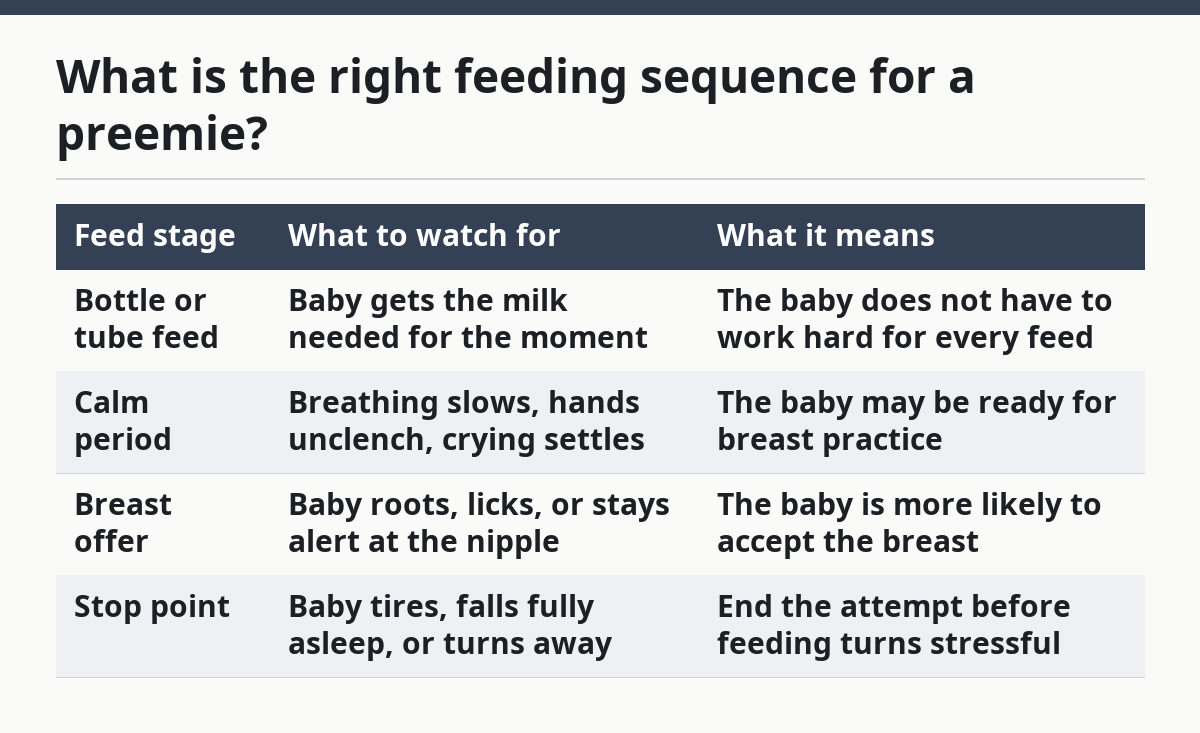
The right feeding sequence is usually bottle or tube feed first when needed, then breast practice once the baby is calm enough to focus. For babies born before 35 weeks, patient.info says tube feeding is often needed at first, and the NHS says babies usually do not coordinate sucking, swallowing, and breathing until about 34 to 36 weeks’ gestation.
That matters because a preemie may look hungry but still lack the muscle control for a full feed at the breast. If the baby is still learning, the breast can be part of the day’s routine without needing to be the only route for milk.
A simple sequence looks like this:
| Feed stage | What to watch for | What it means |
|---|---|---|
| Bottle or tube feed | Baby gets the milk needed for the moment | The baby does not have to work hard for every feed |
| Calm period | Breathing slows, hands unclench, crying settles | The baby may be ready for breast practice |
| Breast offer | Baby roots, licks, or stays alert at the nipple | The baby is more likely to accept the breast |
| Stop point | Baby tires, falls fully asleep, or turns away | End the attempt before feeding turns stressful |
This sequence is not the same as the full transition from tube to breast. That broader change can take time, and for many families it fits into the weaning window that patient.info places at about 4 to 6 months after the baby’s original due date. The day-to-day task here is simpler: use the breast as the next step after another feed when the baby can manage it.
How do I calm my baby before latching?
You calm your baby before latching by slowing the pace for a few minutes, often with skin-to-skin contact and a quiet setup. A preemie who has just finished a bottle feed or tube feed may need that pause to switch from “feeding mode” to “breastfeeding mode.”
Start with low noise, dim light, and a position that keeps the baby close to your chest. Skin-to-skin before nursing is useful because it gives the baby your warmth, scent, and steady contact without the pressure of an immediate latch. For many premature babies, that bridge matters more than perfect timing.
Use this short routine:
- Hold the baby upright against your bare chest for a few minutes. The chest contact can settle the baby’s breathing and lower the startle response.
- Watch the hands and face. Relaxed hands, soft eyes, and slower body movement usually mean the baby is ready to try.
- Offer the breast when the baby is drowsy but still awake. That state often works better than waiting for a strong cry.
- Let the baby explore. Licking, nuzzling, and brief opens of the mouth are useful steps, even if the first attempt is short.
- Stop if the baby gets tense or frantic, and check with your neonatal team or lactation consultant if this keeps happening. A hard push toward the breast usually costs more than it gives.
This is one of the places people get stuck. They try to move straight from a bottle or tube feed to a latch, then assume the breast “isn’t working” when the baby is really too keyed up to switch tracks. A calmer start can make the same baby behave very differently.
How do I offer the breast after a bottle or tube feed?
You offer the breast after a bottle or tube feed by starting when the baby is settled, then making the breast the easy choice. The first goal is comfort and familiarity, not a long session.
Follow this order:
- Finish the bottle or tube feed the way the care team has set it up. A baby who still needs those feeds should not be rushed off them.
- Pause for a calm stretch of a few minutes. This gives the baby time to settle after swallowing.
- Hold the baby skin-to-skin or chest-to-chest. The contact helps the baby move from feeding to seeking.
- Bring the baby to the breast before full crying starts. A preemie often manages best when the hunger cue is mild.
- Let the baby lead the first contact. The baby may sniff, lick, or open briefly before taking a fuller latch.
- Stop if the baby tires quickly, and ask your care team for guidance if this happens often. Fatigue is a real limit in premature babies, and a short attempt is still useful.
The breast offer should feel light, not forced. If the baby turns away, arches, or loses interest after only a brief try, that is information, not failure. A preemie’s feeding stamina is often the limiting factor, not your setup.
A generic article would tell you to “be patient” and stop there. That is too vague to help at 2 a.m. The useful version is to time the breast offer after the baby is calm, not noisy; awake, not frantic; and rested enough to try. That sequence gives the baby a better shot at connecting the breast with a safe, repeatable routine.
What should I do if my baby gets tired fast?
You should shorten the attempt and protect the baby’s energy if fatigue shows up fast. Premature babies often have limited stamina, and fatigue can be the main reason a breastfeed after another feed does not go far.
Watch for the practical signs: slower sucking, drifting asleep, slack body tone, or losing interest after a short burst. When that happens, stop the attempt rather than trying to stretch it into a longer session. A tired baby may take in less milk, get frustrated, and end up working harder for less benefit.
That is one reason direct breastfeeding can look uneven in the early weeks. Babies born after 34 to 36 weeks are usually better able to breastfeed, according to patient.info, but earlier babies may still need bottle feeds or tube feeds for a while. If your baby is not there yet, the breast can still be part of the day without needing to be the only feed that “counts.”
There is also a trade-off here. Pushing through fatigue can make the next feed harder, not easier. A shorter, calmer breast try may preserve energy for the next bottle or tube feed and keep the whole day steadier.
What mistakes make this harder?
The biggest mistakes are timing the breast offer badly, expecting too much from one session, and ignoring fatigue. Each one can turn a workable feeding sequence into a fight the baby cannot win.
| Mistake | What it costs | Better choice |
|---|---|---|
| Offering the breast while the baby is crying hard | The baby uses energy on distress instead of feeding | Calm first, then offer the breast |
| Starting right after a rushed feed | The baby may still be disorganized and unsettled | Leave a short quiet pause before nursing |
| Pushing for a long session | The baby tires and may resist the next attempt | Keep the first tries brief |
| Treating one bad feed as a setback | The parent may stop offering the breast too soon | Use the breast as repeated practice |
| Ignoring that the baby may still need tube or bottle feeds | The baby may get less milk than needed | Keep the other feeds in place as advised |
A common misunderstanding is that breastfeeding has to replace every other feed before it “counts.” That is not the right standard for a premature baby. In this stage, the breast can be a practice place and a feeding place at the same time.
The honest limitation is simple: this approach is not for a baby who is too early, too sleepy, or too unstable to coordinate sucking, swallowing, and breathing. The NHS notes that coordination often comes later, around 34 to 36 weeks’ gestation. Before that, the breast can be offered, but a full feed may not be realistic every time.
When should I ask for help?
You should ask for help if the baby seems too tired to feed, cannot settle after feeds, or keeps refusing the breast even after calm, repeated tries. Babies born earlier than 34 weeks may not be able to breastfeed or bottle-feed directly and may need milk through a tube, according to patient.info, so a hard stall is not something to push through alone.
This is also the point where the feeding plan should stay tied to the baby’s age, weight, and stamina. Patient.info says feeding depends on how early the baby was born and how much the baby weighs. That means the same strategy will not fit every preemie.
If donor milk is part of the picture, the World Health Organization recommends donor human milk for preterm or low-birth-weight infants when a mother’s own milk is unavailable; ask your neonatal team how that fits your breastfeeding plan.
This page supports the broader hub on Breastfeeding a Premature Baby, which covers the larger feeding journey. The question here is narrower: how to move from bottle or tube feed to a breast attempt without making the baby work harder than the baby can manage.
FAQ
Should I breastfeed before or after a bottle?
After a bottle is often easier when the baby is premature and still learning. A short calm period after the bottle can help the baby switch state before a breast offer, while a baby who is already very hungry may become too upset to latch or settle.
Can a baby latch after tube feeding?
Yes, a baby can latch after tube feeding. The key is whether the baby is calm and alert enough to try, not the fact that milk came through a tube first. A short skin-to-skin pause often helps the baby move from passive feeding to active breast seeking.
How do I switch from bottle to breast with a preemie?
You switch by using the breast as a regular practice step, not by forcing a sudden change. Start with calm, skin-to-skin contact, offer the breast when the baby is drowsy but awake, and keep bottle or tube feeds in place as needed while the baby builds stamina and coordination.
Sources
- patient.info, Feeding Premature Babies (checked 28 Nov 2026)
- nhs.uk, Breastfeeding your premature baby – NHS (checked 28 Nov 2026)
- who.int, Breastfeeding (checked 28 Nov 2026)
Drafted with AI; not yet reviewed by a person.