
Last updated: November 18, 2026
Quick answer: oral tension can make breastfeeding harder, but the right position, a calmer start, and a wider mouth opening often help milk transfer.
How to breastfeed when your baby has oral tension or a tight jaw is about lowering pressure, helping the mouth open before latching, and noticing what changes first. The steps below show what to try first, what to watch for, and when a tight jaw needs feeding support.
Key Takeaways
- A tight jaw can make a baby hold the nipple too tightly or clamp before the mouth opens well.
- Start feeds in a calm state, not at full cry.
- Small position changes can matter more than forceful trying.
- If feeding stays hard, a lactation consultant or feeding specialist can help sort out oral tension, body tension, and latch issues.
- If your baby also seems stiff, arches, or fights every feed, the problem may be bigger than the mouth alone.
What oral tension looks like during a feed

Oral tension often shows up as a tight jaw, small mouth opening, and quick jaw fatigue during feeding. Picture this: you bring your baby to the breast, but the mouth stays tight, the lips stay pinched, and the chin never drops the way you hoped. That pattern can make the first minutes of a feed feel like a wrestling match.
A baby with oral tension may also turn away, fuss at the breast, or seem to suck in short bursts instead of settling into a steady rhythm. Some babies clamp hard at the start, then lose suction or pop on and off. Others keep a shallow grip because the jaw never relaxes enough for a wider latch.
Signs to watch for:
- The mouth opens a little, then closes fast
- The jaw looks rigid or bunched
- The baby gums the nipple instead of staying relaxed
- Clicking, slipping, or repeated re-latching
- Feedings that take a long time with little settling
The truth is, oral tension is not one single thing. It can travel with body tension, a favorite head turn, or a tense neck. That is why the same baby may feed better on one side, in one chair, or after a calmer start. A feeding support visit often looks at the whole baby, not just the mouth.
If you are reading this as part of a bigger troubleshooting path, the hub on breastfeeding problems and troubleshooting fits here. This page stays focused on body tension and what you can observe first.
How do I breastfeed a baby with a tight jaw?
You breastfeed a baby with a tight jaw by lowering pressure, helping the mouth open before latching, and using positions that let the jaw drop forward instead of clench upward. Picture this: you are ready to feed, but your baby’s face looks braced, not soft. The goal is not to force a bigger mouth. It is to make opening easier.
Start with the setting:
- Dim the room a bit.
- Hold the baby skin-to-skin or close to bare chest if that calms them.
- Pause if the baby is crying hard; a full cry often tightens the jaw more.
- Bring the baby to the breast only after the face softens a little.
Then try the feed in this order:
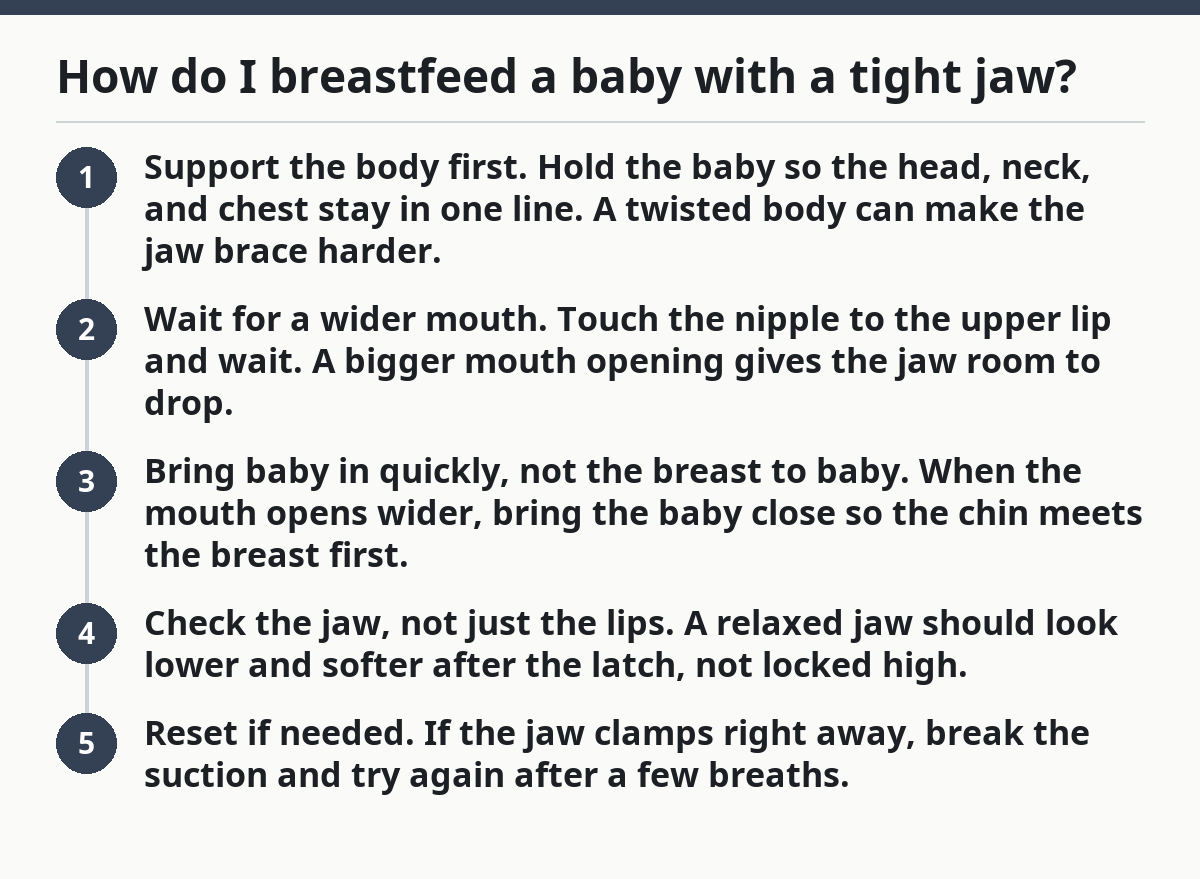
- Support the body first. Hold the baby so the head, neck, and chest stay in one line. A twisted body can make the jaw brace harder.
- Wait for a wider mouth. Touch the nipple to the upper lip and wait. A bigger mouth opening gives the jaw room to drop.
- Bring baby in quickly, not the breast to baby. When the mouth opens wider, bring the baby close so the chin meets the breast first.
- Check the jaw, not just the lips. A relaxed jaw should look lower and softer after the latch, not locked high.
- Reset if needed. If the jaw clamps right away, break the suction and try again after a few breaths.
Small resets are not failure. They are part of the method. A tense baby often needs several calm tries before the jaw gives you room to work with.
Avoid these common mistakes
- Pushing the head in. That can increase bracing and make the jaw clamp harder.
- Rushing the latch before the mouth opens. That can trap the nipple against a tight jaw.
- Trying only one position. A baby with body tension may feed better in a different angle or hold.
- Feeding at peak crying. The jaw is often tightest then.
Instead, use a pause, a reset, and a calmer start. If the baby’s face stays rigid feed after feed, oral tension may be part of the picture, not just a one-time fuss.
Position changes that help oral tension and mouth opening

Position changes help because they reduce strain across the baby’s neck, shoulders, and jaw. Picture this: you shift the baby a few inches lower or turn the body a little more toward yours, and the mouth opens easier on the next try. That is common with babies who carry tension through the whole front of the body.
Start with holds that keep the baby’s chest close to yours:
- Cross-cradle can help you guide the head and body with one hand while the other shapes the breast.
- Football hold can work well if the baby arches or resists pressure on the belly.
- Laid-back nursing may help a tense baby feel less pinned and more in control.
- Side-lying can be easier if the baby settles better when not upright and fussy.
A good position usually does three things at once: it keeps the ear, shoulder, and hip lined up; it lets the chin lead toward the breast; and it leaves the baby with room to tip the head back a little. That last part matters. A chin that can drop is often easier on a tight jaw than a chin tucked toward the chest.
If your baby keeps twisting, look at your own setup too. A stiff chair, a low pillow stack, or a cramped arm position can feed tension into the hold. Your elbows should not be doing all the work. If they are, both of you end up tense.
Try this quick reset if the position feels wrong:
- Unlatch gently.
- Recenter the baby’s body.
- Check that the nose is free and the chin has room.
- Try again without moving the baby’s head alone.
A baby with oral tension may still need several feeds in different positions before one clicks. That does not mean the baby is “being difficult.” It means the body is asking for a better angle.
What body tension changes during breastfeeding?
Body tension changes breastfeeding by making it harder for the jaw, tongue, neck, and shoulders to work as one unit. Picture this: your baby is not only tight in the mouth, but also stiff through the back or curled hard to one side. In that case, the jaw is not the only part that may need help.
Common body signs include:
- Arched back during the feed
- Shoulders held high and tight
- Strong head turn preference to one side
- Fists clenched near the face
- Legs stiff or tucked tightly
These signs matter because a baby who is bracing through the body often braces through the mouth too. A tight jaw can be part of a larger tension pattern. That is why you may see the feed improve after a diaper change, a burp break, or a few minutes of quiet holding.
Here’s the catch: not every tight baby has the same cause. Some babies are simply overstimulated. Others have a pattern that keeps showing up and may benefit from feeding support, bodywork guidance, or evaluation by a specialist trained in infant feeding. A lactation consultant can watch the whole feed and help sort out whether the issue is mouth opening, body tension, or both.
What to try at home:
- Hold the baby upright against your chest for a minute before feeding.
- Slow the pace of movement and talk less during the setup.
- Avoid starting a feed immediately after the baby is upset.
- Use a hold that lets the belly and chest stay close to you.
If your baby is stiff in several feeds a day, or seems harder to settle after every attempt, that is worth bringing to feeding support. A jaw alone does not explain every hard feed.
A simple feeding routine to try before each latch
A short routine helps because it gives a tense baby the same cues before every feed. Picture this: instead of rushing from fussing baby to breast, you use the same 2-minute pattern each time, and your baby starts to expect the shape of the feed. Repetition can matter more than force.
Try this routine:
- Pause and settle. Hold your baby close for a short moment until the face softens.
- Check body line. Head, neck, and trunk should face you, not twist away.
- Offer the breast with a soft cue. Touch the nipple to the upper lip and wait for a wider mouth.
- Bring baby in quickly when ready. Aim for chin-first contact, then let the mouth stay open enough to stay relaxed.
- Watch the first 30 seconds. Look for a softer jaw, less clamping, and more steady sucking.
If the first try goes badly, break the suction and reset. Don’t keep drilling the same bad attempt. A tense baby often gets tighter with repeated forceful tries.
Useful tools for this routine:
- A stable chair with arm support
- One pillow if it helps your arms, not a tower of pillows
- A quiet, low-distraction space
- A burp cloth nearby so you can reset quickly
The routine is not about making every feed perfect. It is about giving the jaw a fair chance to open well before the baby grips the breast.
When to get feeding support for a tight jaw
You should get feeding support when a tight jaw keeps making feeds hard, long, or stressful even after you try position changes and calmer starts. Picture this: you’ve adjusted the hold, slowed the setup, and still see the same clamping, slipping, or fussing day after day. That is a good point to bring in help.
Look for support if:
- Feeds stay painful or inefficient for you
- Your baby tires fast at the breast
- The jaw stays rigid across several feeds
- Your baby arches, turns away, or fights most attempts
- Weight gain, diaper output, or feed length seems off to you
A lactation consultant can observe the feed and help separate oral tension from other latch problems. A feeding specialist may also look at tongue movement, body posture, and oral motor patterns. That is better than guessing from one symptom alone.
You do not need to wait for a crisis. Early support can save time and a lot of frustration. It can also keep you from blaming yourself for something that may be mechanical, positional, or tied to the baby’s tension pattern.
A tight jaw is not the same thing as a bad latch
A tight jaw is not the same thing as a shallow latch, even though the two can look similar from the outside. Picture this: the nipple comes out sore, the baby slips, and the feed feels off. The cause might be mouth opening, body tension, or both — not just one latch mistake.
That matters because this page is not here to tell you how to build a latch from scratch. It is here to help you notice what a tight jaw does to feeding and what changes may help. If the baby’s mouth opens poorly because the jaw is braced, the latch will often look messy no matter how carefully you position the breast.
A few plain rules help:
- Don’t assume every hard feed is a latch problem.
- Don’t keep forcing the same setup if the jaw keeps clamping.
- Do watch the baby’s body, not just the mouth.
- Do ask for feeding support if the pattern repeats.
The goal is a feed that feels more organized and less like a struggle. When oral tension is part of the issue, that usually means the whole baby needs a calmer setup, not more pressure at the breast.
FAQ
What is oral tension in babies?
Oral tension in babies means the muscles around the mouth, jaw, tongue, or face seem too tight or braced for feeding. It can show up as a small mouth opening, jaw clenching, clicking, or trouble staying relaxed at the breast. The pattern matters more than one single feeding moment.
Can jaw tension affect breastfeeding?
Yes, jaw tension can affect breastfeeding by making it harder for the baby to open wide and stay relaxed at the breast. That can lead to slipping, clamping, short sucking bursts, or feeds that take a long time. It may also show up with body tension, like arching or turning away.
How can I help a tense baby feed better?
You can help a tense baby feed better by starting the feed in a calm state, using a position that keeps the body aligned, and waiting for a wider mouth before bringing the baby in. A short reset between attempts often helps more than pushing through a bad latch. If the pattern keeps repeating, feeding support can help sort out what’s going on.
Drafted with AI; not yet reviewed by a person.