
Last updated: November 18, 2026
Quick answer: in 1 short reset, many babies settle enough to feed again. How to breastfeed when your baby is fussy at the breast usually comes down to flow, timing, or comfort, not rejection. The fix is often a calmer setup and a few changes to milk flow or position. The steps below help you sort out what is driving the fussing and what to try next.
Key takeaways
- Fussing at the breast often comes from hunger timing, milk flow, or distraction, not one single cause.
- Start with a calm reset, then change position, timing, or flow before you assume feeding has failed.
- Fast let-down and slow flow can both make a baby pull off, cry, or arch away.
- A newborn and an older, easily distracted baby usually need different fixes.
- If feeding has turned into repeated upset or refusal, feeding aversion can be part of the picture.
Why a baby gets fussy at the breast

A fussy baby at the breast usually needs a different setup, not a different baby. You’re trying to match the feed to the baby’s state: hungry, sleepy, distracted, overstimulated, uncomfortable, or annoyed by how milk is coming out.
Picture this: you sit down to feed, your baby roots for a moment, then pulls back crying after a few sucks. That pattern often points to fast let-down, slow flow, or distractions rather than a lack of interest in nursing.
The main causes worth checking first are:
- Feeding cues missed too late: a baby who is already crying hard is harder to latch and settle.
- Fast let-down: milk sprays or comes in quickly, and the baby gulps, coughs, or pulls off.
- Slow flow: baby works hard, gets frustrated, and fusses after a few sucks.
- Distractions: sounds, light, older siblings, and movement pull an older baby off task.
- Feeding aversion: repeated pressure, forceful attempts, or a long history of tough feeds can make the breast itself feel like a battle.
The truth is, a lot of baby fussing gets blamed on “refusing the breast” when the real issue is timing or flow. That matters, because the fix is different for each one.
- If your baby gets angry before milk starts flowing, think slow flow.
- If your baby coughs, sputters, or pops on and off, think fast let-down.
- If feeds go better in a quiet dark room, think distractions.
- If every feed ends in a struggle, think about feeding aversion and the pattern around it.
For deeper breastfeeding trouble-triage, the hub page on breastfeeding problems and troubleshooting is the right companion page to read next. See also the La Leche League International guidance on breastfeeding challenges and the NHS overview of common breastfeeding problems.
What to do first when your baby starts fussing
You calm the moment first, then feed again. Picture yourself with a baby who is squirming, turning red, or popping off the breast every few seconds; the first move is not to force the latch harder. It is to reset the feed and change the conditions.
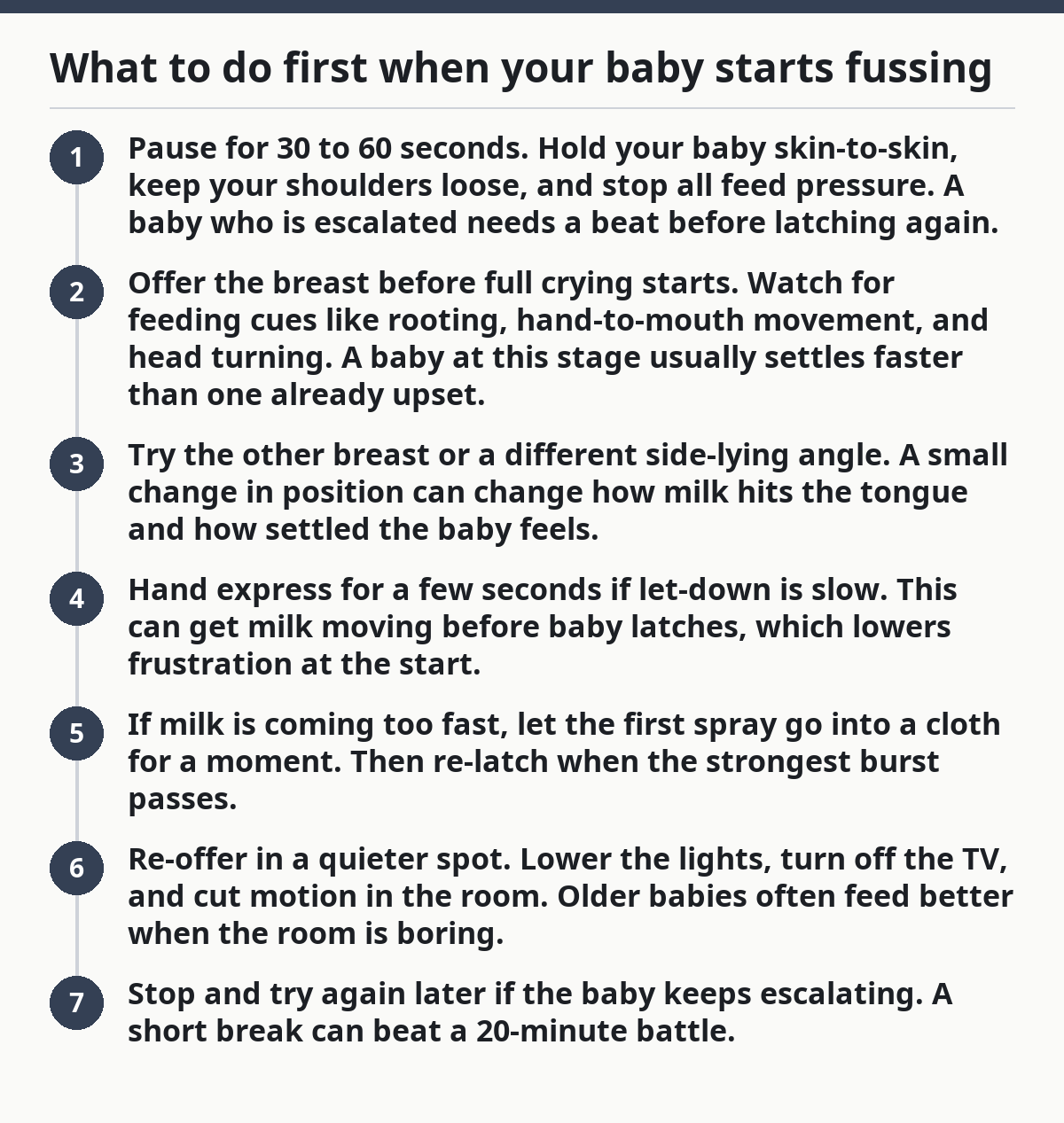
- Pause for 30 to 60 seconds. Hold your baby skin-to-skin, keep your shoulders loose, and stop all feed pressure. A baby who is escalated needs a beat before latching again.
- Offer the breast before full crying starts. Watch for feeding cues like rooting, hand-to-mouth movement, and head turning. A baby at this stage usually settles faster than one already upset.
- Try the other breast or a different side-lying angle. A small change in position can change how milk hits the tongue and how settled the baby feels.
- Hand express for a few seconds if let-down is slow. This can get milk moving before baby latches, which lowers frustration at the start.
- If milk is coming too fast, let the first spray go into a cloth for a moment. Then re-latch when the strongest burst passes.
- Re-offer in a quieter spot. Lower the lights, turn off the TV, and cut motion in the room. Older babies often feed better when the room is boring.
- Stop and try again later if the baby keeps escalating. A short break can beat a 20-minute battle.
Most of these steps are low-risk and reversible. You’re not changing the whole routine; you’re testing one variable at a time.
What not to do in the moment
- Don’t keep pushing the breast back in while your baby is crying harder.
- Don’t keep switching sides every few seconds; that can make the feed feel chaotic.
- Don’t feed in a bright, noisy room if the baby is already distracted.
- Don’t treat every fuss as a latch problem. If the pattern keeps happening, consult a lactation professional or pediatric clinician, since timing or flow may be the real issue NHS.
How fast let-down changes the feed

Fast let-down can make a baby fuss, cough, or unlatch because milk arrives faster than the baby can manage. Picture a baby who seems eager, then suddenly gulps, sputters, and pulls off crying after the first minute. That is a classic fast-flow problem.
The goal is to slow the rush, not stop nursing. A fast let-down can happen more often in the early part of a feed, especially when the breast is very full or the baby is feeding after a longer gap.
Try these adjustments:
- Use a laid-back position. Reclining yourself may help reduce the impact of the fastest initial flow.
- Let the first let-down pass. If the baby pops off at the start, catch the spray in a cloth for a short moment, then re-latch.
- Feed more often. A very full breast can send a stronger initial flow.
- Use brief burp breaks. A baby who gulps air may need a pause to reset.
- Watch the baby’s cues, not the clock alone. If the baby is tense, coughing, or pinching off the nipple, the flow may be too much right now.
Here’s the catch: fast let-down can look like a shallow latch from the outside, but this page is not about teaching latch mechanics. The behavior matters more than the label. If milk is coming in too forcefully, the baby may protect the airway by pulling off.
A baby who has learned to brace against fast flow may start fussing before the breast even goes into the mouth. That does not mean the baby hates nursing. It means the body remembers the last rough feed.
How slow flow can make a baby quit early
Slow flow can frustrate a baby because the reward comes too late. Picture a newborn who latches, sucks a few times, then starts wiggling, grunting, or crying as if the work is not worth it. That is often a timing or milk-transfer issue, not a lack of hunger.
A slow-flow feed usually improves when milk is already moving before the baby latches. The fix is about making the first minute easier.
Try this:
- Offer the breast at early cues. A calm baby has more patience than an already frantic one.
- Hand express or pump briefly first if needed. Even a short start can help the first swallow happen sooner.
- Use breast compression during pauses. Gentle compression can keep milk moving when baby is pausing between sucks.
- Switch sides once the baby slows and fusses. A fresh breast can restart interest.
- Keep the room quiet and low-stimulation. A baby who is half-fed and half-distracted often quits sooner.
A newborn may need more help here than an older baby. Newborn feeding takes repetition, and the baby may still be learning how to organize suck-swallow-breathe without getting irritated.
Do not confuse slow flow with “the baby is done.” If the baby is fussy, rooting again, or still showing hunger cues after a short break, the feed may just need more help getting going.
Why distractions suddenly matter so much
Distractions matter because older babies can notice everything and still want to feed. Picture yourself in a room with a phone buzzing, a sibling moving around, and daylight hitting the baby’s face. A previously fine feeder may now pop on and off just to look around.
This is one of the easiest problems to miss because the baby may not cry. The baby may just snack, pull off, smile, look away, and come back unsettled.
A few practical changes help:
- Move to a dimmer room. Less light means less to track.
- Reduce noise for 10 to 15 minutes. Turn off screens and keep voices low.
- Hold the baby close with less movement. Constant jostling can turn a feed into a sightseeing trip.
- Feed before the baby is overtired. A tired baby gets distracted and fussy faster.
- Use the same feeding spot when possible. Predictable setup can help an easily distracted baby settle faster.
On the flip side, some babies are not distracted at all—they are overfed with stimulation. They need a quieter room before they need another latch attempt.
If the feed is going fine in the dark and falling apart in daylight, that is a clue. It points to distraction, not a milk-supply mystery.
Re-latching without turning the feed into a fight
Re-latching should be quick, calm, and boring. Picture a baby who pulls off, cries once, and then arches away every time you try to put the breast back in. The goal is to reset without making the breast the source of pressure.
Use this simple sequence:
- Break the attempt early. If the baby is upset, pause before the crying escalates.
- Hold the baby close and still. A tight hold can help the baby feel anchored.
- Wait for a cue. Rooting, mouth opening, or head turning is a better sign than pushing in the dark.
- Offer again from a slightly different angle. A small change in body position can matter.
- Stop after a few failed tries. A feed that turns into a wrestling match can train the baby to resist.
This is also where feeding aversion can start to show up. If every feed becomes a forced re-latch, the baby may begin to tense as soon as you position for nursing. That pattern is not rare, and it gets worse when adults keep trying to “win” the feed.
A better approach is to keep the moment short and respectful. One calm reset is useful. Ten repeated attempts are not.
Signs the feed is getting stuck in a bad loop
- The baby cries as soon as the breast appears.
- The baby arches, stiffens, or turns the head away.
- Every attempt gets harder than the one before.
- The baby settles only after a break away from the breast.
If you see that pattern, stop forcing the moment and come back after the baby is calmer.
How to spot feeding aversion before it gets worse
Feeding aversion is a strong dislike of feeding that can build when feeding has felt stressful too many times. Picture a baby who used to nurse, then starts crying as soon as you position for the breast, even when hungry. That is different from a baby who fusses only when milk comes too fast or too slow.
The pattern often matters more than a single bad feed. A baby with aversion may:
- Cry or arch before latching.
- Refuse one breast but not another.
- Calm quickly when not offered the breast.
- Tense up at the start of most feeds.
- Take better to feeds when there has been a long, calm break.
The fix is to remove pressure. That usually means shorter, calmer attempts, fewer forced re-latches, and less chasing of a crying baby with the breast.
A hard truth: if a baby is showing a repeated pattern of refusal, pain, or intense distress around feeding, this is a good time to get feeding help from a qualified lactation professional or pediatric clinician. The pattern can look simple from the outside and still need a closer look.
Don’t keep treating every feed like a test. That makes the baby’s job harder and yours more tiring.
Why this differs for a newborn versus an older baby
A newborn usually needs more help with timing and flow, while an older baby usually needs more help with distraction and habit. Picture a 2-week-old who gets frustrated because milk is slow to arrive versus a 6-month-old who suddenly pops off to look at every sound in the room. Same symptom, different cause.
For a newborn, focus on:
- Early feeding cues
- Calm start-ups
- Help with milk flow at the beginning
- Short, gentle attempts
For an older baby, focus on:
- Quiet rooms
- Fewer visual distractions
- Predictable feeding times
- Less pressure to stay latched every second
The first months often involve a lot of fine-tuning. That is normal. What changes is the main problem you are solving.
A baby who fusses at the breast is sending a signal, not failing a skill check. The job is to read the signal, make one change, and see what happens next.
FAQ
Why does my baby get upset at the breast?
Your baby may be upset because the milk comes too fast, too slowly, or at the wrong moment. Distractions, hunger that has gone too far, and feeding aversion can also play a role. Start by changing one thing at a time so you can see what your baby is reacting to.
What should i do if my baby keeps pulling off?
Pause, reset, and try again in a calmer way. Hold your baby close, let the first let-down pass if flow seems fast, or hand express a little if flow seems slow. If the pulling off happens at nearly every feed, the pattern may need a feeding check from a qualified professional.
How do i calm a fussy baby before feeding?
Use a short reset before you offer the breast. Skin-to-skin contact, a quieter room, less motion, and feeding at early cues can help. A baby who is already crying hard usually needs a minute to settle before feeding works well.
Does fussing at the breast always mean something is wrong?
Fussing at the breast does not always mean a serious problem. Many babies fuss because the timing, flow, or environment is off.
Drafted with AI; not yet reviewed by a person.