
Last updated: November 19, 2026
Breastfeeding problems and troubleshooting — The Complete Guide starts with the most likely cause, not the most dramatic one. Quick answer: most breastfeeding problems improve fastest when you fix latch, milk transfer, supply, or pain, and many parents notice a change within 1 feed to 3 feeds. The steps below sort out what to try first, what to stop doing, and when to get help fast.
Key takeaways
- A shallow latch causes a lot of nipple pain, poor milk transfer, and long feeds.
- Low supply, oversupply, engorgement, and blocked ducts can look similar at first.
- The quickest gains are often position changes, feeding more often, and getting the latch checked.
- Fever, red hot breast areas, and a baby who is hard to wake need prompt medical care.
- If the problem keeps returning, the feeding plan—not just the symptom—needs a reset.
I write about Breastfeeding problems and troubleshooting — The Complete Guide from the lactation side of the room: latch, pump setup, milk transfer, and the real-world reasons good advice falls apart at 2 a.m.
What breastfeeding problem do you actually have?
The right fix starts with the symptom, not the label. A baby who feeds for 45 minutes and still seems upset is a different problem from cracked nipples, and a firm breast with a 38.5°C fever is a different problem again.
Picture this: you sit down to feed, but the baby slides off after a few sucks, your nipples burn, and you can’t tell if the issue is pain, supply, or simple exhaustion. That confusion is normal. The first job is to sort the problem into one of four buckets: latch, milk transfer, supply, or breast inflammation.
Here’s the catch:
- Latch problem: nipple pain, pinched or lipstick-shaped nipple, clicking, shallow mouth, baby fusses at the breast.
- Milk transfer problem: long feeds, sleepy baby, little swallowing, poor weight gain, fewer wet diapers.
- Supply problem: breasts never feel full, baby seems hungry after most feeds, pumping output stays low.
- Inflammation/infection problem: hot red area, fever, flu-like aches, a hard tender spot, worsening pain.
If you’re not sure, watch the baby—not just the breast. A baby who swallows well for several minutes, then relaxes and unlatches, is giving a different signal than one who never really draws milk.
Therefore, a quick self-check helps:
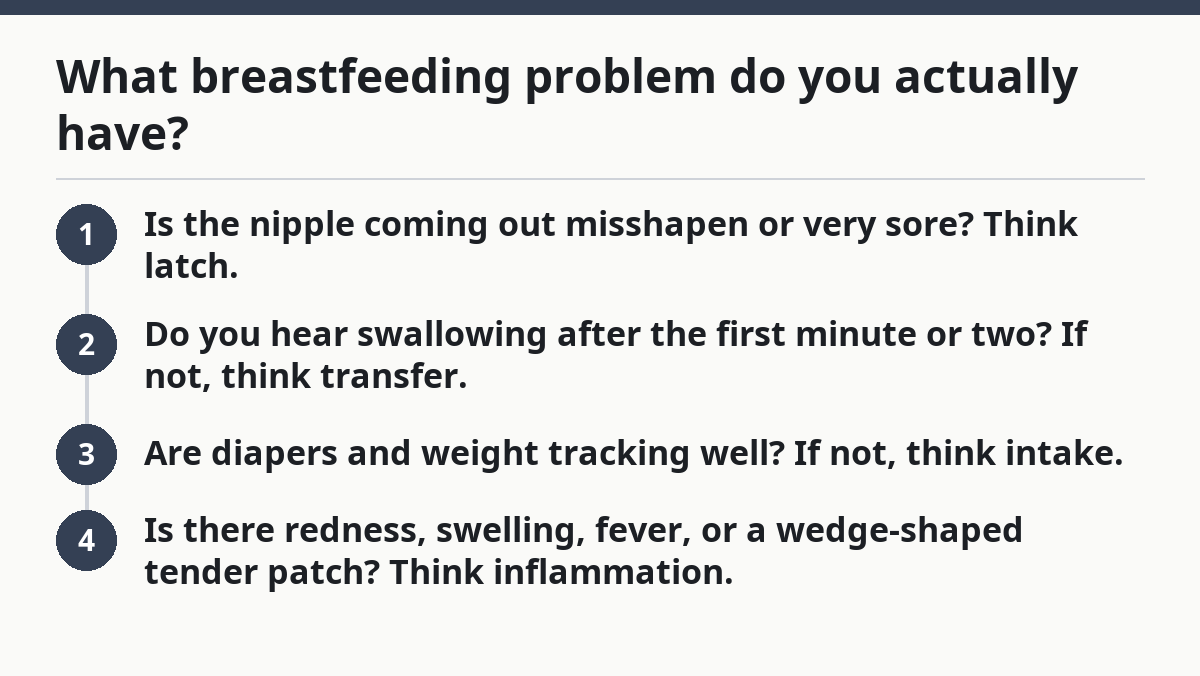
- Is the nipple coming out misshapen or very sore? Think latch.
- Do you hear swallowing after the first minute or two? If not, think transfer.
- Are diapers and weight tracking well? If not, think intake.
- Is there redness, swelling, fever, or a wedge-shaped tender patch? Think inflammation.
The one thing a generic article gets wrong is treating every breast problem like a supply problem. If you are unsure, consult a lactation consultant, midwife, or clinician, because a pattern-based assessment is safer than guessing. The Academy of Breastfeeding Medicine has guidance on mastitis and related breast symptoms that can help frame the next step.
Why does breastfeeding hurt so much?

Breastfeeding hurts most often because the baby is latching shallow, not because your nipples are “too sensitive.” A proper latch usually brings pain down after the first few sucks; pain that stays sharp, pinchy, or worse each feed needs a closer look.
Picture this: you brace for every feed because the first 10 seconds feel like sandpaper. That’s not a normal adjustment phase if it keeps happening. Persistent pain is a signal, not a badge of endurance.
The usual causes are plain:
- Shallow latch: too little breast in the mouth, nipple takes the load.
- Tongue-tie or oral restriction: baby can’t keep a deep hold, feeds may click or pop off.
- Engorgement: the breast is so firm the baby can’t grab enough tissue.
- Pump trauma: flange size or suction is wrong, so the nipple gets rubbed raw.
- Thrush or skin irritation: burning, itching, or shiny sore nipples can point beyond latch.
Try this order:
- Break the latch if it hurts after the first few sucks.
- Reposition so the baby’s chin starts close to the breast.
- Aim the nipple toward the roof of the baby’s mouth.
- Bring baby to the breast, not breast to baby.
- If the breast is too full, hand express a little first.
A few concrete signs help separate common causes:
- Pinched nipple after feed: often shallow latch.
- White compressed stripe on nipple: also points to compression.
- Clicking sound: milk may be leaking from the sides because the seal is weak.
- Pain that starts after the first minute and worsens: check latch, pump fit, or nipple damage.
The truth is, pain that lasts beyond the first couple of weeks deserves attention, especially if there’s bleeding, a fever, or a baby who isn’t transferring milk well. A lactation consultant, pediatrician, or midwife can check latch, oral anatomy, and feeding efficiency.
How do I fix a bad latch?
A bad latch usually improves when the baby gets more breast tissue in the mouth and the chin, tongue, and lips line up better. The goal is a wide mouth, deep latch, and a hold that does not crush the nipple.
Picture this: you line up the baby, wait for a big open mouth, then the latch still feels shallow and painful. That usually means the timing or angle is off, not that you failed. Small setup changes can make a big difference within one feed.
Use these steps:
- Hold baby close, nose level with nipple.
- Wait for a wide yawn-like mouth.
- Aim the nipple toward the upper part of the mouth.
- Bring baby in quickly, chin first.
- Check the lips are flanged out, not tucked in.
- Watch for swallowing after the first few sucks.
A good latch usually looks and feels like this:
- More areola visible above the top lip than below the bottom lip.
- Chin pressed into the breast.
- Rounded cheeks, not dimpling.
- Rhythmic suck-swallow-breathe pattern.
- Pain that fades after the first moments.
Bad latch often shows up as:
- Clicking sounds.
- Nipple coming out flattened, creased, or lipstick-shaped.
- Baby repeatedly slipping off.
- Long feeds with little settling.
- Nipple damage that keeps returning on the same side.
A practical trick is the “reset.” If it hurts, take the baby off, breathe, and start again. Don’t tolerate a bad latch just because the baby is already on. That habit turns a fixable issue into cracked nipples and dread.
If the latch stays poor despite good positioning, look for tongue restriction, high palate, prematurity, or a sleepy baby who cannot maintain suction. That’s the point where a skilled feeding assessment matters more than another online tip.
Is my milk supply low or is my baby not transferring milk?

Low supply and poor transfer are not the same thing, and mixing them up leads to bad advice. A baby can seem hungry after feeds because milk isn’t flowing well, not because the breast isn’t making enough.
Picture this: you pump and get only a little, the baby nurses forever, and you assume your body is failing. Sometimes it is a production issue. Sometimes it’s a removal issue. That distinction changes the whole plan.
Clues that suggest low supply:
- Breasts rarely feel fuller before feeds.
- Baby has fewer wet diapers than expected.
- Weight gain is slow or stalls.
- Pump output stays low across several sessions.
- Baby feeds often and still seems unsatisfied.
Clues that suggest poor transfer:
- Baby nurses a long time but swallows little.
- You hear clicking, see dimpling, or notice a shallow latch.
- Baby is sleepy at the breast and then wakes hungry soon after.
- Output looks low only at the breast, not necessarily with pumping and hand expression.
Things that can help both:
- Feed more often.
- Offer both breasts.
- Use breast compressions during sucking pauses.
- Keep baby awake with diaper changes or skin-to-skin.
- Get the latch checked.
Do not jump straight to pumping more without checking the latch. If milk removal is already poor, a weak latch can keep the breasts from emptying and can drive supply down over time. On the flip side, if supply is genuinely low, long gaps between feeds make it worse.
If your baby is underweight, sleepy, jaundiced, or has fewer wet diapers, get pediatric review promptly. The feeding pattern matters, but weight and hydration matter more.
What do I do about engorgement, blocked ducts, and mastitis?
Engorgement, blocked ducts, and mastitis can overlap, but they are not all the same problem. Engorgement is fullness and pressure; a blocked duct is a tender localized area; mastitis adds inflammation and often fever.
Picture this: one breast feels hot, heavy, and hard, and the baby can’t latch well on that side. The breast is not “just making too much milk.” Swelling can block milk flow and set off a cascade of pain.
What usually helps first:
- Feed or express milk regularly.
- Start with the painful breast if baby can latch there.
- Use cold packs after feeds for swelling.
- Use gentle massage, not hard digging into the breast.
- Wear a supportive bra that does not pinch.
For a firm, tender spot:
- Keep milk moving with frequent feeds.
- Try different positions so the baby’s chin points toward the lump.
- Use hand expression or pumping briefly if the baby won’t drain that area.
- Watch for worsening redness or fever.
For mastitis warning signs, take it seriously:
- Fever.
- Flu-like aches.
- A red, hot, painful patch.
- Rapid worsening pain.
- Feeling ill beyond simple breast tenderness.
A common mistake is aggressive massage on a painful lump. That can bruise tissue and make swelling worse. Another mistake is suddenly cutting feeds because the breast hurts. Milk stasis often makes the problem hang on longer.
If fever or redness appears, or if symptoms do not improve within a short window of active feeding and rest, contact a clinician. Some cases need medical treatment, not just home measures, so do not wait if symptoms are escalating. The NHS breastfeeding advice pages also outline when breast pain and redness need review.
Why does my baby keep falling asleep at the breast?
A sleepy baby often means the baby isn’t getting enough steady milk flow, is too young, is jaundiced, or is simply using the breast as a comfort spot. Sleepiness can be normal; sleepiness plus poor intake is not.
Picture this: your baby latches, sucks for a minute, and then turns floppy while the breast still feels full. That is a milk transfer problem until proven otherwise. Sleepy feeds need structure.
Try these ideas:
- Skin-to-skin before feeding.
- Change diaper before latching.
- Switch sides when sucking slows.
- Compress the breast when swallowing stops.
- Keep the room bright enough to stay alert.
Signs the baby may need review:
- Hard to wake for feeds.
- Weak suck.
- Fewer wet diapers.
- Poor weight gain.
- Long, unproductive feeds.
A baby who dozes off after an effective feed is different from a baby who never really starts. Listen for swallowing. If swallowing is rare, the baby may be working but not getting much.
Don’t rely on “just keep trying” if the baby is persistently sleepy. A feed that looks calm can still be ineffective. That’s especially true in the first days, when jaundice, birth weight loss, or a difficult delivery can make babies less vigorous.
What should I do if I have cracked nipples or bleeding?
Cracked nipples mean the nipple skin has been injured, and the most effective way to stop the cycle is to fix the cause of friction. Ointments alone won’t solve a bad latch or a poorly fitting pump flange.
Picture this: every feed starts with a tear-like sting, then the nipple looks raw and may even bleed a little. That does not mean breastfeeding is impossible. It does mean the breast needs a mechanical fix.
Start with the cause:
- Recheck latch.
- Look for tongue tie or persistent shallow latch.
- Check pump flange size and suction if pumping hurts.
- Shorten very painful sessions only if milk is still being removed often enough.
Helpful basics:
- Air-dry or use breast milk on the nipple if that soothes you.
- Change nursing pads often to keep the area dry.
- Avoid harsh soap on the nipples.
- Use a protective dressing if recommended by a clinician or lactation consultant.
Watch for infection signs:
- Increasing redness.
- Warmth spreading beyond the nipple.
- Fever.
- Pus or worsening pain.
- Burning pain that doesn’t match visible skin injury.
Cracked skin is common in the early learning phase, but repeated bleeding is not something to ignore. If the same side keeps reopening, the latch or pumping setup is still wrong.
When does a breast pump help, and when does it make things worse?
A breast pump helps when the breast needs extra milk removal, but it can make things worse if the flange is wrong, suction is too high, or pumping replaces too many effective feeds. Pumping is a tool, not a cure-all.
Picture this: you buy or borrow a pump because everyone says it will fix supply, yet your nipples come out sore and the output looks discouraging. That’s a setup problem more than a willpower problem. A pump should not add injury.
Pumping can help when:
- Baby cannot latch well.
- Baby is premature or sleepy.
- You need to protect supply after a missed feed.
- You are building a freezer stash under guidance from a lactation professional.
Pumping can hurt when:
- Flange size is too small or too large.
- Suction is set too high.
- Sessions are too long or too frequent without enough rest.
- Pumping replaces direct feeding without a plan.
Use the pump to solve a defined problem:
- Remove milk after poor feeds if needed.
- Use the lowest effective suction.
- Stop if pain rises.
- Check nipple shape after pumping.
The mistake is treating the pump as proof of supply. Pump output is only one data point, and it should be interpreted with weight gain, diaper count, and feed behavior. The American Academy of Pediatrics and La Leche League both note that output alone does not tell the whole story.
If pumping hurts even at low suction, the flange fit and nipple movement need review. A lactation consultant can often spot the issue quickly.
When should I get help urgently?
You should get urgent help when fever, breast redness, dehydration, or poor baby output shows up, because these are not problems to troubleshoot alone. The line between “common feeding issue” and “needs medical care” is clearer than people think.
Picture this: your breast is red and hot, your body aches, and the baby has had fewer wet diapers than usual. That is not the time to wait and see for days. Act fast when the mother or baby looks unwell.
Seek prompt care if:
- You have fever or flu-like symptoms with breast pain.
- A red area is spreading or getting more painful.
- The baby is too sleepy to feed.
- Wet diapers are clearly down.
- The baby has poor weight gain or signs of dehydration.
- You notice pus, severe swelling, or sudden worsening pain.
Professional sources worth reading include the Academy of Breastfeeding Medicine for mastitis guidance and the NHS breastfeeding advice pages, which cover latch pain, engorgement, and when to seek help. The American Academy of Pediatrics also has feeding and newborn warning signs that are useful for parents.
Do not wait for a perfect diagnosis if the baby is not feeding well or you feel sick. Feed issues can escalate faster than people expect, especially in the first weeks.
What if the problem keeps coming back?
If the same breastfeeding problem keeps returning, the root cause is usually still there: latch mechanics, pumping fit, feeding frequency, or an untreated oral issue. Repeated symptoms mean the fix was partial, not wrong.
Picture this: you solve the pain for two days, then it comes roaring back on day three. That pattern usually means the feeding setup changed back to the old shape. Recurring trouble needs a full reset, not a patch.
Look for these repeat offenders:
- Same sore side every time.
- Recurrent plugged area in the same spot.
- Baby always slips off in one position.
- Pain only during pumping, not direct feeds, or the reverse.
- Supply dips after long stretches without milk removal.
A reset plan:
- Recheck latch on both sides.
- Review pump parts and flange fit.
- Track diaper output and weight trends.
- Watch for tongue-tie, high palate, or prematurity issues.
- Get hands-on help from a lactation professional.
A generic article often misses the real cost of recurrence: confidence drops, feeds get shorter, and some parents start avoiding the breast. That avoidance can reduce milk removal and make the cycle worse.
Breastfeeding troubleshooting: what to try first
The best first move is to match the fix to the symptom, because that saves time and keeps you from solving the wrong problem. If you are overwhelmed, this order usually works best.
If the problem is pain in breastfeeding problems and troubleshooting
- Break and relatch.
- Aim for a deeper latch.
- Check pump fit if pumping also hurts.
- Look for cracked skin or blebs.
If the problem is low transfer
- Feed more often.
- Use breast compressions.
- Wake the baby if needed.
- Get weight and diaper output checked.
If the problem is fullness or hard breasts
- Feed or express more often.
- Use cold packs after feeding.
- Avoid deep tissue digging.
- Watch for fever or spreading redness.
If the problem is low supply
- Increase milk removal frequency.
- Check latch and transfer first.
- Get help early if weight gain is slow.
- Don’t rely on one pump session to judge supply.
If the problem is recurring
- Step back and review the whole feeding pattern.
- Ask about tongue-tie, engorgement, and pump setup.
- Get a hands-on assessment.
The hard truth is that most breastfeeding problems are not solved by one miracle tip. They usually improve when the feed is made less painful, more efficient, and more frequent.
Can breastfeeding problems be fixed at home?
Some breastfeeding problems can be fixed at home, but only if the baby is feeding well, weight is tracking, and there are no warning signs. Home steps are right for mild latch pain, early engorgement, and minor nipple irritation.
Picture this: the breast is sore, but the baby is otherwise well, feeds are improving, and diapers look normal. That can be a home-care situation for a short time, but only if it is improving.
Reasonable home steps include:
- Position and latch changes.
- More frequent feeds.
- Gentle milk expression.
- Cold packs for swelling.
- Skin care for cracked nipples.
Home care is not enough if:
- Fever appears.
- Pain worsens instead of easing.
- The baby feeds poorly or sleeps through feeds.
- Diapers or weight are down.
- Redness spreads.
A lot of parents try to “tough it out” for a week, then seek help when the baby is struggling too. Earlier support is simpler, cheaper, and less exhausting than waiting for a bigger problem.
What if I need help and don’t know where to start?
Start with the person who can observe a full feed and check both the baby and the breast. That is usually a lactation consultant, midwife, pediatrician, or breastfeeding medicine clinician.
Picture this: you have one appointment slot and ten questions. You want the right one, not the most convenient one. Choose the person who can watch the latch, check weight, and review output.
Bring this information:
- Baby’s age.
- Diaper count.
- Feed length and frequency.
- Any pain, fever, or redness.
- Pump details if you pump.
- Weight checks, if available.
Ask for:
- A latch assessment.
- A weight check before and after a feed if needed.
- Mouth exam for tongue movement.
- Pump fit review if pumping hurts.
- A plan for the next 24 to 72 hours.
The best help is specific, not generic. “Breastfeeding is hard” is true, but “the right side hurts, the nipple is flattened, and the baby clicks off after two minutes” is what gets you useful help.
FAQ
Why does breastfeeding hurt only on one side?
One-sided pain usually means one side has a different latch angle, nipple shape, milk flow, or pump fit issue. A recurring sore side can also happen if the baby prefers one side and latches more shallowly there.
Why does my baby click while breastfeeding?
Clicking often means the seal breaks and remakes during sucking. Shallow latch, tongue restriction, or a very full breast can all cause it, and it often goes with nipple pain or poor milk transfer.
How do I know if my baby is getting enough milk?
Enough milk usually shows up as steady weight gain, regular wet diapers, and a baby who seems satisfied after effective feeds. If the baby is sleepy, diapers are low, or weight gain is slow, get a feeding check.
Should I keep breastfeeding if my nipples are bleeding?
Small cracks can sometimes improve with latch correction and skin care, but repeated bleeding means the problem is still active. If pain is severe, the baby is not feeding well, or infection signs appear, get help promptly.
When is mastitis an emergency?
Mastitis needs prompt care when fever, spreading redness, worsening pain, or flu-like symptoms appear. If you also feel very unwell or the baby is not feeding enough, seek medical review quickly.
Drafted with AI; not yet reviewed by a person.