
Last updated: November 26, 2026
Quick answer: the transition usually happens in 3 stages: gavage feeds, mixed feeds, and full breastfeeding. In How to Transition a Premature Baby from Tube Feeding to Breastfeeding, the safest approach is usually small steps, with the NICU team watching feeding readiness, stamina, and milk transfer.
Key takeaways
- Tube-to-breastfeeding transition is usually gradual, not all at once.
- Readiness matters more than age alone.
- Gavage feeds, breast practice, and oral feeds can overlap during the same day.
- An occupational therapist can help with positioning, pacing, and oral skills.
- The plan should change when the baby shows stress, fatigue, or poor coordination.
- This is not the page for latch troubleshooting or milk-supply checks; it is about the move from tube support to the breast.
What is the tube-to-breastfeeding transition?
The tube-to-breastfeeding transition is the move from gavage feeding through a feeding tube to feeding at the breast as the baby builds the skill and stamina to handle it. In the NICU, How to Transition a Premature Baby from Tube Feeding to Breastfeeding usually happens in stages, because a premature baby may know how to suck but still tire out fast or lose coordination with swallow and breathing.
A tube feeding does not mean breastfeeding has failed. It means the baby still needs time and support while the mouth, jaw, tongue, and breathing pattern mature. Some babies begin with a few minutes at the breast and finish by tube; others move between both methods for days or weeks. That mixed pattern is normal.
This step-down process works best when the team treats feeding as a skill, not a single event, but ask the NICU team or lactation consultant for individualized guidance. Readiness can change from one feed to the next, especially in a preterm infant who has had a long NICU stay, recent illness, or extra sleepiness after procedures. For background, see the American Academy of Pediatrics and the Academy of Breastfeeding Medicine guidance on preterm feeding and breastfeeding support. The goal is steady practice without pushing the baby past safe limits.
When is a premature baby ready for oral feeding?
A premature baby is ready for oral feeding when the baby can stay alert enough, coordinate suck-swallow-breathe, and tolerate the work of feeding without obvious stress. Gestational age by itself is not enough. A baby at a certain week may still need tube support if the baby cannot handle the full load of oral feeding yet.
Signs of readiness often include calmer alert periods, a rooted or interested response at the breast, and less distress during handling. The baby should also be able to keep a stable breathing pattern and recover quickly after short bursts of sucking. If feeds leave the baby gray, sweaty, coughing, or exhausted, the baby is not ready for more pressure, and the NICU team should reassess.
The NICU team may use oral feeding readiness as a daily check, not a one-time green light. That matters because some babies are ready for a 5-minute breast attempt before they are ready for a full oral feed. A baby can be ready to practice and still need the tube for the rest of the feed.
Here is a simple way to think about the stages:
| Stage | What it looks like | What usually happens next |
|---|---|---|
| Gavage only | Milk goes through the feeding tube | Baby practices non-nutritive sucking and brief breast contact |
| Mixed feeds | Some feeds at the breast, some by tube | Time at the breast increases as stamina improves |
| Mostly oral | Baby feeds by mouth more often | Tube feeds are reduced or stopped by the team |
| Full breastfeeding | Baby feeds at the breast without tube support | Care team confirms the plan is holding |
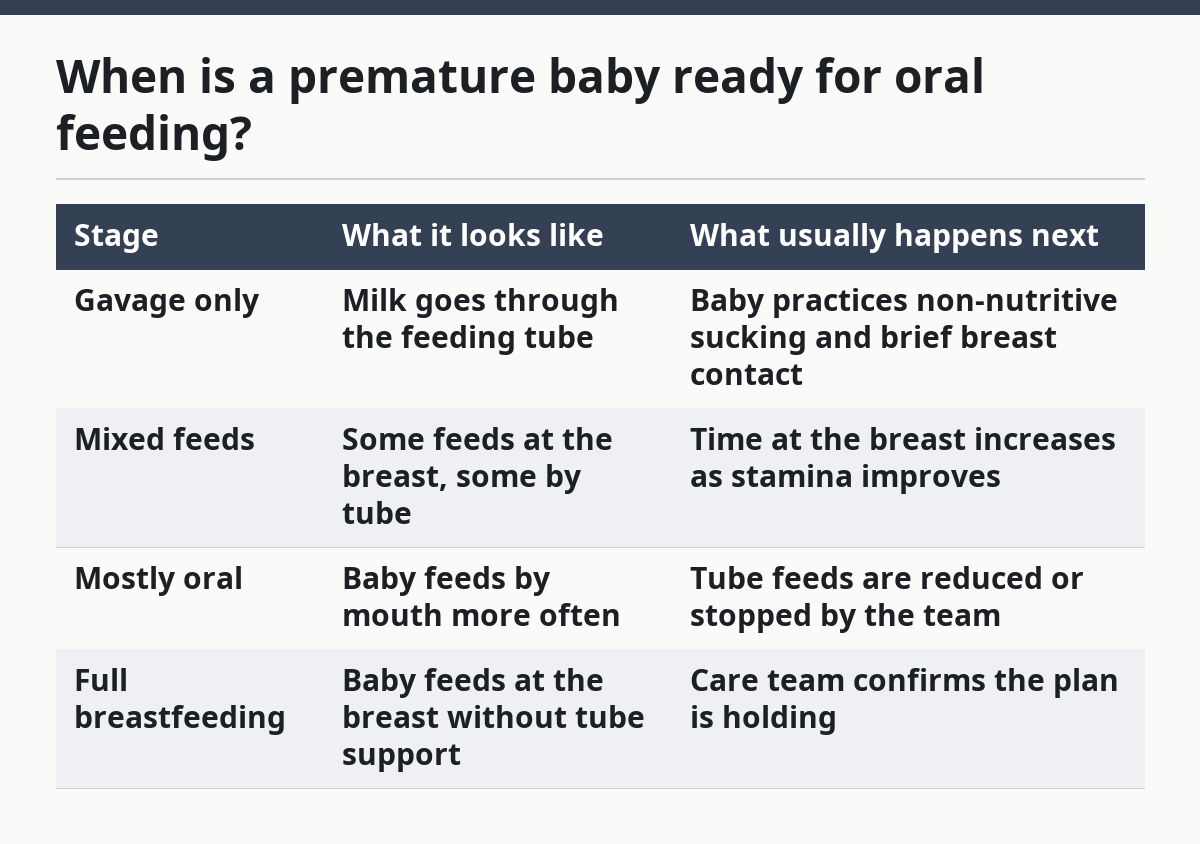
A common mistake is waiting for “perfect” readiness. That can delay oral learning. Another mistake is pushing oral feeds too soon because the baby looked alert once. The better move is a plan based on repeated readiness, not a single good moment. If you want the bigger picture, see How to Transition a Premature Baby from Tube Feeding to Breastfeeding and When is a premature baby ready for oral feeding?.
How do you make the switch step by step?
The switch works best as a step-down feeding plan, with the tube used as backup while oral skills build. The order below fits many NICU settings, but the exact sequence should come from the care team.
- Start with short breast practice during a calm feed window. Offer the breast when the baby is awake enough to cue but not overstimulated, often before the baby is fully hungry and upset. The goal is practice at the breast, not a race to finish the feed.
- Let the baby try to latch and suck for a brief period. Give the baby time to organize the mouth and jaw, then stop if the baby loses breathing rhythm or turns away. A few successful minutes are more useful than a long, stressful attempt.
- Finish the feed by tube if the baby tires. This keeps total intake stable while the baby learns. The tube protects calories and fluid when oral work is still too hard.
- Repeat oral practice at times the baby is most alert. Look for regular windows across the day rather than forcing every feed to be oral. Some babies do better with one or two stronger practice feeds instead of many rushed tries.
- Increase oral time only when the baby shows steady control. Add more time at the breast, or more oral feeds, only when the baby handles the current level without stress. The goal is smooth progress, not a fixed calendar date.
- Review the plan with the NICU team often. Feeding plans often change as the baby grows, gains tone, or recovers from illness. The team may adjust how much is done by breast, tube, or both.
A step-down plan is not a sign that the baby is behind. It is a way to protect feeding skill while avoiding overwork. For many families, the hardest part is accepting that a baby may breastfeed well for one feed and need the tube for the next. That does not mean the process is failing.
How does the NICU team support the move?
The NICU team supports the move by watching readiness, protecting safety, and adjusting the feeding plan as the baby changes. That team may include nurses, lactation staff, neonatology clinicians, and an occupational therapist. Each person looks at a different part of feeding, from posture to stamina to coordination.
An occupational therapist can be especially helpful when the baby has trouble organizing the mouth, staying stable in position, or pacing the suck bursts. That role is practical, not decorative. The therapist may suggest positioning that reduces strain, helps the jaw stay aligned, or makes the baby less likely to tire too soon. The focus is efficient feeding with less work from the baby.
Care team coordination matters because tube feeding, breast practice, and daily weight checks all affect one another. A plan that works on paper may not work if the baby is too sleepy after a procedure or too worked up after handling. That is why feeding plans in a NICU often change from day to day.
Use the team for questions about the transition itself, not just one feed. A good plan can answer when to try the breast, when to stop, and when to keep the tube in place for part of the feed. For a broader guide on the subject, the hub page on breastfeeding a premature baby belongs beside this article.
What helps the transition work better?
The transition works better when the baby gets repeated, low-pressure chances to practice and the feeding setup stays consistent. Consistency helps because premature babies often do better when the body position, timing, and handling are similar from feed to feed.
Three things usually help most:
- Low-stress timing. Offer the breast when the baby is alert enough to work, not already overtired.
- Skilled positioning. A stable hold reduces extra effort and can help the baby conserve energy.
- Clear handoff between breast and tube. If the baby tires, finish by tube instead of stretching the breast attempt until the baby is overdone.
A 10-minute calm attempt can teach more than a 30-minute struggle. The baby learns that the breast is a place for feeding, not a place where the body gets overloaded. That matters because stressful feeding can create a cycle of fatigue and refusal.
The other part is patience with mixed feeding. In many NICU plans, the breast and the tube are partners for a while. That is not a detour. It is often the bridge that makes breastfeeding possible. For more on How to Transition a Premature Baby from Tube Feeding to Breastfeeding, keep the pace tied to the baby’s cues, not the clock.
What mistakes slow the transition?
The biggest mistakes are rushing the pace, ignoring fatigue, and treating one bad feed as failure, but ask the NICU team before changing the plan. Each one costs the baby energy and can make the next feed harder.
| Mistake | What it costs | Better move |
|---|---|---|
| Trying to force every feed at the breast | More stress, more fatigue | Keep tube backup in the plan |
| Waiting for the baby to be fully asleep or fully frantic before feeding | Poor coordination and a harder start | Aim for calm alertness |
| Changing positions and timing every feed | Less consistency for the baby | Keep the routine predictable |
| Treating one good feed as proof the baby is ready for full oral feeding | Premature step-up and possible burnout | Look for repeatable readiness across feeds |
| Pushing through coughing, color change, or clear distress | Safety risk and feeding aversion | Stop and reset with the care team |
A premature baby is not a small full-term baby. The feeding plan needs to match the baby’s level of control, not the family’s wish for a faster finish. That is the hard truth. A slower transition can feel frustrating, but pushing too fast can set the process back. If you are comparing notes with the NICU team, bring the How to Transition a Premature Baby from Tube Feeding to Breastfeeding plan into the same conversation.
When should the plan change?
The plan should change when the baby’s feeding pattern changes in a real, repeated way, not because of a single feed. If the baby is suddenly less alert, gets tired much faster, or seems stressed at the breast, the team may need to reduce oral demands for a while.

The plan also needs review if the baby is moving between very different feeding results from one day to the next. That can happen during illness, after a procedure, or when the baby is growing fast and using more energy. A good feeding plan is flexible enough to slow down or step up without drama.
This is the point where a generic article goes wrong: it makes transition sound linear. It rarely is. Some babies need a brief step back to tube-heavy feeds before they move ahead again. That is not a setback in the real-world sense; it is part of how fragile feeding systems mature.
If the baby is having clear breathing trouble, choking, or repeated distress at the breast, the plan should be reviewed promptly by the NICU team. Feeding should never be treated as a test the baby must pass alone, and the baby’s care team should guide the next step. For a more detailed transition plan, see When should the plan change? and How does the NICU team support the move?.
When can a preemie switch from tube feeding to breastfeeding?
A preemie can switch when the baby shows steady oral feeding readiness, not just when the calendar says the baby is older. The switch is usually gradual and may begin with short breast practice while the tube still finishes the feed. The NICU team should guide the timing because readiness can change from day to day.
How do babies learn to breastfeed after tube feeding?
Babies learn by repeating short, low-stress breast attempts while still getting part of the feed by tube. That gives the baby practice with suck-swallow-breathe coordination without the pressure of finishing every feed by mouth. Over time, the baby often builds stamina, smoother rhythm, and longer time at the breast.
What helps a premature baby move to oral feeds?
What helps most is repeated readiness, stable positioning, and a step-down feeding plan that does not push too hard. An occupational therapist can help with oral skill, body alignment, and pacing. The tube stays useful until the baby can handle oral feeding without clear fatigue or stress.
Sources to discuss with the care team
The most useful outside references for How to Transition a Premature Baby from Tube Feeding to Breastfeeding are the American Academy of Pediatrics, the Academy of Breastfeeding Medicine, and NICU feeding guidance from hospital-based lactation and occupational therapy teams. The CDC breastfeeding guidance is also a useful reference point for families. Those sources can help explain why feeding readiness, milk transfer, and oral skill matter in preterm infants. A local NICU team should still make the final plan, since each baby’s feeding pattern can differ.
Drafted with AI; not yet reviewed by a person.