
Last updated: November 26, 2026
Quick answer: Use paced bottle feeding for premature babies who also breastfeed with a slow-flow nipple, a mostly upright hold of about 45 degrees, and pauses every few sucks. This bottle technique helps the baby take milk at a steadier pace and can support breastfeeding skills while reducing feeding stress.
Key takeaways
- Paced bottle feeding is about control, not speed. The goal is to keep the baby in charge of the rhythm.
- A slow bottle nipple and an upright hold do most of the work.
- Short pauses matter because preemies tire fast and can lose coordination if milk moves too quickly.
- The technique can make bottle days and breast days feel more similar for the baby.
- A lactation consultant can help if the baby gulps, coughs, leaks milk, or seems exhausted after bottles.
What is paced bottle feeding?
Paced bottle feeding is a bottle method that slows the milk flow so a premature baby can suck, swallow, and breathe in a more controlled pattern. For Paced Bottle Feeding for Premature Babies Who Also Breastfeed, that matters because a bottle that flows too fast can make the breast feel harder work later.
The point is not to force the baby to finish quickly. The point is to let the baby set the pace, with the feeder tipping the bottle only when the baby actively sucks and lowering it during pauses. That reduces the chance of milk flooding the mouth and helps the baby keep a calmer feeding rhythm.
This matters even more for a premature baby because preemies often have less stamina and less steady coordination than full-term babies. A fast bottle can tire them out before they have had a fair chance to feed. Paced feeding tries to make the bottle feel closer to the breast, where milk flow changes with the baby’s effort.
It also helps protect breastfeeding skills. The baby keeps practicing jaw movement, tongue control, and breath pauses instead of learning that milk arrives only when the bottle is tipped high and left there.
For more on bottle flow and breastfeeding-friendly feeding patterns, CDC breastfeeding guidance and the WHO breastfeeding topic page are useful starting points.
If you want a broader roadmap for feeding a preemie at the breast and by bottle, the main hub on breastfeeding a premature baby belongs here as the bigger guide, while this page stays focused on bottle technique.
How do I pace a bottle for a preemie?
You pace a bottle for a preemie by starting upright, using a slow bottle nipple, and giving milk in short bursts instead of a constant stream. The easiest way to think about it is: the baby works, then rests, then works again.
-
Hold the baby more upright, not flat. Keep the head and neck supported while the body stays at about a 45-degree angle. That position helps the baby manage swallowing and lowers the chance that milk runs too fast into the mouth.
-
Touch the nipple to the lips and wait for a wide open mouth. Let the baby latch to the bottle nipple instead of pushing it in. A good latch at the bottle makes the seal steadier and cuts down on air swallowing.
-
Keep the bottle nearly horizontal at first. Tilt it just enough for milk to reach the nipple, not enough for a full stream. If milk pours immediately, the nipple flow is too fast for a paced feed.
-
Watch the sucking rhythm, then lower the bottle during pauses. When the baby stops sucking, tip the bottle down or remove it briefly so milk is not flooding the mouth. The pause gives the baby a breath and a chance to reset.
-
Resume only when the baby asks for more. When rooting, sucking, or renewed mouth movement starts again, raise the bottle and let another short burst of milk come through. That keeps the baby in charge of the pace.
-
Stop for a break if the baby shows fatigue. Splayed fingers, limp arms, leaking milk, coughing, or a glazed look can mean the feed is becoming too hard. A brief break can make the rest of the feed calmer.
-
End the feed when the baby is done, not when the bottle is empty. A preemie who is slowing down, turning away, or falling asleep may be telling you the feed is finished. Forcing the last bit in can set up stress and dislike for the bottle.
The big difference between paced feeding and a regular bottle is control of flow. In a standard bottle feed, the bottle often stays tipped and milk keeps coming. In paced feeding, the feeder keeps checking the baby’s rhythm every few seconds and changes the bottle angle to match it.
What bottle nipple works best?
A slow-flow bottle nipple is often the best starting point for a premature baby who also breastfeeds. The nipple should match the baby’s size, suction strength, and feeding pattern, not the label’s marketing claim.
A nipple that is too fast can swamp a preemie in 30 seconds or less. That can lead to coughing, gulping, leaking at the corners of the mouth, or a baby who starts to prefer the bottle because milk comes too easily. A nipple that is too slow can be the opposite problem: the baby burns energy, gets frustrated, and quits before getting enough practice or milk.
| Nipple choice | What it tends to do | Main trade-off |
|---|---|---|
| Slow-flow nipple | Gives the baby more control | May feel frustrating if the flow is too low |
| Faster-flow nipple | Delivers milk with less effort | Can overwhelm a premature baby and work against breastfeeding skills |
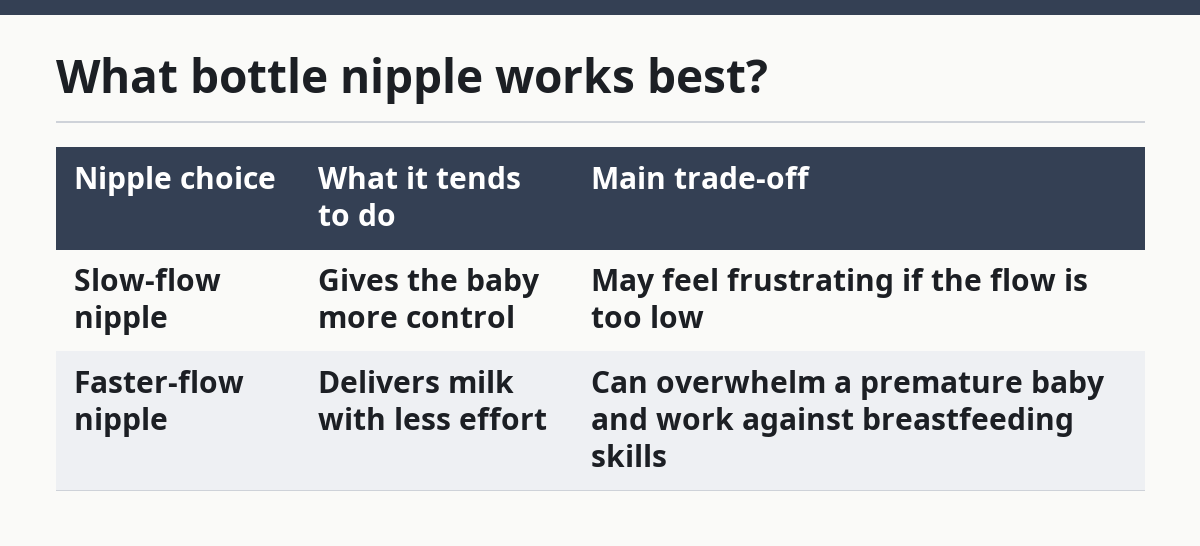
For a baby who breastfeeds part of the time, the slowest nipple that still lets the baby feed without long struggle is usually the better choice. If the baby coughs, gulps, or milk drips even when the bottle is held nearly level, the flow is probably too fast.
I would be cautious about jumping to a faster nipple just because the feed takes longer. A longer feed is not always a problem; a rushed feed often is. If the baby is working hard for 15 to 20 minutes and finishing calmly, that may be a better sign than a quick bottle with lots of spill and stress.
The American Academy of Pediatrics and the CDC both emphasize feeding cues and responsive feeding; those ideas fit paced bottle feeding for premature babies who also breastfeed.
A lactation consultant can help compare nipple flow, latch, and breast comfort if the baby switches between breast and bottle several times a day.
How does paced feeding protect breastfeeding skills?
Paced feeding protects breastfeeding skills by keeping the baby’s mouth, tongue, and breathing rhythm closer to what breastfeeding asks for. A bottle that rushes milk can train the baby to expect a steady stream with little effort, which is not how the breast works.

That matters for switching between breast and bottle. A baby who gets used to a fast bottle may become impatient at the breast, where milk flow can start slower and change during the feed. Paced feeding reduces that mismatch. The baby still practices sucking, but the bottle does not overpower the pattern.
It can also help feeding fatigue reduction. Preemies often have limited stamina, and a bottle that runs too fast can lead to gulping and then a hard crash. Slower pacing gives the baby smaller work cycles, which can leave more energy for the next breastfeed.
One practical way to think about it is this: the goal is to avoid making bottle feeds feel like a race the breast cannot win. If the bottle is calm, pause-heavy, and closer to breast rhythm, the baby is less likely to choose the bottle simply because it is easier.
This is one reason paced bottle feeding fits well in a mixed-feeding plan for a premature baby. It supports the breast instead of competing with it.
What mistakes make bottle feeding harder for preemies?
The biggest mistakes are a fast nipple, a flat bottle angle, and ignoring signs that the baby needs a break. Each one costs the baby control, and control is the whole point of paced feeding.

A fast nipple can flood the mouth and make swallowing messy. That can lead to coughing, air swallowing, and a feed that ends in stress instead of comfort. The fix is to slow the flow, keep the bottle more horizontal, and let the baby pull milk rather than pour it in.
A bottle held too upright can turn the feed into a constant stream. That often looks efficient, but it can be rough on a premature baby’s coordination. The better choice is to tip the bottle only as needed and lower it during pauses.
Ignoring fatigue is another common error. A preemie may not have the reserves to keep feeding once the rhythm falls apart. Signs like fluttery sucking, milk leaking, or turning away mean the feed should slow down or stop for a rest.
| Common mistake | What it can cost | Better move |
|---|---|---|
| Fast nipple | Overwhelm, coughing, bottle preference | Use slower flow |
| Bottle tipped high | Milk floods too quickly | Keep the bottle more level |
| No pauses | Tired baby, poor coordination | Lower the bottle during breaks |
| Pushing the feed to finish | Stress and refusal later | End when the baby is done |
This method is not ideal for every feed, either. If a baby is medically unstable, has new breathing trouble, or a care team has given different instructions, follow that plan first and ask a clinician before changing technique.
Should I ask a lactation consultant?
Yes, a lactation consultant is worth involving if the baby keeps struggling at the breast or bottle, or if switching between them seems to be getting harder rather than easier. That is especially true for a premature baby, where small technique changes can have a big effect.
A consultant can look at the whole feeding pattern: latch, bottle nipple flow, tongue movement, fatigue, and how the baby behaves after feeds. They can also help you decide whether the current bottle setup is working against breastfeeding skills. That kind of check is more useful than changing nipples at random every few days.
This is not a page about how to tell if a premature baby is getting enough milk, and it is not the place to decide how often the baby should breastfeed. Those are separate questions that need their own answers and sometimes a more detailed feeding plan.
For general breastfeeding guidance, trusted starting points include the CDC breastfeeding recommendations page at https://www.cdc.gov/breastfeeding/recommendations/index.htm and the World Health Organization’s breastfeeding topic page at https://www.who.int/health-topics/breastfeeding. A lactation consultant can help translate broad guidance into a plan that fits a premature baby’s actual feeding pattern.
If the baby seems to work very hard at every bottle, falls asleep almost immediately, or never seems settled after feeds, that is a good time to get help rather than keep guessing.
How do I switch between breast and bottle?
You switch between breast and bottle more smoothly when the bottle pace stays close to the breast pace. That means no fast-flow “catch-up” feeds, and no long bottle sessions that leave the baby too tired to nurse later.

A useful pattern is to keep the bottle feed calm and responsive, then offer the breast when the baby is alert enough to practice. If the bottle is used as a backup, the goal is not to make it the easiest possible feed. The goal is to make it compatible with breastfeeding.
Timing matters too. A baby who is already exhausted may not do well at either breast or bottle, and a feed that starts with frustration often stays that way. A quiet setting, good support for the baby’s body, and a slow nipple can all reduce the chance of a hard switch.
The real test is not whether the bottle looks neat. It is whether the baby can move between breast and bottle without one method wrecking the other. Paced bottle feeding is one of the simplest ways to help that happen.
FAQ
How do I bottle feed a premature baby without affecting breastfeeding?
Use paced bottle feeding, a slow nipple, and an upright hold so the bottle does not feel much easier than the breast. The baby should still work for the milk, just with fewer spikes in flow and less gulping.
What bottle nipple is best for a preemie?
A slow-flow bottle nipple is often the best place to start for a premature baby who also breastfeeds. The right nipple is the one that lets the baby feed with control, without coughing, gulping, or long frustration.
Should preemies use paced feeding?
Yes, paced feeding is often a good choice for preemies because it supports flow control and protects breastfeeding skills. It is not the answer for every feeding problem, but it is a strong default when a premature baby also breastfeeds.
Drafted with AI; not yet reviewed by a person.