Last updated: November 28, 2026
Quick Answer: Around 32 weeks’ gestation, when oral feeding may be possible, the safest approach is usually to slow the feed, watch for stress signals, and pause early if a premature baby has trouble coordinating suck, swallow, and breathe. The topic here is what to do when a premature baby has trouble coordinating suck, swallow, and breathe: keep the baby safe, steady, and able to finish a feed without getting overwhelmed. If the pattern stays messy, a lactation consultant or NICU team should review the feeding plan.
Key takeaways
- Suck-swallow-breathe coordination is a timing problem, not a willpower problem.
- Pausing during feeds can be a safer first move when the baby starts to cough, gulp, or lose rhythm.
- Small babies have very limited stomach capacity, so a calmer feed can matter more than a bigger one.
- Some feeding plans work better with shorter sessions, slower pacing, and fewer demands at once.
- If the baby keeps showing disorganized feeding or is hard to wake for repeated feeds, get help from a lactation consultant or NICU team.
What is suck-swallow-breathe coordination?
Suck-swallow-breathe coordination is the baby’s ability to draw milk, swallow it, and take a breath in a smooth pattern without getting stressed. For a premature baby, that timing may not be ready yet, even when the baby looks hungry. Therapy is usually started around 32 weeks’ gestation, when oral feeding may be possible, according to MAM Baby.
That matters because a feed is not just about milk transfer. It is also about keeping airway control steady and preventing the baby from working so hard that breathing falls behind. A baby can be eager to feed and still be too immature to manage the rhythm well.
Therefore, the biggest mistake is often treating every feed like a race to the finish; if the pattern keeps breaking down, a lactation consultant or NICU team should help review the plan, and this is especially important for babies with very limited stomach capacity, as noted by the University of Washington.
The right response is not to force the mouth to keep going when the whole body is saying stop. Think of coordination as a skill that can improve with maturity and the right feeding setup, not a test the baby passes or fails in one sitting. For more context, see breastfeeding a premature baby and how to bottle-feed a preemie.
How do I know the feeding is getting disorganized?
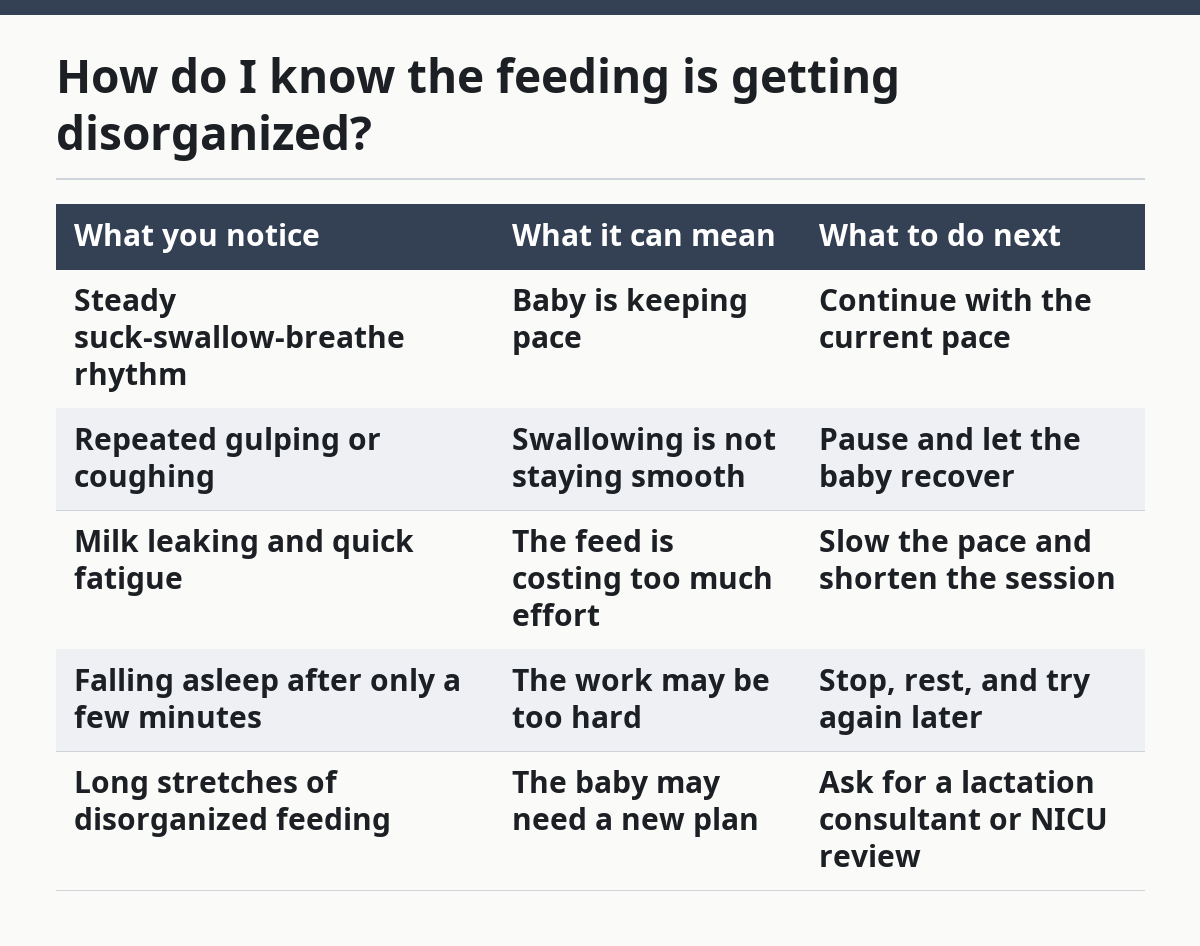
You can spot disorganization when the baby loses rhythm, works harder, or shows stress before the feed is done. Common signs include repeated pauses that seem to happen because the baby cannot keep up, coughing, gulping, milk spilling from the mouth, widening stress eyes, flaring nostrils, or a sudden drop in energy.
In particular, the feed may turn choppy. The baby may suck a few times, stop, swallow awkwardly, then pull away or fall asleep. That pattern often means the baby is spending too much effort on coordination and not enough on efficient feeding.
A useful benchmark from USDA ARS says that if infants show over 30% proficiency and over 1.5 ml/min efficiency, 86% have satisfactory oral feeding performance. That does not mean every baby must hit those numbers at home, but it shows why feeding teams pay close attention to both skill and flow.
Here is a simple comparison of what you may see and what it usually means.
| What you notice | What it can mean | What to do next |
|---|---|---|
| Steady suck-swallow-breathe rhythm | Baby is keeping pace | Continue with the current pace |
| Repeated gulping or coughing | Swallowing is not staying smooth | Pause and let the baby recover |
| Milk leaking and quick fatigue | The feed is costing too much effort | Slow the pace and shorten the session |
| Falling asleep after only a few minutes | The work may be too hard | Stop, rest, and try again later |
| Long stretches of disorganized feeding | The baby may need a new plan | Ask for a lactation consultant or NICU review |
A generic article often says “watch for signs of distress” and leaves it there. That is too vague. What matters is whether the baby can keep a steady pattern long enough to feed without turning the whole meal into a struggle.
What should I do during the feed?
You should slow the feed, pause often, and reduce the baby’s workload right away. The aim is to protect the rhythm before the baby tips into fatigue.
Use this basic procedure when suck-swallow-breathe coordination looks shaky:
-
Start in a calm setting with the baby as settled as possible. Keep noise and handling low so the baby can focus on feeding rather than sorting through extra stimulation. A calmer start often lowers the chance of an early breakdown in rhythm.
-
Offer the breast or bottle in a way that does not rush milk flow. If the feed begins too fast, the baby may lose timing before the first few swallows. A slower, more controlled start gives the baby a better chance to match suck and breath.
-
Watch the first signs of strain, not the last. If you see gulping, coughing, milk loss, or a sudden pause, stop before the baby becomes fully disorganized. Early pausing protects the rest of the feed.
-
Let the baby breathe and reset. A short break can be enough for the baby to regain rhythm. The result you want is a return to smoother sucking, not a forced restart while the baby is still stressed.
-
Resume only if the baby looks ready. If the baby remains tense, sleepy, or scattered, end the feed and try again later. A shorter session can be better than a long, messy one.
-
Keep the session efficient. Small babies have very limited stomach capacity, so the feed should not drag on after the baby’s energy starts dropping. A feed that ends before exhaustion is often more useful than one that keeps going without coordination.
The common error here is pushing through a bad rhythm because the baby has “just a little more to go.” That can cost the baby stability and make the next feed worse. The better move is to treat each pause as information, and if the problem keeps repeating, a lactation consultant or NICU team should review the feeding plan. See also premature baby feeding cues.
Which feeding adjustments help most?
Since different babies need different adjustments, no single intervention works for all babies. That is one reason a feeding plan that helps one preemie can do little for another. Some very low birth weight babies never want to breastfeed, and that reality should be named plainly instead of treated like failure; if that situation is happening, a lactation consultant or NICU team should help decide what is realistic.
The best adjustments are usually the ones that lower effort without creating a new problem. Shorter sessions can help a baby who tires fast. More frequent breaks can help a baby who starts well but falls apart after several swallows. A quieter setting can help a baby who gets overloaded by stimulation.
The trade-off is simple: slower pacing may mean less milk transfer in one sitting, but it can also mean a more organized feed and less stress. For a premature baby, that trade-off is often worth it.
Here is a practical comparison.
| Adjustment | What it helps | Main drawback |
|---|---|---|
| Slower pace | Gives the baby time to coordinate | Feed may take longer |
| More pauses | Helps breathing stay steady | Baby may need more rest time |
| Shorter session | Reduces fatigue | The feed may end before you hoped |
| Lower stimulation | Helps the baby stay organized | Takes more effort to keep the room calm |
| Changing only one thing at a time | Makes it easier to see what works | Progress may feel slow |
Therefore, the safest pattern is to change one variable, then watch what happens. If you change too many things at once, it becomes hard to know whether the baby improved because of pacing, timing, position, or simple maturity. For related guidance, see NICU feeding support.
When should I ask for help?
You should ask for help when the feeding pattern keeps breaking down, when the baby cannot recover quickly, or when the feed keeps ending in stress instead of steadier rhythm. A lactation consultant can help sort out whether the issue is timing, milk flow, position, stamina, or readiness for oral feeding.
In contrast, this is especially worth doing if the baby was born very small or is newly home. Most low birth weight infants are nutritionally vulnerable, especially when they first come home, according to the University of Washington. That means there is less room for guesswork and more reason to get a feeding plan checked.
The NICU team is also the right place to ask if the baby is still in the hospital and the feed looks unstable. Therapy is usually started around 32 weeks’ gestation, when oral feeding may be possible, according to MAM Baby, so a team that knows preemie feeding can help judge whether the baby is ready for more oral practice or needs more time.
This page belongs to the larger guide on breastfeeding a premature baby, but it does not replace direct care when feeding problems keep repeating. A generic “keep trying” answer is wrong for a baby who is working too hard every time. The point is to prevent a small feeding problem from turning into a bigger one.
Why does pausing matter so much?
Pausing matters because a preemie’s body may need a reset before it can keep feeding safely. A pause gives the baby time to breathe, swallow what is already in the mouth, and settle back into rhythm instead of stacking one stress on top of another.
That matters even more because some babies may sleep longer than 3 to 4 hours at night, and some infants will not get enough breastmilk or formula to grow if they sleep much longer than 4 hours, according to the University of Washington. A baby who is hard to wake and also disorganized at the breast may need a feeding plan reviewed, not just more effort from the parent.
A pause is not a failure. It is a control point. In many feeds, the pause is what keeps the baby from sliding from “a little out of sync” into fully overwhelmed.
The mistake to avoid is waiting until the baby is clearly distressed before stopping. By then, the feed often takes longer to recover, and the baby may be too tired to finish well. A brief, early pause is easier to manage than a long recovery.
What makes this problem different from a normal feeding struggle?
Because of that, this problem is different because the issue is coordination, not just preference, mood, or a temporary fussiness streak. A full-term baby may have a bad moment at the breast and then recover quickly. A premature baby may not yet have the nervous system maturity to keep suck, swallow, and breathe lined up for long.
That is why the response needs to be practical and specific. A baby who is still developing oral feeding skills may need extra time, closer watching, and a plan that respects limited stamina. If the baby has over 30% proficiency and over 1.5 ml/min efficiency, USDA ARS notes that 86% have satisfactory oral feeding performance, which shows how closely teams look at both skill and efficiency.
The hard truth is that this is not the right topic for guesswork. If the baby keeps showing disorganized feeding, the next step is not to keep repeating the same pattern and hoping it changes on its own. It is to bring in a lactation consultant or NICU team that can look at the feed as a whole.
For a baby who is struggling to coordinate suck, swallow, and breathe, the safest path is simple: slow the feed, pause early, watch for stress, and ask for help when the pattern does not improve. That approach respects both the baby’s limits and the work feeding already asks of a premature infant. For more detail, see preemie feeding readiness.
Why does my preemie stop and start while nursing?
A preemie often stops and starts because the baby is not yet keeping suck, swallow, and breathe in steady rhythm. The baby may be trying to feed, but the timing falls apart after a few swallows. When that happens, pausing and slowing the feed is usually more helpful than pushing through.
Is poor coordination common in premature babies?
Yes, poor coordination is common enough that feeding skill is often watched closely as babies mature. Therapy is usually started around 32 weeks’ gestation, when oral feeding may be possible, according to MAM Baby. That timing reflects how much development is still happening before feeding feels smooth.
When should I worry about feeding coordination?
Worry when the problem keeps repeating, the baby cannot recover after pauses, or feeds stay stressful instead of becoming more organized. A lactation consultant or NICU team should review the feeding plan when the pattern does not improve. If the baby is very sleepy, hard to wake, or feeding poorly after repeated tries, the plan needs attention.
Drafted with AI; not yet reviewed by a person.