Last updated: November 28, 2026
Cup feeding is usually the better choice when a premature baby is ready for small oral feeds and the NICU team wants to protect feeding skills; syringe feeding is usually used for tiny, controlled volumes or when the baby is not ready to manage a cup. The right method depends on the baby’s stability, coordination, and the NICU nurse’s plan. For background on the bigger breastfeeding path, see the hub on breastfeeding a premature baby.
Key takeaways
- Cup feeding and syringe feeding are both short-term ways to give milk before a preemie can feed normally.
- Cup feeding is often chosen when the goal is to keep the mouth involved in feeding without forcing a nipple.
- Syringe feeding fits very small, carefully measured volumes and can be easier when the baby tires fast.
- The safer choice is the one the NICU nurse can supervise with the baby’s current breathing, tone, and alertness.
- If the baby coughs, splutters, turns blue, or stops coordinating suck-swallow-breathe, stop and ask NICU staff.
What is the real difference?
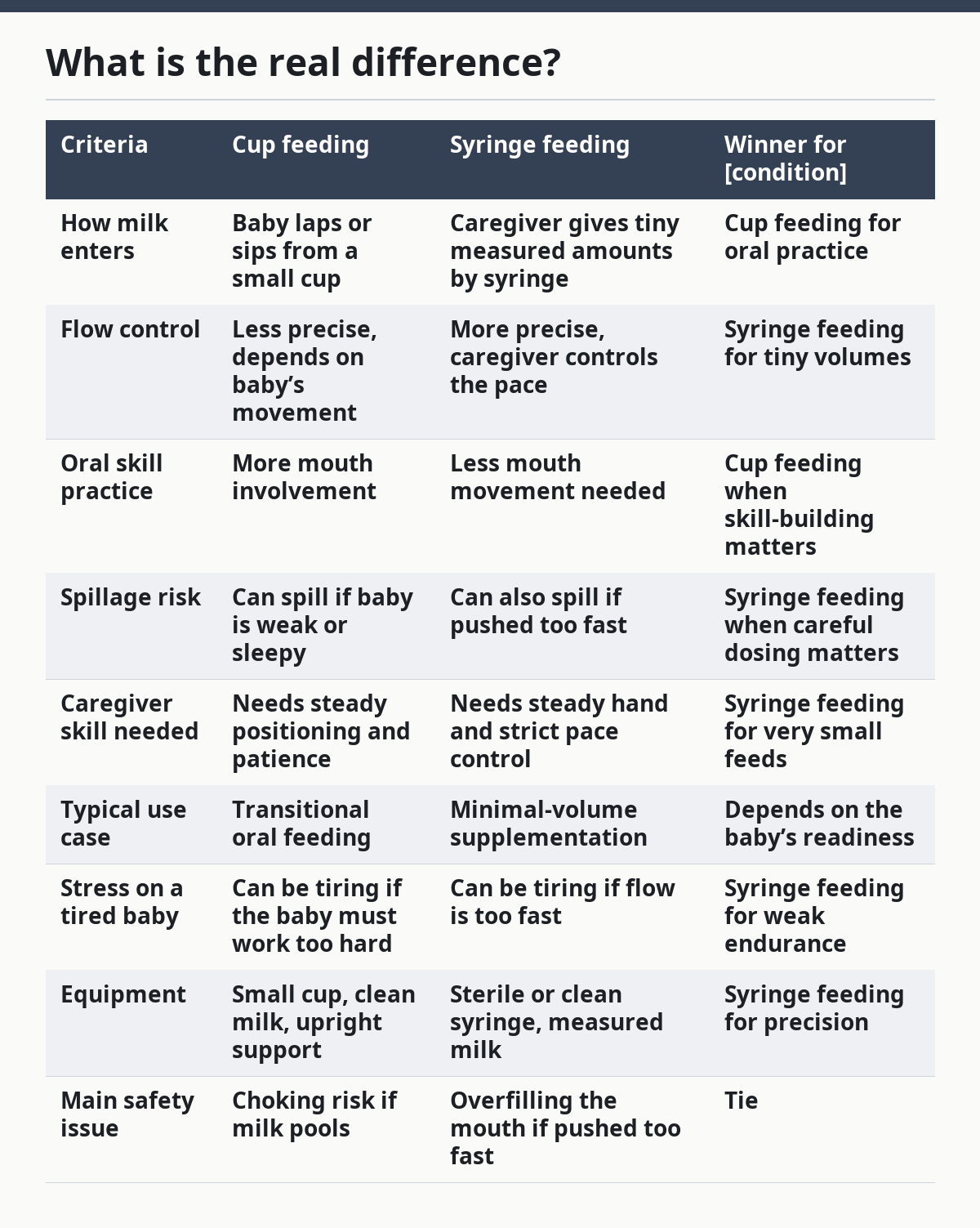
Cup feeding gives milk in a small open cup or medicine cup, while syringe feeding gives milk in tiny measured drops or a slow squirt, usually into the side of the mouth. The difference is not just the tool; it is the level of control and how much the baby has to participate.
In cup feeding, the baby can lap or sip small volumes, which may suit a preemie who can stay alert and manage some oral movement. In syringe feeding, the adult controls the flow more directly, which can help when the baby needs only a few milliliters at a time or cannot handle a cup without spilling or stress. A NICU nurse often chooses between them based on feeding safety, not on convenience alone.
| Criteria | Cup feeding | Syringe feeding | Winner for [condition] |
|---|---|---|---|
| How milk enters | Baby laps or sips from a small cup | Caregiver gives tiny measured amounts by syringe | Cup feeding for oral practice |
| Flow control | Less precise, depends on baby’s movement | More precise, caregiver controls the pace | Syringe feeding for tiny volumes |
| Oral skill practice | More mouth involvement | Less mouth movement needed | Cup feeding when skill-building matters |
| Spillage risk | Can spill if baby is weak or sleepy | Can also spill if pushed too fast | Syringe feeding when careful dosing matters |
| Caregiver skill needed | Needs steady positioning and patience | Needs steady hand and strict pace control | Syringe feeding for very small feeds |
| Typical use case | Transitional oral feeding | Minimal-volume supplementation | Depends on the baby’s readiness |
| Stress on a tired baby | Can be tiring if the baby must work too hard | Can be tiring if flow is too fast | Syringe feeding for weak endurance |
| Equipment | Small cup, clean milk, upright support | Sterile or clean syringe, measured milk | Syringe feeding for precision |
| Main safety issue | Choking risk if milk pools | Overfilling the mouth if pushed too fast | Tie |
Authoritative guidance on infant feeding and breastfeeding support is available from the World Health Organization and the Centers for Disease Control and Prevention; a NICU team may also use local protocol or hospital policy. WHO: https://www.who.int/health-topics/breastfeeding and CDC: https://www.cdc.gov/breastfeeding/
When does cup feeding win?
Cup feeding wins when the goal is a gentle transition to oral feeding and the baby can manage small, supervised sips. It is often used for premature babies who are stable enough to be awake, hold their head reasonably well, and take a tiny amount without distress.
The main advantage is that a cup does not require a nipple. That matters when the team wants to avoid creating a strong bottle preference or when the baby is practicing mouth-based feeding without needing a full suck pattern yet. Cup feeding can also be useful for small-volume feeds, because the caregiver can offer milk in short pauses and let the baby lead.
The limit is obvious: cup feeding is not for every sleepy, fragile, or poorly coordinated preemie. If the baby cannot stay alert, cannot swallow safely, or shows coughing and milk pooling, the cup can become a bad fit fast. A cup also demands patience from the caregiver, because a rushed tilt can flood the mouth. This is why a NICU nurse often prefers cup feeding only when the baby is steady enough to handle the rhythm.
Pros
- Supports oral practice without a nipple
- Fits transitional feeding
- Can work well for small, supervised volumes
Cons
- Needs good timing and positioning
- Can spill easily
- Not ideal for a very weak or drowsy baby
Cup feeding is not for a baby who is very unstable, cannot coordinate swallowing, or shows clear signs of stress with each attempt.
When does syringe feeding win?
Syringe feeding wins when the baby needs tiny, controlled amounts and the caregiver has to place the milk with precision. It is often used when the volume is so small that a cup would be clumsy, or when the baby is not ready to manage active sipping.
That control is the whole point. A syringe lets the NICU nurse or trained caregiver give milk slowly into the cheek area in very small amounts, which can reduce waste and make it easier to track exactly how much was taken. This matters for a premature baby whose feed plan may change from attempt to attempt.
The drawback is that syringe feeding can be passive. The baby may not get as much mouth practice as with cup feeding, and if the caregiver pushes too fast, the mouth can fill before the baby is ready. That can raise stress instead of lowering it. Syringe feeding is not the right choice when the team wants the baby to practice oral coordination more actively.
Pros
- Very precise for small-volume feeds
- Useful when the baby tires quickly
- Easy to match strict amounts
Cons
- Less oral skill practice
- Flow can be mishandled if rushed
- Can turn into a gulping problem if not done carefully
Syringe feeding is not for a baby who is ready to practice oral feeding and would benefit more from active mouth movement than from passive delivery.
Which one is safer?
The safer method is the one that matches the baby’s current coordination and the caregiver’s skill. Safety is not about one tool being universally gentle; it is about whether the milk stays controlled and whether the baby can handle the pace without coughing, choking, or losing color.
Cup feeding can be safe when milk is offered in tiny amounts and the baby is upright, calm, and alert. Syringe feeding can be safe when the milk is placed slowly and the caregiver avoids pushing it into the mouth too quickly. In both cases, the danger comes from rushing, poor positioning, or using the method before the baby is ready.
A good rule for a parent or caregiver is simple: if the baby seems to struggle, pause and ask the NICU nurse. Signs like coughing, sputtering, wet breathing, flaring nostrils, turning dusky, or falling asleep mid-feed mean the method may need to change.
The honest side-by-side
Cup feeding is the better pick for babies who are ready to practice oral feeding; syringe feeding is the better pick for babies who need tiny, controlled amounts. That is the cleanest way to think about it.
Cup feeding
Cup feeding is best when the NICU team wants the baby to participate more actively in the feed. It can support the transition from tube feeds to mouth feeds because the baby has to engage the lips and tongue, not just accept a drip of milk.
The weakness is that it asks more of the baby. A 34-week or 35-week preemie may manage it better than a much sleepier or less coordinated baby, but that is a general pattern, not a promise. If the baby has poor tone, poor alertness, or frequent stress cues, cup feeding can become messy and tiring.
Syringe feeding
Syringe feeding is best when the baby needs exact amounts with minimal waste. It is also useful when the care team wants to keep the feed very slow and controlled.
The weakness is that syringe feeding can shortchange oral practice. It can also become a problem if the caregiver uses pressure instead of patience. For that reason, syringe feeding is usually more of a control tool than a learning tool.
When should NICU staff decide instead?
NICU staff should decide instead when the baby’s breathing, heart rate, or alertness makes home judgment too risky. A premature baby can look ready for a feed and still not have the coordination to handle it safely.
That is especially true after recent illness, a new oxygen change, or a rough stretch with fatigue. If the baby has repeated desats, coughs during feeds, or cannot stay awake long enough to manage even a tiny volume, the question is not cup versus syringe. The question is whether oral feeding should pause or be adjusted under NICU guidance.
This is also the point where a caregiver should not “try one more time” just because the volume is small. Small-volume feeds still count as real feeds. If the plan changes, that is a feeding plan issue, not a willpower issue.
The verdict
Choose cup feeding if the premature baby is stable enough to practice oral feeding and the goal is skill-building with small, supervised sips. Choose syringe feeding if the baby needs very tiny, controlled amounts or is not ready to manage a cup. Neither if the baby is coughing, turning blue, working too hard to breathe, or the NICU nurse has said oral feeding should wait.
FAQ
Is cup feeding safe for preemies?
Cup feeding can be safe for preemies when the baby is stable, alert, and closely supervised. The key is not the cup itself but the baby’s ability to coordinate breathing and swallowing. If the baby coughs, splutters, or looks stressed, stop and ask NICU staff before trying again.
When is syringe feeding used instead of breastfeeding?
Syringe feeding is used instead of breastfeeding when the baby is not ready to latch, tire quickly, or needs only a very small measured amount. It gives the care team more control over flow and volume. NICU staff may choose it as a short-term step while the baby builds readiness.
Can a premature baby learn to breastfeed after cup feeding?
Yes, a premature baby can still learn to breastfeed after cup feeding. Cup feeding does not block later breastfeeding, and it may help some babies practice mouth movement before a breast latch is realistic. The timing and sequence should still follow the NICU plan, because readiness varies a lot from baby to baby.
Drafted with AI; not yet reviewed by a person.