
Last updated: November 18, 2026
Quick Answer: For Pumping, breast care, and equipment — The Complete Guide, the most practical choice for many families is a standard electric pump, because it usually fits repeated use better than a manual model or a wearable. Pumping should feel manageable, not mysterious: pick the right pump for how often you need milk, use a flange that fits your nipple comfortably, and clean every milk-contact part with care. The right breast care routine can protect supply, reduce pain, and keep clogged ducts, cracked nipples, and skipped sessions from snowballing.
Key takeaways
- The best pump is usually the one that matches your schedule and your budget, not the most expensive model on the shelf.
- Flange fit matters more than a lot of first-time pumpers expect; poor fit can hurt, reduce milk removal, and make sessions drag on.
- Manual pumps work well for short-term, occasional use; electric pumps are often the better choice when you need to pump several times a day.
- Breast care is mostly about mechanics: gentle suction, good flange size, consistent emptying, and prompt attention to pain or hard spots.
- Cleaning and storage are not optional details. Follow the pump maker’s instructions and the CDC’s breast milk handling guidance for parts that touch milk.
- If pumping is painful, milk output drops suddenly, or a breast becomes red and hot, talk to a lactation consultant or clinician.
A useful starting point is the American Academy of Pediatrics’ guidance on breastfeeding and lactation support, and the CDC’s page on cleaning breast pumps and milk storage. Both are worth bookmarking because they address the details people usually need after the first day. See the CDC’s breast pump cleaning guidance and the AAP policy statement on breastfeeding and the use of human milk. For broader pumping, breast care, and equipment questions, the CDC and AAP remain the most practical starting references.
What pumping is for, and when breast care stops being optional

Pumping is a tool for removing milk when direct nursing is hard, impossible, or not the best fit for a given hour of the day. Breast care becomes important the moment the pump starts replacing a baby’s mouth, because suction, fit, and frequency now influence comfort and supply. That is why a parent pumping twice a week has a very different setup from someone pumping eight times in 24 hours.
A good rule is this: if you only need to express milk occasionally, a manual pump or a small electric unit may be enough; if you are back at work, building a stash, or exclusively pumping, the setup needs to be more serious. The difference is not cosmetic. A person pumping 6 to 8 times daily needs a device that can hold up to repeated sessions, plus extra parts, storage containers, and a wash routine that does not eat the whole day.
The basic breast-care goal is to keep milk moving without injuring tissue. That means three things matter more than packaging claims: the flange tunnel size, the suction pattern, and the total number of milk removals in 24 hours. A pump that is “strong” but pinches the nipple is not a good pump for that body. A pump that feels gentle but leaves the breast full after 20 minutes is not helping supply.
This is also where a lot of generic advice goes wrong. People are often told to “just pump more” or “turn the suction up.” That can backfire. Higher suction is not the same as better milk removal, and longer sessions do not fix a badly fitted flange. The person most likely to benefit from a careful setup is the one already in pain, on a tight schedule, or trying to protect supply after a rough start.
Which pump is right for your situation?
The right pump is the one that matches your pumping frequency, your tolerance for maintenance, and your budget for accessories and replacements. For most people, the choice comes down to manual, standard electric, wearable, or hospital-grade rental.
Manual pumps: best for occasional use, not a full-time plan
Manual pumps win when the need is occasional and portability matters more than speed. They are simple, usually cheaper than electric models, and useful for a one-off missed feed, travel day, or short-term relief from engorgement. A manual pump also gives the user direct control over rhythm and suction, which can be helpful if machine settings feel too aggressive.
The weakness is obvious: your hand does the work. That matters after several minutes, and it matters a lot if milk needs to be expressed many times a day. A manual pump can also be a poor fit for someone with wrist pain, postpartum swelling, or a baby’s feeding pattern that demands repeated sessions. It is not the tool for exclusive pumping.
Manual pumps are for the parent who pumps infrequently, knows how to tolerate a little trial and error, and wants a lightweight backup. They are not the answer for someone who needs to replace nursing at every feeding or maintain supply on a demanding schedule. A basic manual pump can be a smart second device even for people who own an electric one, but it should not be the only plan if pumping is becoming routine.
Standard electric pumps: best for daily pumping and returning to work
A standard electric pump is the strongest default choice for regular pumping because it saves time and does the repetitive work for you. If a person needs to pump several times a day, this category usually makes the most sense. Many double electric pumps let both sides drain at once, which shortens the session and can improve convenience during work breaks or overnight pumping.
The trade-off is that electric pumps bring more parts, more cleaning, more setup, and more things that can wear out. Tubing, duckbill valves, membranes, and collection bottles all need attention. A weak or leaky component can change performance fast, which is why replacement parts matter as much as the main unit. Some pumps also have a learning curve around stimulation mode, suction level, and session length.
This option fits the person who wants reliability and repeatability. It is often the middle ground many families choose because it balances comfort, speed, and cost better than the extremes. It is not ideal for someone who wants silent, truly hands-free use in every setting, and it is overkill for very occasional expression.
Wearable pumps: best for mobility, not always for maximum milk removal
Wearable pumps are appealing when the user needs to move around while pumping. They sit inside a bra and reduce the need to stay tethered to a wall unit, which is useful during work, childcare, or travel between tasks. That convenience is real, and for some people it is the difference between pumping and skipping a session.
The drawback is equally real: wearables can be less forgiving about fit, positioning, and full breast drainage. Many users also find them harder to inspect while they run, which makes it easier to miss a seal problem or a poorly seated flange. Some models have smaller milk capacity, so a person with a larger supply may need to empty them mid-session. If a wearable leaves milk behind, comfort and supply can suffer.
Wearable pumps can work well for someone who values mobility and can accept a little extra compromise on drainage or monitoring. They are not the first pick for building supply after a difficult start, for very sensitive breasts, or for someone whose clinician has advised close attention to milk transfer.
Hospital-grade rental pumps: best for protecting supply in hard situations
Hospital-grade rental pumps are the strongest choice when milk removal is medically important or supply is fragile. They are commonly recommended after preterm birth, low supply, breastfeeding complications, or during a temporary separation from baby. Their value is not about glamour; it is about dependable suction and strong performance over repeated sessions.
The downside is cost and convenience. Rentals require access through a pharmacy, medical supply provider, or lactation channel in many areas, and the setup is less mobile than a personal pump. Some people also find them intimidating or bulky. They are usually not necessary for routine casual pumping.
This category is the right answer when the problem is not comfort but output. If a person needs the strongest possible support for maintaining lactation, a rental often beats trying to force a weak personal pump to do a hard job.
The honest side-by-side

The best choice depends on how often pumping happens, how much milk removal matters, and how much friction the routine can tolerate. This table makes the trade-offs plain.
| Criteria | Manual pump | Standard electric pump | Winner for [condition] |
|---|---|---|---|
| Daily frequency | Best for occasional sessions | Built for repeated use | Standard electric pump for 3+ sessions per day |
| Portability | Very light and simple | Less convenient, more parts | Manual pump for travel or backup use |
| Hands-free practicality | Requires active hand pumping | Can be worn in a pumping bra | Standard electric pump for multitasking |
| Speed | Slower and more tiring | Usually faster for regular use | Standard electric pump for time-limited sessions |
| Control over suction | Direct, manual control | Preset levels and patterns | Manual pump for people who want tactile control |
| Learning curve | Low | Moderate, especially with settings | Manual pump for first-time occasional users |
| Cleaning burden | Fewer parts | More parts and valves to wash | Manual pump for minimal cleanup |
| Supply protection | Limited by user stamina | Better for scheduled milk removal | Standard electric pump when supply matters most |
| Best backup role | Excellent spare device | Good main device | Manual pump as a backup to an electric setup |
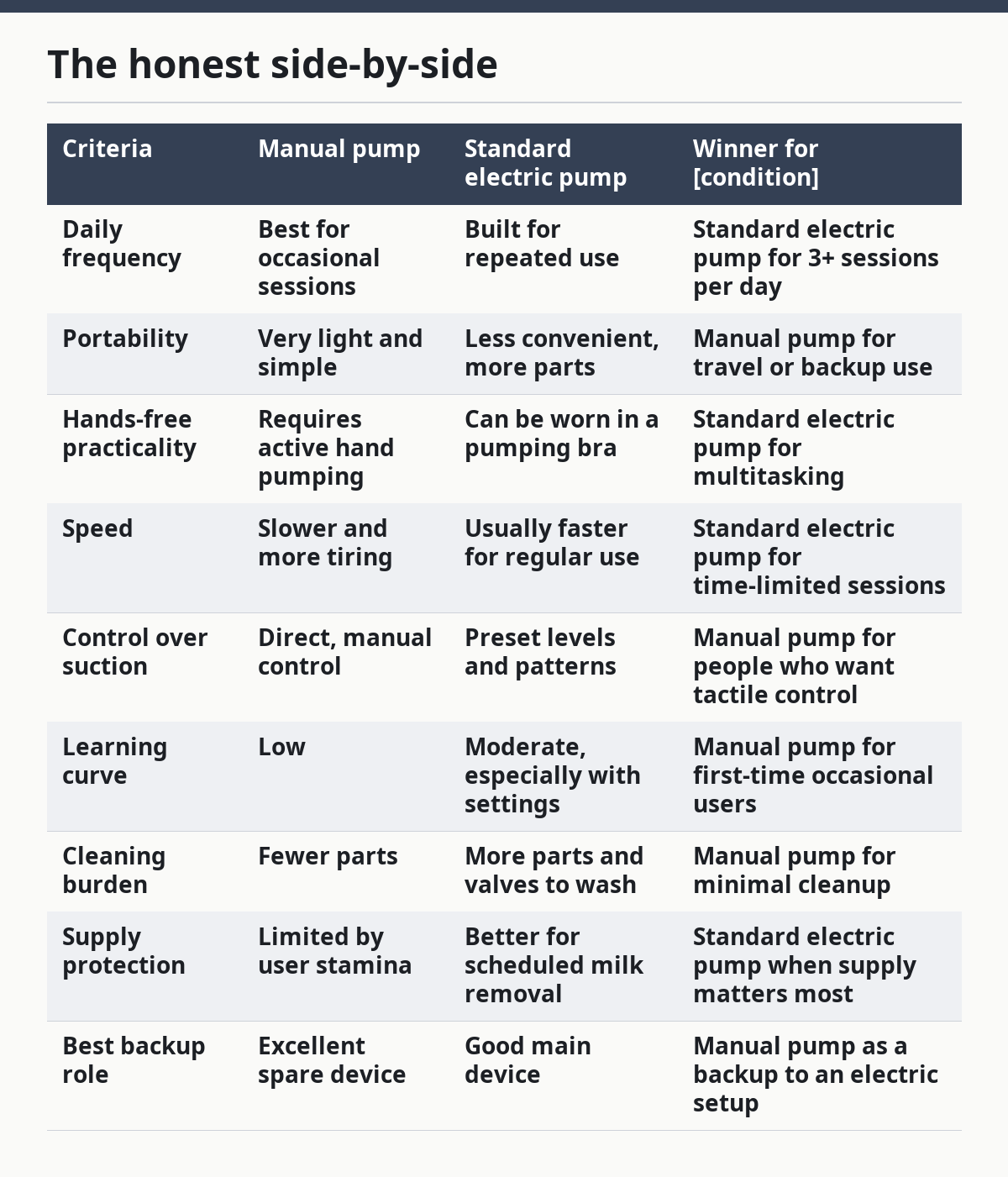
The table makes one point clear: a manual pump wins on simplicity, while a standard electric pump wins on repeatable milk removal. The reader who is pumping more than once a day should usually start with the electric option unless there is a strong reason not to. The reader who only needs a backup or occasional express session should not overspend on features that will sit unused.
The choice also depends on who is doing the work. If there is a parent recovering from birth, the simplest device is not always the best one; the one that removes milk efficiently with the least strain is usually better. If there is wrist pain, a standard electric pump beats a manual model almost every time. If there is limited storage space and the goal is only relief, the manual pump earns its keep.
How to get the right flange fit and avoid sore nipples
The right flange fit is the fastest way to improve comfort, and bad fit is one of the most common reasons pumping hurts. The flange tunnel should let the nipple move without rubbing hard against the sides, and the areola should not be pulled excessively into the tunnel. Pain, blanching, swelling, or a white ring after pumping are all signs that the fit may be wrong.
A lot of people assume the flange size printed in the box is the size they must use. That is a mistake. Nipple diameter changes with swelling, pregnancy, and pumping itself. Some parents need a smaller tunnel than the default size, and some need a larger one. If the nipple is dragging against the sides, the tissue can become sore and inflamed fast. If the tunnel is too wide, the pump may pull too much areola and reduce efficiency.
A practical fit check is simple: after a session, the nipple should look roughly centered and not chafed, and the breast should feel drained rather than bruised. If suction has to be very high to get output, the problem may be fit, not strength. For a first-time setup, a lactation consultant or an experienced pump fitter can be worth the visit because a 1- to 3-mm adjustment may change comfort noticeably.
Flange fit matters most for exclusive pumpers and for people with repeated nipple pain. It matters less if pumping is rare and short, but even then a bad fit can ruin a one-off session. This is one area where “more suction” is the wrong answer. Good fit and moderate suction usually outperform force.
Breast care during pumping: what actually prevents pain and blocked ducts?
Consistent milk removal, not aggressive pumping, is what helps prevent pain and clogged areas. The breast does best when milk is removed on a predictable schedule, the flange fits, and pumping stops before tissue gets irritated. A hard lump, localized tenderness, or a breast that feels full but not empty after the session should be treated as a signal to check technique, not to crank the machine harder.
Gentle breast care starts before the session. Warmth can help some people let down more easily, while a brief massage before pumping may help with flow. The hands should be used to guide and soften, not to bruise. Heavy kneading can make inflammation worse. After pumping, a cool compress may reduce swelling if the breast feels hot or overworked.
There is also a limit to self-treatment. If there is redness, fever, chills, rapidly worsening pain, or a hot, wedge-shaped area on the breast, that is not routine pumping soreness. That pattern can signal mastitis or another issue that needs prompt medical advice. The American Academy of Family Physicians and the Academy of Breastfeeding Medicine both emphasize that persistent inflammatory symptoms deserve evaluation rather than guesswork.
The reader who worries about supply should focus on frequency first. Missing a long stretch can lower output more than almost any pump setting. The reader who worries about soreness should focus on fit and pressure. Breast care is not a “more is better” category. It is a “less damage, more consistency” category.
Cleaning, storage, and replacement parts that actually matter
Cleaning is one of the most boring parts of pumping, and it is also one of the most important. Any piece that touches milk needs to be cleaned according to the manufacturer’s instructions, then air-dried in a clean place. The CDC advises that pump parts should be washed after each use and fully dried before storage, because leftover moisture can encourage germ growth.
The biggest mistake is assuming all parts are interchangeable or dishwasher-safe. They are not. Some components tolerate the top rack of a dishwasher; others warp, crack, or lose seal quality. Tubing often does not need washing unless milk gets inside it, but a wet or contaminated tube is a problem if it happens. Valves and membranes also wear out and can quietly reduce suction long before they look damaged.
Replacement parts are not a luxury. Duckbill valves, membranes, backflow protectors, and tubing can all degrade with use. If suction seems weaker than usual, the simplest fix may be a worn part rather than a broken motor. A parent pumping several times a day should expect to replace some consumables on a regular schedule, though the exact timing depends on brand and use. The pump manual matters here more than a generic chart.
Storage also matters. Milk storage containers should be clean, sealed, and labeled. The CDC provides detailed guidance on how long expressed milk can be stored under common conditions, and that guidance is more reliable than crowd-sourced rules passed around in parent groups. If the milk is intended for a daycare or a backup freezer stash, label it clearly with date and time. Confusion later is a preventable waste problem.
Pumping bra, bottles, and the accessories worth paying for
The accessories that earn their place are the ones that reduce friction every single day. A good pumping bra is worth far more than decorative add-ons because it holds flanges securely and frees both hands. For a person pumping at work or while caring for a baby, that hands-free support can be the difference between finishing a session and skipping it.
Bottle choice also matters more than people expect. A bottle that is hard to attach, prone to leaks, or awkward to transport makes routine pumping more annoying. Many standard pump systems use their own bottles, but compatibility with storage bags or common bottle shapes can change the daily routine. If the bottle system is inconvenient, people eventually avoid using it as intended.
An insulated cooler bag with cold packs is useful when pumping away from home, especially during a workday or a long outing. A simple milk-travel setup can keep the process manageable without pushing someone into a giant diaper-bag arrangement. A cleaning brush, drying rack, and spare set of parts are also worthwhile. They are not glamorous, but they save time.
The wrong accessories are the ones that look clever but solve no real problem. Extra decorative covers, complicated adapters, and add-ons that only work with one narrow setup often become clutter. The person who should spend money here first is the one pumping more than once a day, away from home, or under time pressure. The person who only pumps once in a blue moon can keep the accessory list short.
When to pick a different setup entirely
A different setup is the right answer when pumping is causing harm, not helping. If nipple trauma keeps recurring, the issue may be flange size, suction pattern, or the pump itself. If the breast does not empty well despite a good fit, a stronger system or a different strategy may be needed. If pumping sessions are so stressful that they are not sustainable, that matters as much as output.
There are also times when a pump should not be the only answer. A baby with latch difficulty may need a lactation consult, oral assessment, or feeding plan rather than just a better pump. A parent with repeated plugged areas may need hands-on evaluation. Someone with low supply may need to discuss endocrine issues, postpartum hemorrhage, retained placenta, medication effects, or thyroid concerns with a clinician. A pump is a tool, not a diagnosis.
This is the section where the overall verdict can flip.
- If the goal is to build or protect supply after a difficult start, a hospital-grade rental can beat any personal pump.
- If the goal is occasional relief, a manual pump can be enough and may be the most sensible choice.
- If the goal is all-day mobility, a wearable may justify its trade-off in drainage and capacity.
- If pain, fever, or redness is present, stop treating the problem as a gear choice and get medical advice.
The best setup is the one that fits the body, the schedule, and the reason for pumping. The wrong setup is any device that forces the user to fight every session. If that is happening, the answer is not to push harder. The answer is to change the system.
The verdict: which setup to choose and why
Choose a standard electric pump if pumping will happen more than once a day, if supply matters, or if the user needs a reliable routine around work, sleep, or exclusive pumping. Choose a manual pump if pumping is occasional, brief, and mostly about backup or relief. Neither if pumping is causing repeated pain, red-hot areas, or ongoing output problems that have not been checked by a lactation consultant or clinician.
That is the cleanest call. The standard electric pump is often the best default because it handles the hardest common use case: repeated milk removal with less effort from the person using it. The manual pump is better when convenience, simplicity, and infrequent use matter more than speed or throughput. The wrong move is buying around the problem with accessories when the real issue is fit, schedule, or medical concern.
FAQ
How long should a pumping session last?
A pumping session often lasts about 15 to 20 minutes, but the right length depends on letdown, comfort, and how the breasts respond. The goal is not to sit attached indefinitely; it is to remove milk effectively without causing soreness or overpumping.
How do I know if my flange is too small or too large?
A flange may be too small if the nipple rubs, turns white, or aches during the session. It may be too large if too much areola is pulled into the tunnel and the nipple looks swollen or oddly stretched afterward. A fit check with a lactation consultant can save a lot of trial and error.
Can I clean pump parts in the dishwasher?
Sometimes yes, but only if the manufacturer says the parts are dishwasher-safe. The CDC still advises washing pump parts after each use and drying them fully before storage. If the manual is silent or unclear, hand washing is the safer assumption.
When should I replace pump parts?
Replace worn parts when suction drops, parts crack, membranes deform, or valves no longer seal well. Some consumable pieces wear out before the motor does, and weak suction is often the first clue. The manufacturer’s manual is the best source for brand-specific replacement guidance.
When should I call a doctor or lactation consultant?
Call a doctor or lactation consultant if pumping is painful, a breast becomes red or hot, there is fever or chills, or milk output changes suddenly and stays low. Those signs can point to a fit problem, inflammation, infection, or another issue that needs more than equipment tweaks.
Drafted with AI; not yet reviewed by a person.