Last updated: November 28, 2026
For a premature baby, expressed breast milk is usually the safer starting point when feeding stamina is low, while direct nursing at the breast becomes the better choice as coordination and milk transfer improve. This guide to premature baby breastfeeding at the breast vs expressed milk explains why the choice changes over time. The main difference is how much work the baby must do at each feed.
Because many babies do not coordinate sucking, swallowing, and breathing until about 34–36 weeks of pregnancy, according to the NHS, the same baby can need expressed milk one week and do better at the breast later. For more background, see the NHS page on premature babies and the American Academy of Pediatrics guidance on breastfeeding.
Key takeaways
The key takeaways are simple: premature baby breastfeeding at the breast vs expressed milk depends on stamina, coordination, and how well the baby transfers milk.
- Direct nursing asks for more coordination; expressed milk can be easier when a preemie tires fast.
- The breast helps with practice and closeness, but only if the baby can stay organized long enough to transfer milk well.
- Expressed breast milk is useful when the feed must be controlled, paced, or easier to finish.
- A lactation consultant can help judge readiness, especially when feeding stamina changes from day to day. CDC breastfeeding support can also help families find reliable basics.
- The right choice is not fixed. It can change as the baby matures, sometimes around the 34–36 week window named by the NHS.
What changes between breast and expressed milk?
The main change is not the milk itself; it is the work the baby has to do to get it, and that work matters for a premature baby. At the breast, the baby has to latch, keep rhythm, and handle milk flow while coordinating sucking, swallowing, and breathing. With expressed milk, the milk is already out of the breast, so the feeding task can be simpler and easier to pace.
That difference matters because babies usually do not coordinate sucking, swallowing, and breathing for feeding until about 34–36 weeks of pregnancy, according to the NHS. Before that, a preemie may look interested but still run out of energy, lose rhythm, or need breaks. The same baby may manage a few minutes at the breast and then do better with expressed milk for the rest of the feed.
The breast also asks for more milk transfer skill. If the baby is not moving milk well, the feed can take effort without much payoff. Expressed milk removes that step, which is why it often suits early feeding stages or days when stamina is poor.
When does direct nursing at the breast win?
Direct nursing at the breast wins when the baby can stay organized long enough to transfer milk and finish without losing too much energy. That makes it the better option for a preemie who has moved past the earliest feeding stage and can handle the pattern of latch, suck, swallow, and breathe. See also our guide to direct breastfeeding a premature baby.
The breast has a real advantage once feeding stamina improves. It gives the baby practice with the full feeding sequence, and it can make the transition toward normal feeding feel more natural. It also reduces the number of steps between hunger and feeding, which can help when the baby is ready but still small.
That said, direct nursing is not the right choice if the baby cannot keep up. A feed that drags on without good milk transfer can leave the baby tired and frustrated. A premature baby who is still near the 34–36 week coordination window may need more help than the breast alone can give.
This is the better choice for a family who wants to build toward breastfeeds and has support from a lactation consultant. It is not the best choice for a baby who falls asleep quickly, tires after a short burst, or cannot coordinate well enough to move milk.
When does expressed milk win?
Expressed milk wins when the baby needs less work to feed and more control over the feeding pace. It is the better option when the baby is too tired for sustained sucking, when milk transfer at the breast is weak, or when a feed has to be completed with less struggle.
That can matter early on, because preterm babies may not yet manage a full coordinated feed. Expressed milk lets the adult control the flow and the pace, which can protect feeding stamina. It also helps when the goal is to give human milk while the baby is not yet ready to do all the work at the breast. Our expressed milk for premature babies page goes into that step by step.
A practical point matters here: preterm infants are often started on fortified milk or formula once they are fed 100 mL/kg of body weight, according to Wikipedia. That does not mean every baby needs the same plan, but it does show that feeding decisions can shift as intake grows. Expressed milk fits well in that shifting phase because it can be easier to deliver consistently.
This option is not ideal if the only goal is to teach direct nursing and the baby is already ready for more at-breast practice. It also does not give the same chance to rehearse the breast-feeding pattern.
The honest side-by-side
The clearest way to choose is to compare what the baby has to do, how long the feed may last, and how much stamina is left at the end. A feed could last 10–20 minutes and be given every 3 hours, according to Wikipedia, but a premature baby may not manage that pattern in the same way every day.
| Criteria | Breast | Expressed milk | Winner for this condition |
|---|---|---|---|
| Milk transfer | Depends on latch and coordination | Milk is already expressed and easier to deliver | Expressed milk when transfer is weak |
| Energy cost | Higher | Lower | Expressed milk when stamina is low |
| Skill practice | Trains the full feeding sequence | Less practice at the breast | Breast when learning to nurse |
| Timing flexibility | Can be slow if the baby tires | Easier to pace | Expressed milk for short attention spans |
| Fit with 34–36 week readiness | Better after coordination improves | Better before coordination improves | Expressed milk earlier, breast later |
| Feed completion | May stall if the baby loses rhythm | More likely to finish cleanly | Expressed milk for incomplete feeds |
| Relationship to fortification plans | Harder to measure intake by itself | Easier to track intake | Expressed milk when intake tracking matters |
| Parent effort during feed | Requires active help and monitoring | Can be easier to manage | Expressed milk when the goal is efficiency |
| Support from lactation consultant | Helpful for latch and transfer | Helpful for feeding plan and timing | Both, but breast needs more hands-on guidance |
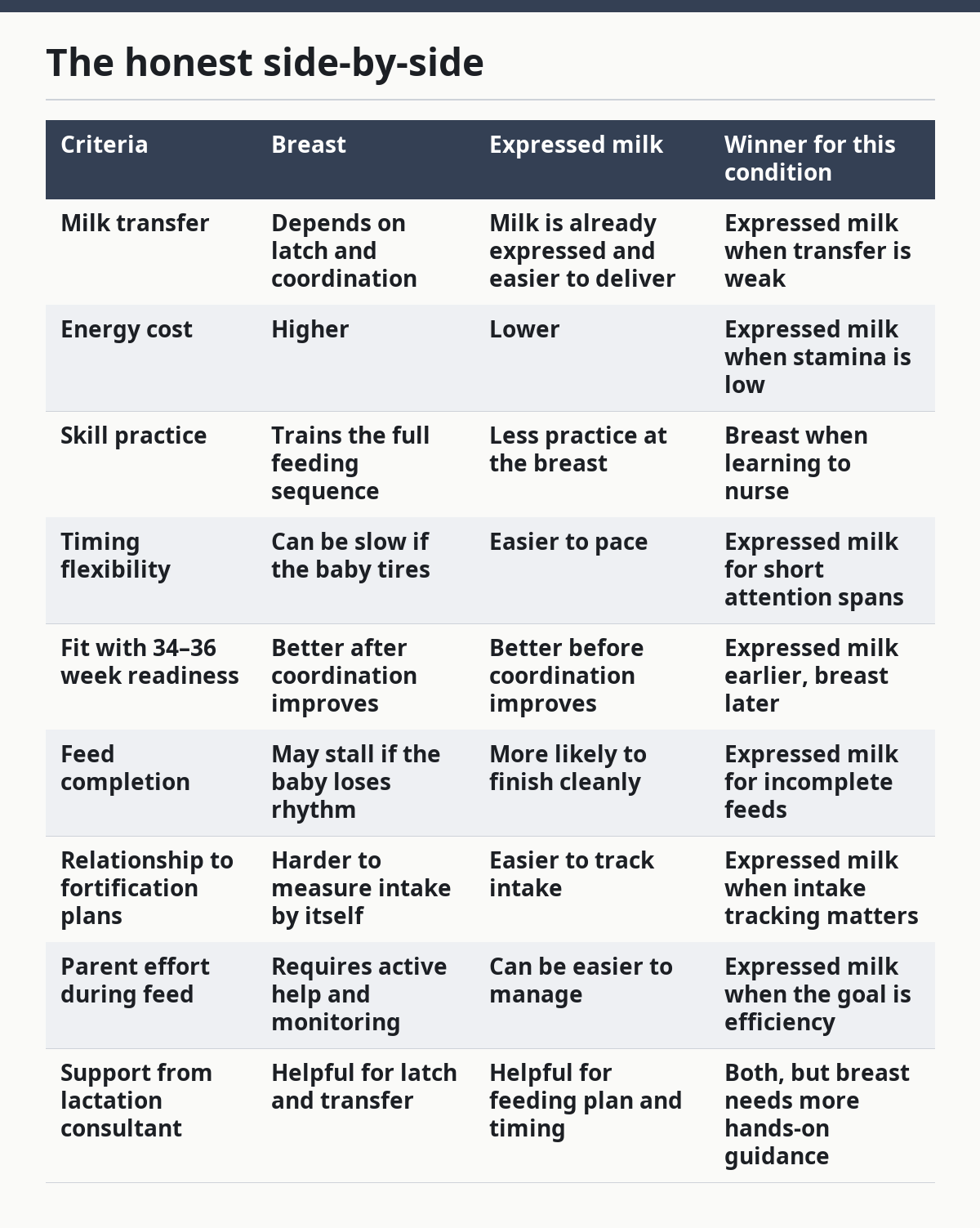
The table points to a simple pattern: the breast wins on practice and eventual direct feeding, while expressed milk wins on ease, pacing, and protecting energy. For a premature baby, that trade-off is the whole decision.
Which choice fits which baby?
The breast is the better pick for a premature baby who can stay awake, keep a rhythm, and move milk without burning out. That usually means the baby is getting closer to the 34–36 week coordination window named by the NHS, or is already showing steadier feeding stamina.
Expressed milk is the better pick for a baby who cannot yet handle the full job at the breast. It is also the better choice when the feed needs to be more controlled, when the baby tires before a useful transfer happens, or when the adult needs a clearer sense of how much milk the baby got.
A lactation consultant matters here because the line between “not ready yet” and “ready but inefficient” can be thin. One baby may need only a short break and another may need to step back from direct nursing for a while. That difference is why a rigid rule misses the point.
When does the choice flip?
The verdict flips in a few specific cases, and those cases are common enough to matter. A baby near 34–36 weeks of pregnancy who suddenly starts coordinating better may move from expressed milk to the breast faster than expected. A baby who still cannot coordinate may need expressed milk even if the family hoped to nurse directly.
It also flips when feeds become too long. If a feed drifts far beyond the kind of 10–20 minute window described in Wikipedia and the baby is still not transferring well, expressed milk becomes the safer, calmer option for that moment. The same is true when the baby is due to feed every 3 hours but has no reserve left to do the full work at the breast.
Here are the most important exception scenarios:
- The baby is alert and strong for one feed, then too tired for the next.
- The baby latches but does not transfer milk well enough to make the effort worthwhile.
- The baby is improving quickly and the plan needs to change week by week.
- A lactation consultant sees that the breast is ready as practice, but not yet ready as the main source of milk.
In those cases, the best choice is not fixed. It changes with the baby’s energy, coordination, and feeding pattern.
The verdict: which one to choose?
Choose direct nursing at the breast if the premature baby can latch, stay organized, and transfer milk without fading fast. Choose expressed breast milk if the baby is not yet coordinating sucking, swallowing, and breathing well enough, or if feeding stamina is the bigger problem. Neither if the baby is struggling so much that a lactation consultant or medical team needs to reassess the feeding plan.
For the hub page on Breastfeeding a Premature Baby, this comparison is the decision point: breast is the longer-term skill, expressed milk is the easier near-term route, and many families move between them.
Is direct breastfeeding better than pumped milk for preemies?
Direct breastfeeding is better when the baby can actually transfer milk well and has enough stamina to stay organized. Expressed milk is better when the baby is still too immature for steady sucking, swallowing, and breathing, which the NHS says usually does not come together until about 34–36 weeks of pregnancy. The better choice is the one the baby can handle without draining energy.
Can a preemie do both breast and bottle?
Yes, a preemie can do both breast and bottle when the feeding plan is matched to the baby’s stamina and coordination. Mixed feeding is often useful while the baby is still learning the breast and needs a simpler way to finish some feeds. A lactation consultant can help keep the switch from becoming confusing.
When should expressed milk be used instead of nursing?
Expressed milk should be used instead of nursing when the baby is too tired, too disorganized, or not transferring milk well at the breast. It is also the better choice when the feed needs to be paced or when a more predictable intake matters. If the baby starts feeding less effectively or seems worn out, expressed milk is the safer short-term option.
Sources
- nhs.uk, Breastfeeding your premature baby – NHS (checked 28 Nov 2026)
- en.wikipedia.org, Preterm birth – Wikipedia (checked 28 Nov 2026)
Drafted with AI; not yet reviewed by a person.