
Last updated: November 19, 2026
Quick Answer: for many people, a 5-minute setup on one side while the baby nurses on the other side is enough to test whether this rhythm works. When learning how to use a breast pump during a nursing session, start with a short, calm setup and adjust as needed. The goal is to collect milk without interrupting the latch, the baby’s rhythm, or your own comfort.
Key takeaways
- Pumping during a feed usually works best as a one-side-at-a-time setup.
- A short pump session can help milk start flowing, but it should not pull the baby off the breast.
- The best timing is the one that protects the latch and leaves the baby calm, because every feed is different.
- A collection bottle should sit where it will not tip when your hands are busy.
- If the setup feels awkward, switch the pump to after the feed instead of forcing it.
How do you use a breast pump during nursing?

Using a breast pump during nursing means setting up the pump on one breast while the baby feeds on the other breast, then collecting milk in the collection bottle without breaking the session. That is the simplest way to do it for most people.
The cleanest setup is usually a short, calm one: baby first, pump second, hands ready, bottle secure. If you are unsure about timing or positioning, CDC breastfeeding guidance and a lactation consultant can help you choose what is safest for you and your baby. This works best when the baby can stay latched for several minutes and you have a free hand for the pump flange or tubing. It is not a good fit for a feed that already feels rushed, painful, or unstable.
- Position the baby at the first breast and settle into a stable hold before touching the pump.
- Attach the pump flange to the opposite breast and keep the rim centered so the edge does not pinch.
- Start the pump at the lowest comfortable setting and let the milk begin to flow without pulling hard.
- Collect the milk in the collection bottle while the baby keeps nursing on the other side.
- Switch sides only if the baby finishes one breast and still wants the second side.
- Stop the pump when the flow slows, the baby unlatches, or the setup starts to feel awkward.
- Cap the collection bottle right away so it stays upright and ready for storage.
This method is most useful when you want milk from both breasts in one feeding window. It is less useful if the baby needs constant repositioning, if the pump setup keeps sliding, or if you only have one hand free for a short time. For more positioning ideas, see What timing works best? and How do you keep the baby comfortable?.
What timing works best?
The best timing depends on the feed you already have, not on a fixed clock. Pumping during the first letdown, near the start of a feed, or after the baby has settled can each work differently.
| Timing | What it can help with | Trade-off |
|---|---|---|
| Before nursing | May help milk start flowing sooner | Can make the baby impatient if the feed is already delayed |
| During nursing | Lets the baby eat while the pump collects milk from the other side | Needs a steady position and good bottle placement |
| After nursing | Can catch milk left after the baby finishes | Takes extra time after the feed |
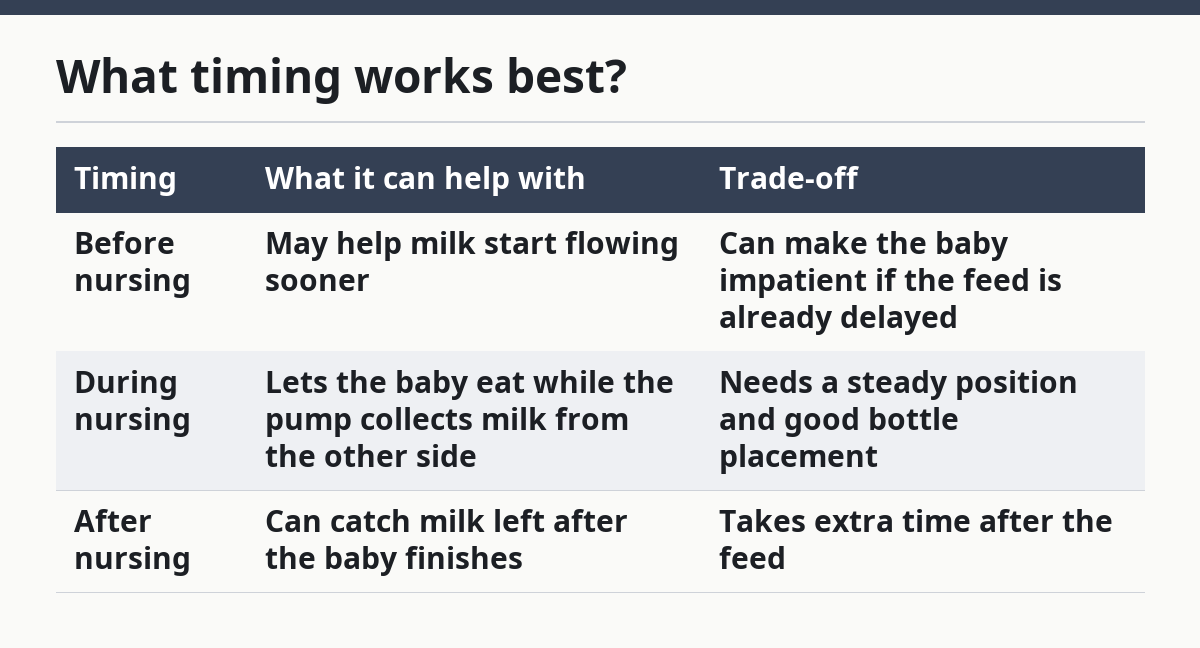
A short pre-pump of a few minutes can make letdown easier for some people, but it can also steal time from a hungry baby. Pumping after the feed is calmer when the baby is sleepy or when the side you are pumping is not producing much right away. During the feed can be a good choice when the baby stays latched well and the pump does not crowd the nursing side.
This is where many generic guides miss the real problem: timing is not just about milk flow. It is also about whether the baby, the pump, and your hands can all fit into the same 10-minute window without a fight.
How do you keep the baby comfortable?

Keeping the baby comfortable means protecting the latch, the line of sight, and the baby’s space while the pump sits on the other side. A calm latch matters more than squeezing in more milk.
The baby should not have to twist toward the pump tubing, the bottle, or your free hand. Keep the nursing side open and easy to reach. If the pump tubing drapes across the baby’s face or the bottle bumps the baby’s arm, the feed often goes downhill fast.
A small pillow, rolled blanket, or firm arm support can help hold the baby in place for the 1 breast that is not being pumped. The baby’s body should stay close to yours, with the head free to tilt back and forward as needed. If the baby keeps slipping off the breast, the pump is probably making the whole setup too crowded.
Comfort also includes your own body. A breast pump flange should not need you to hunch forward for several minutes. If your shoulders are raised or your wrist is bent, the setup is too tight or too low. A posture that feels relaxed for 5 minutes usually lasts longer than a fancy position that looks efficient but collapses at the first wiggle.
What helps milk flow during the session?
A warm start, a calm feed, and the right suction setting can help milk flow during the session. Letdown often comes easier when the body is not rushed.
Some people do better if they begin with the baby on the breast and wait for the sucking rhythm to settle before turning on the pump. Others prefer to start the pump on the opposite side right away and let the baby’s nursing trigger the response. Both can work, but forcing the pump to start at a high setting is a common mistake.
Try these simple helpers:
- Warmth: A warm cloth on the pumping side for a few minutes can help the breast feel ready.
- Massage: Gentle breast massage before or during the first minute can help milk move toward the nipple.
- Low start: Begin with the lowest comfortable suction and increase only if it still feels fine.
- Quiet setup: Keep the bottle steady so you are not fighting a wobble while the baby feeds.
The drawback of pushing suction too high is simple: pain, tension, and a feed that stops feeling natural. A strong pull is not the same thing as better milk flow. If the pump hurts, ease off before you try anything else.
For general breastfeeding and pumping support, the CDC breastfeeding pages and La Leche League International both have practical guidance that can help you compare approaches.
How do you hold the pump while the baby nurses?
You hold the pump by making the setup do some of the work, not by gripping it for the whole feed. A stable chair, a pillow, or a hands-free bra can make the difference between a 3-minute trial and a usable routine.
The easiest approach is to seat the collection bottle where it will stand upright and keep one hand free for small adjustments. If the pump needs both hands to stay in place, the nursing position is probably too loose or the flange is not staying centered. A hands-free bra can help, but only if it keeps the flange snug without pinching.
Use one of these hold styles:
- One-hand support: Good for short sessions and quick milk collection.
- Hands-free support: Good when the pump needs to stay on for more than a few minutes.
- Pillow support: Good when the baby needs extra height and the pump needs less holding.
The main trade-off is simple. The more you try to hold everything yourself, the more likely the feed becomes tense. The more stable the setup, the less you need to babysit the pump and the bottle every 30 seconds.
If the collection bottle keeps tipping, move it lower and keep tubing away from your lap. A tipped bottle is not just messy; it also pulls your focus off the baby. For more setup help, see How do you hold the pump while the baby nurses?.
When should you stop and switch plans?
You should stop and switch plans when the baby’s latch slips, the pump hurts, or the whole setup starts taking more effort than it gives back. A bad session is a sign to change the timing, not a sign to push through.
This method is not for every feed. It is a poor choice when the baby is very fussy, when your body is sore, or when the pump creates more stress than milk. It is also not the best option if you need to keep both hands on the baby for support or if the feed already feels unsteady.
A better backup plan is to pump after the baby finishes, even if that means only a short collection. Another option is to pump before the feed for a few minutes and then nurse as usual. If one side repeatedly feels uncomfortable during pumping, stop using that side during the feed and return to a calmer schedule.
Breast pumping during nursing should make the feed easier to manage, not turn it into a contest. If the setup keeps failing, the right answer is usually simpler timing, not more force.
Can you pump while breastfeeding?
Yes, you can pump while breastfeeding if the baby can stay latched and the pump stays out of the way. The most common setup is to nurse on one side and pump on the other at the same time.
That said, it is not the right choice for every feed. If the baby needs full support, if the pump is painful, or if the collection bottle keeps moving, it is often easier to pump before or after nursing instead.
Should I pump before or after nursing?
You can pump before or after nursing, and each choice serves a different job. Pumping before a feed can help milk start moving, while pumping after a feed can catch what the baby leaves behind.
If the baby is hungry and impatient, pumping before nursing may create more delay than benefit. If the goal is extra collection without disturbing the feed, pumping after is usually calmer.
How do I hold the pump while the baby nurses?
You hold the pump by stabilizing the bottle and supporting the flange so the baby can stay the focus. A pillow, a firm chair, or a hands-free bra can reduce how much you need to hold with your arms.
If the pump keeps slipping, change the position rather than tightening your grip. A steady setup for 5 minutes is better than a tense setup that wears out your hand and your patience.
Drafted with AI; not yet reviewed by a person.