Last updated: November 28, 2026
Quick Answer: look for 3 cues together — rooting, hands-to-mouth movement, and a brief alert period — and check over a 5 to 10 minute window. This guide on how to recognize feeding cues in a premature baby focuses on the small, early signals that can appear before crying and may be easier to catch in a calm moment.
Key takeaways
- Early cues often show up before crying and can be easy to miss.
- Rooting, hands near the mouth, and short alert windows are the main signs to watch.
- Premature babies may look sleepy and still be ready to feed.
- Stress cues mean the baby may need a pause, not more pressure.
- A calm room and a short observation period help the pattern stand out.
What feeding cues look like in a premature baby
Feeding cues in a premature baby are small body signals that say, “I may be ready to eat now.” The most useful ones are rooting, hands-to-mouth movement, lip licking, mouth opening, and a brief alert state where the baby looks awake without getting fussy.
A premature baby may not show the loud hunger signs many parents expect. Crying often comes later, and by then the baby may be too upset to latch or coordinate sucking and swallowing well. That is why the earliest signs matter more than waiting for a full cry.
In a baby born early, cues can look soft and uneven. One feed may start with steady rooting. Another may begin with a hand drifting to the mouth or a quick eye-open moment that lasts only a short while. The pattern can change from feed to feed, which is normal for a preemie.
It helps to think of feeding cues as a ladder. At the bottom are early signs like stirring and mouth movements. In the middle are stronger signs like rooting and active hand-to-mouth behavior. At the top are stress signs and crying, which mean the baby may already be past the easiest window.
How do I spot feeding cues in a premature baby?
You spot feeding cues in a premature baby by watching for the first small changes in face, hands, and alertness during a calm 5 to 10 minute check. Start with the baby at rest, then look for rooting, hands moving toward the mouth, tongue movement, lip smacking, and a brief awake period.
- Watch the face first. Look for mouth opening, tongue movement, lip licking, or turning the head as if searching. These are often the earliest signs and may appear before the baby makes any sound.
- Check the hands. A preemie who brings a hand to the mouth, sucks on fingers, or holds fists near the face may be showing readiness. Hands moving away from the body are often more useful than a crying sound.
- Notice alertness. A short, quiet awake period can be a useful feeding window, although it is not a guarantee of readiness. The baby may look still, open-eyed, and focused for a few minutes before drifting off again.
- Watch for rooting. If the baby turns toward a touch on the cheek or mouth area, that rooting reflex can point to readiness. Rooting is one of the clearest feeding cues in early infancy.
- Track the pattern, not one sign. One cue alone may not mean the baby is ready. Two or three cues together, such as rooting plus hands-to-mouth movement plus alertness, are a stronger signal.
This method works best when distractions are limited. Bright light, loud noise, or too much handling can hide the cues. A quieter room makes the subtle signs easier to see.
For a fuller overview of newborn readiness, the American Academy of Pediatrics and the NHS both describe rooting, mouth opening, and hand-to-mouth behavior as early feeding cues in infants. AAP | NHS
What are early hunger signs and what comes later?
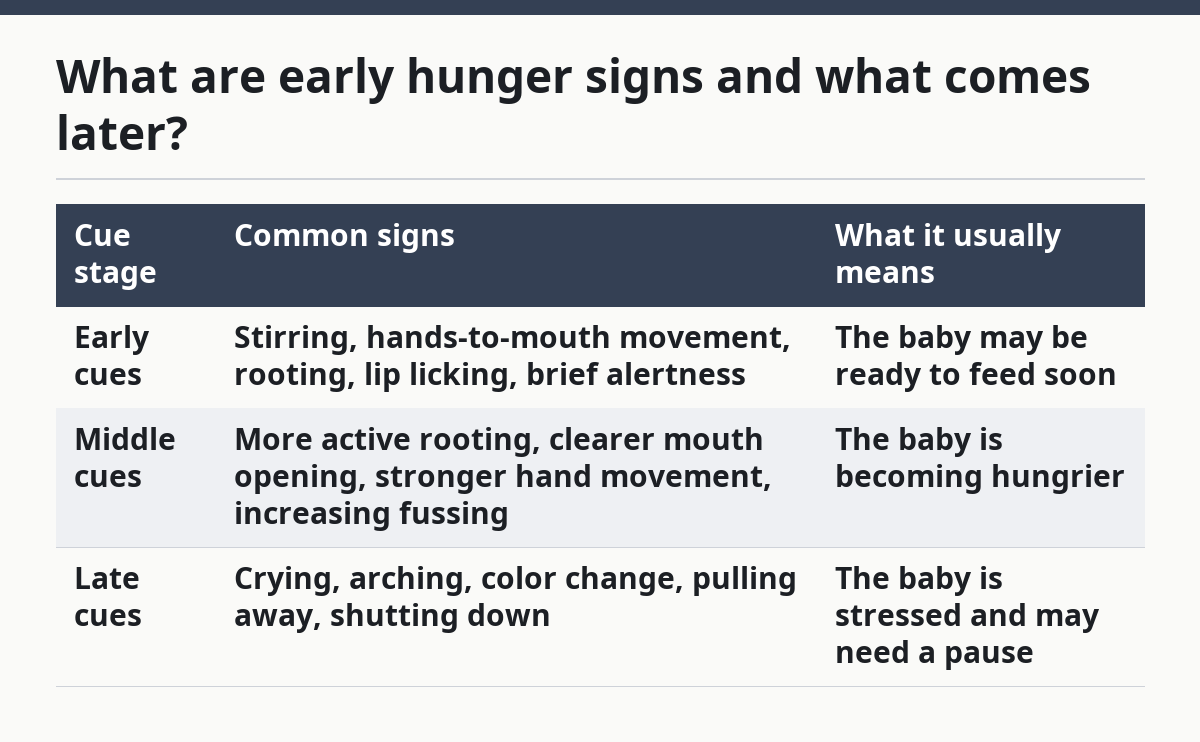
Early hunger signs are the cues that appear before crying, while later signs usually mean the baby has moved past the easiest feeding window. In a premature baby, the difference matters because earlier cues are easier to act on and often lead to a calmer feed.
| Cue stage | Common signs | What it usually means |
|---|---|---|
| Early cues | Stirring, hands-to-mouth movement, rooting, lip licking, brief alertness | The baby may be ready to feed soon |
| Middle cues | More active rooting, clearer mouth opening, stronger hand movement, increasing fussing | The baby is becoming hungrier |
| Late cues | Crying, arching, color change, pulling away, shutting down | The baby is stressed and may need a pause |
The mistake many parents make is waiting for crying because it seems like the obvious hunger signal. For a premature baby, crying can be a late cue, not the first one. By the time crying starts, coordination and calm are often harder to find.
Hands-to-mouth movement is especially useful because it can be seen even in very small babies. It is not just a random motion; it often shows the baby is organizing for feeding. When it appears with rooting or an alert face, it carries more weight.
If you want a medical overview of early versus late cues, Cleveland Clinic and Stanford Medicine both discuss infant feeding cues and the value of responding before a baby becomes distressed. Cleveland Clinic | Stanford Medicine
What sleepy patterns still count as cues?
Sleepy patterns still count as cues when the baby briefly wakes, changes face and hand movement, or shows a short alert stretch before drifting off again. Premature babies often give sleepy cues instead of the wide-awake, vigorous hunger signs that full-term babies may show.
A preemie may sleep through most of the day and still show a tiny feeding window. That window may last only a few minutes. During that time, the baby may stretch, open the eyes, move the hands to the mouth, or make small rooting movements.
The trade-off is that sleepy cues are easy to miss. A baby who looks deeply asleep may still be signaling readiness with subtle movement. On the other hand, a baby who is fully limp, hard to wake, or turns away from touch may not be ready yet.
A good rule is to look for change, not energy. A shift from stillness to light stirring, or from closed mouth to repeated lip movement, tells more than size of movement alone. In a premature baby, small changes can matter a lot.
What stress cues mean instead of hunger cues
Stress cues mean the baby may need a break, not more pressure to feed. Signs can include splaying fingers, grimacing, color change, coughing, gagging, pushing away, or turning the head sharply from the breast or bottle.
These signs are easy to misread when a parent is focused on getting a feed started. A baby who arches or turns away may look “fussy,” but the body is often saying the feed is too much right now. The right move is usually to pause, regroup, and look for calmer cues later.
A premature baby can move from ready to overwhelmed faster than a full-term baby. That is why feeding cues and stress cues should be read together. Rooting and hands-to-mouth movement point toward readiness; grimacing, wide eyes, and color change point toward overload.
| Sign type | What it looks like | Best response |
|---|---|---|
| Readiness cue | Rooting, hands-to-mouth, brief alertness | Prepare to feed |
| Stress cue | Arching, gagging, pushing away, color change | Pause and reduce pressure |
| Late hunger cue | Crying, frantic movement | Slow down and calm first |
This is one reason a preemie may seem to “refuse” a feed when the issue is really timing. If the cue is stress, pushing harder often makes the feed harder.
Common mistakes when reading preemie cues
The biggest mistake is waiting for crying, because that can push a baby past the easiest feeding window. Another common mistake is treating one sign, like a yawn or a stretch, as proof of hunger when it may mean something else; if you are unsure, check with your baby’s clinician or lactation support rather than guessing.
Parents also often miss cues because they expect them to look dramatic. Premature babies can show a feeding signal with just a small mouth movement or a few seconds of alertness. If you are watching for a full-bodied hunger display, you may miss the real one.
A third mistake is mixing up alertness with readiness. A baby can be awake and still not ready to feed. Readiness usually shows up as awake plus mouth and hand cues together, not wakefulness alone.
The cost of these mistakes is usually a harder feed, more stress, and more guessing. The better move is to look for a cluster of cues over a short window rather than reacting to one isolated motion.
For a broader feeding plan, this page sits alongside the main guide in the Breastfeeding a Premature Baby hub, which covers the next steps after cue recognition.
When should I ask for help?
You should ask for help when your premature baby gives few cues, shows stress instead of readiness, or seems harder to wake than usual. That matters because subtle feeding behavior can change fast in a preemie, and the pattern is sometimes more important than a single feed.
Call your baby’s clinician or lactation support if the cues seem absent for repeated feeds, if the baby often shuts down before feeding starts, or if rooting and hands-to-mouth movement are getting weaker instead of clearer. Those patterns deserve a closer look.
A baby who cannot stay alert for even a brief feeding window may need a plan change. A baby who repeatedly shows stress cues may also need the timing adjusted. This is not the place to guess for long.
If the baby is in the NICU or has a care plan from a team, follow that plan first. Feeding cues are still useful, but they should fit the baby’s medical and developmental situation.
How do I know my preemie is ready to breastfeed?
A preemie is usually ready to breastfeed when rooting, hands-to-mouth movement, and brief alertness appear together in a calm window. Those signs are often more useful than waiting for crying, although crying can still happen before a feed is missed.
Readiness can be subtle. The baby may open the mouth a little, turn toward touch, or hold the hands near the face for only a short time. That short window is often the moment to try.
Readiness is also about what the baby is not doing. If the baby is arching, pushing away, or showing color change, the body is likely signaling stress rather than readiness. In that case, forcing the issue usually backfires.
A simple way to think about it is: awake is not enough, but awake plus mouth and hand cues is a much better sign. That is the pattern to watch.
Do premature babies give different feeding cues than full-term babies?
Yes, premature babies often give quieter and less obvious cues than full-term babies. A preemie may show short alertness, rooting, or hands-to-mouth movement without much crying at all.
That difference is why parents often miss the first signs. The cue is there, but it is small and brief. Watching for a cluster of early signs works better than waiting for a loud hunger signal.
What if my premature baby sleeps through feeds?
If your premature baby sleeps through feeds, the pattern may be telling you the baby’s alert window is very short or inconsistent. That is common in preemies, but it still deserves attention if it happens often.
Look for the lightest signs of waking, then watch for mouth and hand movement. If those signs do not appear, or if the baby is hard to wake repeatedly, contact the baby’s clinician or lactation support for guidance.
How do I know my preemie is ready to breastfeed?
Your preemie is usually ready to breastfeed when you see rooting, hands-to-mouth movement, and a brief alert period in the same short window. Those signs together are stronger than any one sign alone.
If the baby is showing stress cues, wait and try again later. Readiness in a premature baby is often a narrow window, not a long stretch, so timing matters as much as the cue itself.
Drafted with AI; not yet reviewed by a person.